Battle Analysis
Chuncheon–Hongcheon (June 1950): Three Days Bought with a River and Guns
· 1950-06-25 – 1950-06-30
Overview (BLUF)
Before dawn on 25 June 1950, NK II Corps attacked from Hwacheon and Inje toward Chuncheon and Hongcheon. While much of the ROK front gave way in the opening days, the ROK 6th Division held Chuncheon for nearly three days. When its outposts fell, the 7th Regiment went straight back to its main line on the Soyang River and fought there with the 16th Field Artillery Battalion firing on pre-registered concentrations. The NK 2nd Division committed its reserve regiment on day one and still could not cross, and II Corps turned the 7th Division, bound for Hongcheon, toward Chuncheon. Chuncheon fell on 27–28 June (sources differ) and Hongcheon on 30 June.
The battle shows that a unit weak in anti-tank means can still buy time if it chooses to fight where an obstacle and planned fires work for it, sets a limit on its offensive action, and settles the timing of its withdrawal and its covering force in advance.
Background and Strategic Context
In the North Korean invasion plan the main effort was the Uijeongbu axis; II Corps in the centre-east was the supporting attack. According to Lee (2015), II Corps was to drive down the Inje–Hongcheon and Hwacheon–Chuncheon–Gapyeong axes, then swing west across the Han, take the area south of Suwon and cut the line of retreat of the ROK forces around Seoul. Each day lost at Chuncheon delayed the whole envelopment.
The ROK 6th Division held a front of about 84 km from northwest of Gapyeong to Hyeonri. The 7th Regiment was at Chuncheon, the 2nd at Hongcheon, and the 19th was division reserve at Wonju. The US Army official history (Appleman) notes that the division had issued no passes, so its positions were fully manned.
Terrain and Weather
Chuncheon sits in a basin where the Bukhan and Soyang rivers meet. The road from Hwacheon crosses the Bukhan at Mojin Bridge, passes Oksanpo and enters the town over the Soyang bridge (Figure 1). Oksanpo, north of the Soyang, is flat open ground with little cover for an attacker, while Udu-san and Bongui-san give good observation. Mechanised forces had to use Mojin Bridge, and the ROK demolition of it failed. Route 5 runs south over Wonchang Pass to Hongcheon, and Route 46 runs west to Gapyeong. Fog and drizzle limited observation on the morning of 25 June.
 Figure 1. Chuncheon–Hongcheon, schematic (25–30 June 1950). Positions and routes are approximate and the terrain is simplified — own work, based on sources 1–3 and 5 and the scenario map
Forces and Dispositions
- ROK: On 15 June 1950 the 6th Division had 9,112 men, 2,411 of them in the 7th Regiment. Its artillery was the 16th FA Battalion with fifteen 105-mm M3 howitzers (effective range about 7,250 yd). Its 57-mm-class anti-tank weapons could not get through the front armour of the self-propelled guns. The regiment placed its 1st Battalion around Oksanpo and Udu-san and its 2nd Battalion on the south bank of the Soyang.
- North Korea: The 2nd Division (about 10,800 men) led with its 4th and 6th Regiments and held the 17th in reserve. The 7th Division (about 12,000) attacked from Inje toward Hongcheon. The 2nd Division had 16 SU-76 self-propelled guns, and no tanks appeared at Chuncheon until the 7th Division arrived (Appleman). On the Chuncheon front the NK side had 211 guns and mortars to the ROK's 93, and 64 anti-tank guns to 12 (Lee 2015).
 Photo 1. An SU-76 self-propelled gun used by North Korean forces (left) and a US Marine Corps M26 tank, 3 December 1950. ROK 57-mm weapons at Chuncheon could not stop this vehicle from the front — photo: Cpl. Wolfe (USMC), public domain, via Wikimedia Commons
Course of the Action
- The main-line fight (25 June): After a preparation that opened at 0400–0500, NK infantry behind SP guns crossed Mojin Bridge and pushed in the outposts. The 7th Regiment fell back to the Soyang line, and after noon the enemy lead entered Oksanpo. The 16th FA Bn fired on its registered concentrations. Close-assault teams led by an anti-tank platoon leader went after the SP guns, and at 1900 a battalion counterattacked. The enemy committed its reserve 17th Regiment but did not cross the river.
- Limited attack and enemy reinforcement (26 June): Overnight the 2nd Battalion, 19th Regiment reached Udu-san. At about 0800 the 1st Battalion attacked toward Oksanpo under concentrated artillery fire, stopping at the road-junction line. When the enemy came back about two hours later, the battalion returned to Udu-san and that night crossed to Bongui-san. An enemy attempt to cross downstream at the Garaemuk ferry was stopped by artillery. That evening the NK 7th Division reached Chuncheon.
- Withdrawal from Chuncheon (27–28 June): At 0800 on 28 June a simultaneous attack came on three axes, the main effort down Route 5 behind tanks and artillery. The 2nd Battalion and 2nd Battery fought for nearly three hours but lost Hill 897. Appleman writes that nine T-34s led the NK main body into the town that morning.
- The Wonchang rearguard (29–30 June): The 2nd Battalion and one battery stayed on Wonchang Pass. At 0600 on 29 June about two enemy regiments came up; the battalion held its fire until 200 m and then broke the attack with a volley. It withdrew at 1300, and by midnight the regiment held Hills 371 and 418 and Sammachi on the south bank of the Hwayang. At Hongcheon the 2nd Regiment delayed the enemy at Malgogae and elsewhere, and the town fell on 30 June.
 Figure 2. Chuncheon–Hongcheon timeline. Orange cells are events tied to a decision point. Sources differ on when Chuncheon fell — own work, based on sources 1, 3 and 5–8
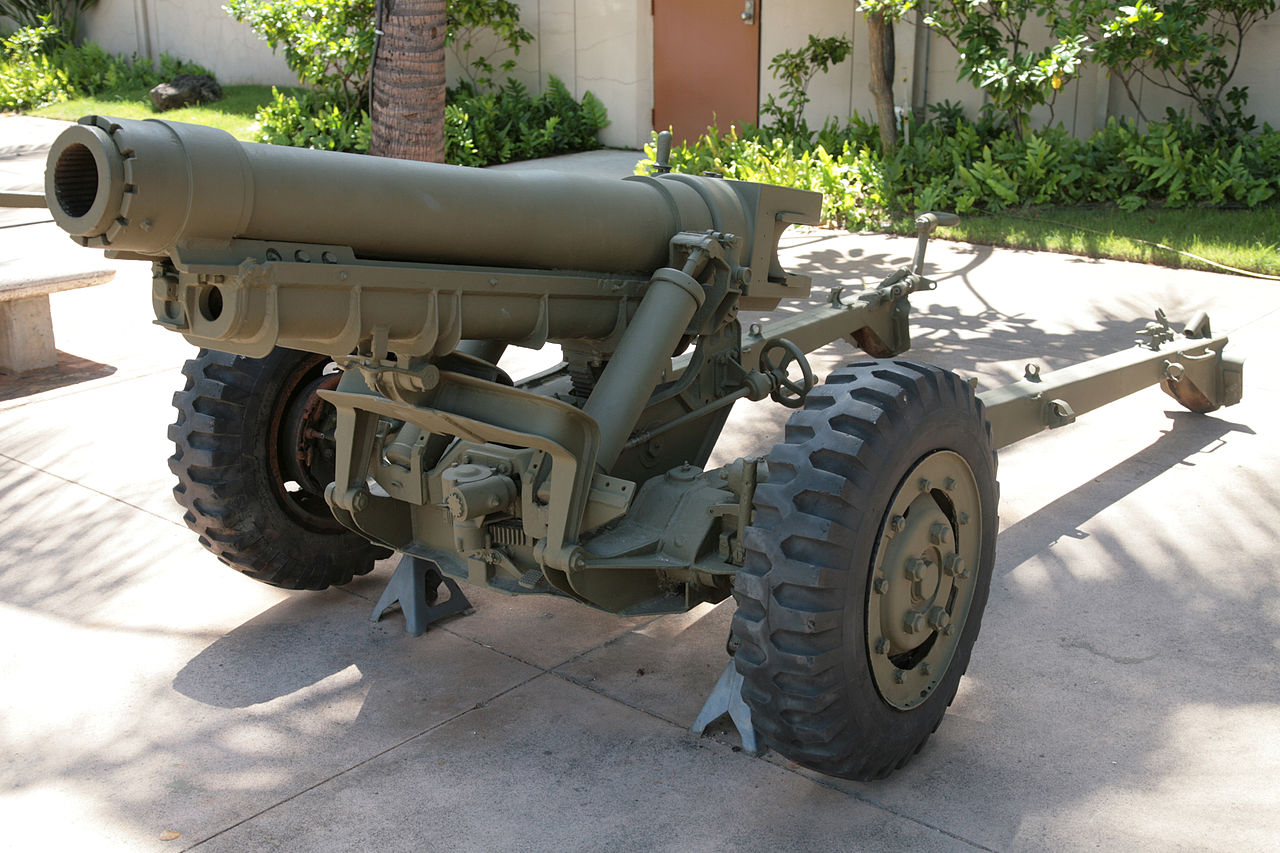 Photo 2. A 105-mm M3 howitzer at the US Army Museum of Hawaii, photographed in 2006. It was the main gun of ROK divisional artillery in 1950 — photo: Max Smith, public domain, via Wikimedia Commons
Decision Point Analysis
 Figure 3. Options and choices at each decision point. The orange border marks the course actually taken. DP 3 alternatives are inferred because the sources do not list them — own work, based on the analysis and sources 1, 3 and 5
DP 1: The outposts are broken (7th Regiment commander, morning of 25 June)
The options were (a) counterattack to retake the outposts, (b) fight from the Soyang main line with pre-planned fires, (c) hold the outposts, or (d) fall back into the town and blow the bridges. The regiment chose (b). With no weapon that could stop the SP guns, a counterattack in the open would have been the fight the enemy wanted. Using the river as the obstacle and the Oksanpo fields as the target area appears to have been the reasoning. The enemy did not cross on day one.
DP 2: Offensive action in the defence (7th Regiment commander, 0800 on 26 June)
The options were (a) stay on the river line, (b) make a limited attack to the road-junction line, (c) counterattack deep to Mojin Bridge, or (d) keep the arriving battalion in reserve. The regiment chose (b). The new battalion covered Udu-san and Oksanpo was already registered, so there was a chance to upset an enemy preparing to cross. Because the limit was set in advance, the battalion did not stay on the open fields when the enemy struck back.
DP 3: Where to reinforce (NK II Corps, 25–26 June)
The options can be read as (a) keep the 2nd Division attacking alone, (b) divert the 7th Division to Chuncheon, or (c) screen Chuncheon and move on toward Gapyeong. Appleman writes that the failure on day one made II Corps change the 7th Division's plan. Without Chuncheon's road net, the swing west seems to have been judged too hard. Chuncheon fell on 28 June, but the push on Hongcheon was weakened. The Soviet chief adviser's report, cited by Lee, says the 2nd Division advanced only 30 km in three days.
DP 4: Hold or withdraw (7th Regiment commander, 27–28 June)
The options were (a) hold Chuncheon, (b) counterattack the tank column, (c) withdraw in stages behind a rearguard at Wonchang Pass, or (d) go straight back to Hongcheon. With the division commander's approval the regiment chose (c). Artillery ammunition was nearly gone, the fronts on either side were collapsing, and the enemy from Inje could cut the regiment's rear. Because the rearguard held into the afternoon of the 29th, the regiment kept its fighting strength and occupied a new line.
Lessons
- Terrain and fires together: The river and the fires registered on the open ground in front of it made up for weak anti-tank means. Choosing where to fight is itself a decision.
- Combined arms: If you cannot beat the armour, separate it from its infantry. The artillery took the infantry; close-assault teams took isolated vehicles.
- Offensive action in the defence: A limited attack with an objective, a limit of advance and a plan to come back broke the enemy's tempo without unhinging the defence.
- Delay and fire control: The timing of the withdrawal and the covering force were settled first, and the rearguard's 200-m fire discipline made scarce ammunition count.
- Limits of operational effect: The tactical delay slowed an enemy corps plan, but once the neighbouring fronts collapsed Chuncheon could not be held any longer.
Unresolved Questions
- When Chuncheon fell: noon on 27 June (Lee), a withdrawal order around 1800 on the 27th (Jeonbuk Ilbo), or 28 June (Appleman, ko.wikipedia, a 1991 company commander's memoir).
- Who ordered the withdrawal: division approval (ko.wikipedia), a higher-HQ judgement (1991 memoir), or an Army HQ instruction (memorial-hall guide, search summary only, original not seen).
- Loss figures: Appleman, from prisoner interrogations, gives NK 2nd Division casualties above 40% and 7 of its 16 SU-76s destroyed by ROK fire. These are claims resting on prisoner statements; ROK losses could not be confirmed.
- Close-assault results: the number of SP guns destroyed ranges from two (Lee) to about six (Wilson Center summary). After a 2016 challenge, a Ministry of National Defense committee reportedly confirmed the account with some corrections in 2017.
- The ROK official history (vol. 2) was not consulted directly.
To make these decisions yourself, command the 7th Regiment in the training scenario "Chuncheon–Hongcheon".
Sources
- U.S. Army Center of Military History, South to the Naktong, North to the Yalu (1961), ch. III "Invasion Across the Parallel". https://history.army.mil/books/korea/20-2-1/sn03.htm (original site blocked automated access; mirror used: https://www.koreanwaronline.com/history/Appleman/Chapter3.htm) (accessed 2026-10-13)
- Same work, ch. II, Table 1 (ROK Army strength, 15 June 1950) and artillery data. https://history.army.mil/books/korea/20-2-1/sn02.htm (mirror: https://www.koreanwaronline.com/history/Appleman/Chapter2.htm) (accessed 2026-10-13)
- Lee Seong-chun, "A Reanalysis and Evaluation of the Chuncheon District Battle in the Early Part of the Korean War", Journal of Convergence Security 15(4) (2015-06), in Korean. https://www.koreascience.kr/article/JAKO201522562218864.pdf (accessed 2026-10-13)
- Wilson Center, Sources and Methods blog, on the battle of Chuncheon and the 2017 revision of the official history (2020-05-28). https://wilsoncenter.org/blog-post/battle-chunchon (accessed 2026-10-13)
- Korean Wikipedia, "춘천 전투" (cross-check only). https://ko.wikipedia.org/wiki/%EC%B6%98%EC%B2%9C_%EC%A0%84%ED%88%AC (accessed 2026-10-13)
- Seoul Shinmun, anniversary feature on the Chuncheon battle (2023-06-23), in Korean. https://m.seoul.co.kr/news/2023/06/23/20230623500150 (accessed 2026-10-13)
- Seoul Shinmun, a company commander's memoir of the Chuncheon defence (1991-06-23), in Korean. https://www.seoul.co.kr/news/1991/06/23/19910623005001 (accessed 2026-10-13)
- Jeonbuk Ilbo, article on the Chuncheon battle (2023-01-16), in Korean. https://jjan.kr/article/20230116580210 (accessed 2026-10-13)
- Wikimedia Commons, file page for the SU-76 and M26 photo (public domain). https://commons.wikimedia.org/wiki/File:SU-76-and-M26-19501203.JPG (accessed 2026-10-13)
- Wikimedia Commons, file page for the 105-mm M3 howitzer photo (public domain). https://commons.wikimedia.org/wiki/File:M3_105mm_Howitzer.jpg (accessed 2026-10-13)