Battle Analysis
Mogadishu (October 1993): A Coalition Column to Reach a Force Cut Off in the City
· 1993-10-03 – 1993-10-04
Overview (BLUF)
Just after 1530 on 3 October 1993, US Task Force Ranger launched a daylight raid near the Olympic Hotel in central Mogadishu. About half an hour later a Black Hawk was brought down by an RPG, and a second went down roughly 1.6 km away. Getting the cut-off force out fell to the Quick Reaction Force (QRF) of the UN mission (UNOSOM II): a light infantry battalion of the US 10th Mountain Division.
The first relief attempt, in soft-skinned vehicles, was stopped on National Street and recalled. The battalion then rebuilt the column with Malaysian APCs and Pakistani tanks and linked up with the Rangers at crash site 1 at 0155 on 4 October. After about three hours spent recovering a body trapped in the wreck and accounting for every man, the force left at 0537 and reached the Pakistani-held stadium.
The case shows where light infantry without armour, and a coalition with split chains of command, get stuck in a night rescue in a city. The loss of 18 US soldiers reversed US policy in Somalia, and US forces were out by 31 March 1994.
 Photo 1. The K-4 circle on 22 December 1993. The first relief column came under fire near here on 3 October — Photo: US Department of Defense, public domain, via Wikimedia Commons
Background and Strategic Context
On 4 May 1993 the US-led Unified Task Force (UNITAF) handed over to UNOSOM II. On 5 June militia of Aideed's Somali National Alliance (SNA) attacked Pakistani troops carrying out weapons-site inspections; more than 20 Pakistani soldiers fell. On 6 June Security Council Resolution 837 authorized the arrest of those responsible, turning a humanitarian mission into a fight against one faction.
There were in effect three chains of command: the UN force; US Forces Somalia, commanded by the UNOSOM II deputy force commander; and TF Ranger, which arrived in August and reported directly to US Central Command. For secrecy the QRF knew only the general location of Ranger operations. The deputy commander had asked for a mechanized battalion from July onward without result, so the only armour in the city was the Pakistanis' old M48 tanks.
Terrain and Weather
The objective lay near the Bakara Market, home ground of the Habr Gidr clan that backed the SNA and an area US troops had avoided for months. Narrow streets in a dense grid left almost no landing zones, and maps matched the streets poorly. The militia built hasty roadblocks on the expected approaches (Figure 1).
The raid was planned as a daylight mission of under an hour. To lighten their loads in the heat, the Rangers left their night-vision goggles behind. As darkness fell, the fight became a night battle in the streets.
Forces and Dispositions
- TF Ranger: Company B, 3rd Battalion, 75th Ranger Regiment, special operations personnel and aviation; about 160 men, 19 aircraft and 12 vehicles.
- QRF: a 10th Mountain Division brigade. The ground force was the three rifle companies of 2nd Battalion, 14th Infantry, with little experience of armoured vehicles. Attack helicopters provided cover.
- Coalition support: two Malaysian companies (32 wheeled APCs) and a Pakistani M48 tank company. Italian mechanized infantry and Indian T-72s needed approval from their capitals and did not come.
- SNA militia: organized by neighbourhood and rallied on prearranged signals. They fought in fire teams and squads, could coordinate larger moves, and had many RPGs.
Course of the Action
 Figure 1. Schematic of the relief operation (3–4 Oct 1993). Positions, routes and scale are approximate — own work, based on CSI Map 10 and text (source 1)
- First alert (afternoon of 3 October): The Ranger commander asked for the QRF ready company to stand by under his control. The company took the long way round to the airfield; meanwhile the second Black Hawk went down. The Ranger ground convoy lost its way in the side streets and returned to base.
- First relief (from 1747): The column came under fire near K-4 before its air cover arrived. It fought through to National Street but was mired in a major fight, and the QRF commander ordered it back to the airfield.
- Combined column (2130 to 0155 on 4 October): Formed at the New Port, the column left at 2323. At the first roadblock the Pakistani tanks stopped for fear of mines, and they were not authorized to lead past the last Pakistani checkpoint. Several Malaysian APCs that moved up front strayed off route and were hit by RPGs, taking a US squad with them. On National Street the main body split into two companies; the lead company dismounted and walked the last few hundred metres to crash site 1.
- Holding on and getting out (0155 to morning): Ranger infrared strobes helped the linkup. Recovery at the wreck took about three hours. The force left at 0537 with 40–50 wounded, but the unrehearsed plan for some men to run alongside the APCs for cover soon broke down. Those left behind came out on foot, flagged down a Pakistani M113 and reached the stadium. No survivors were found at crash site 2.
 Figure 2. Timeline of the relief operation. Dashed bars mark phases whose end time the sources do not give — own work, based on source 1
Decision Point Analysis
 Figure 3. Options and choices at each decision point. Orange borders mark the option taken — own work, based on source 1; the Decision 2 options are an analytical framing
Decision 1: The road to the airfield (QRF battalion commander)
Of (a) the fastest route through hostile districts, (b) a longer but surer route and (c) waiting for air cover, he chose (b), after assurances that the perimeter was under pressure but not about to collapse. The fast route carried a much higher risk of being stopped, and a reinforcement that never arrives rescues no one. The company reached the airfield, but the second crash happened in the meantime.
Decision 2: Mass on the crash sites and block the routes (SNA militia)
No militia-side record was found. CSI judges that the militia anticipated US routes and built obstacles on them, and that it read a downed aircraft as the US weak point. It had brought down another Black Hawk with an RPG on 25 September. The result was that both the Ranger convoy and the first relief turned back.
Decision 3: Organizing the combined column (QRF battalion commander, 2130)
Of (a) US infantry in Malaysian APCs behind Pakistani tanks, (b) each nation carrying its own infantry with the US following, and (c) going again at once in trucks and HMMWVs, he chose (a) after consulting the assistant division commander, so that only soldiers trained in his planned tactics would ride. It met his intent and the urgency, but the language barrier and national limits remained. The tanks could not lead past the checkpoint, and the strayed APCs took a US squad with them.
Decision 4: Stay at the crash site? (leaders at crash site 1)
Of (a) recovering the body and accounting for all before leaving, (b) leaving at once in darkness, and (c) abandoning the APCs and walking out, they chose (a). TF Ranger had set itself the rule of returning with all its people. The battalion commander sent the company at crash site 2 to find the detached squad, ordering that no one be left on the battlefield, Malaysian or American. The price was a withdrawal pushed toward dawn and an unrehearsed extraction method that fell apart.
Lessons
- Mission command and shared understanding: Secrecy left the reinforcing unit ignorant of the operation. Split command chains block the channels for sharing intent just when a crisis hits.
- Coalition operations: National limits, such as who may lead and how far, must be confirmed before moving. Binding units with different languages into one column takes liaison officers and simple reference points.
- Combined arms: Light infantry alone could not get through roadblocks and RPGs. In narrow streets, though, the armour also needed dismounted infantry to open the way.
- Night linkup: Infrared strobes and Rangers riding with the column made the linkup work, but earlier linkup drills had been daytime communications exercises, and flares washed out the night-vision goggles of helicopter pilots.
- Sustainment: A one-hour mission carried too little night equipment and evacuation capacity. Extraction methods must be agreed with every driver in advance.
Unresolved Questions
- APC numbers and departure time: CSI gives 32 APCs and 2323; another account gives 24 Condors and 2324.
- Time of the first crash: CSI says only "perhaps half an hour" after the assault began. The often-quoted time of about 1620 could not be confirmed in a primary source.
- Pakistani losses on 5 June: 23 according to CSI, 25 according to the UN.
- Somali casualties: CSI says only "hundreds"; other estimates vary widely and are not repeated here.
- The streets of the long route, and where exactly the first relief was stopped, could not be pinned down (Figure 1 is approximate).
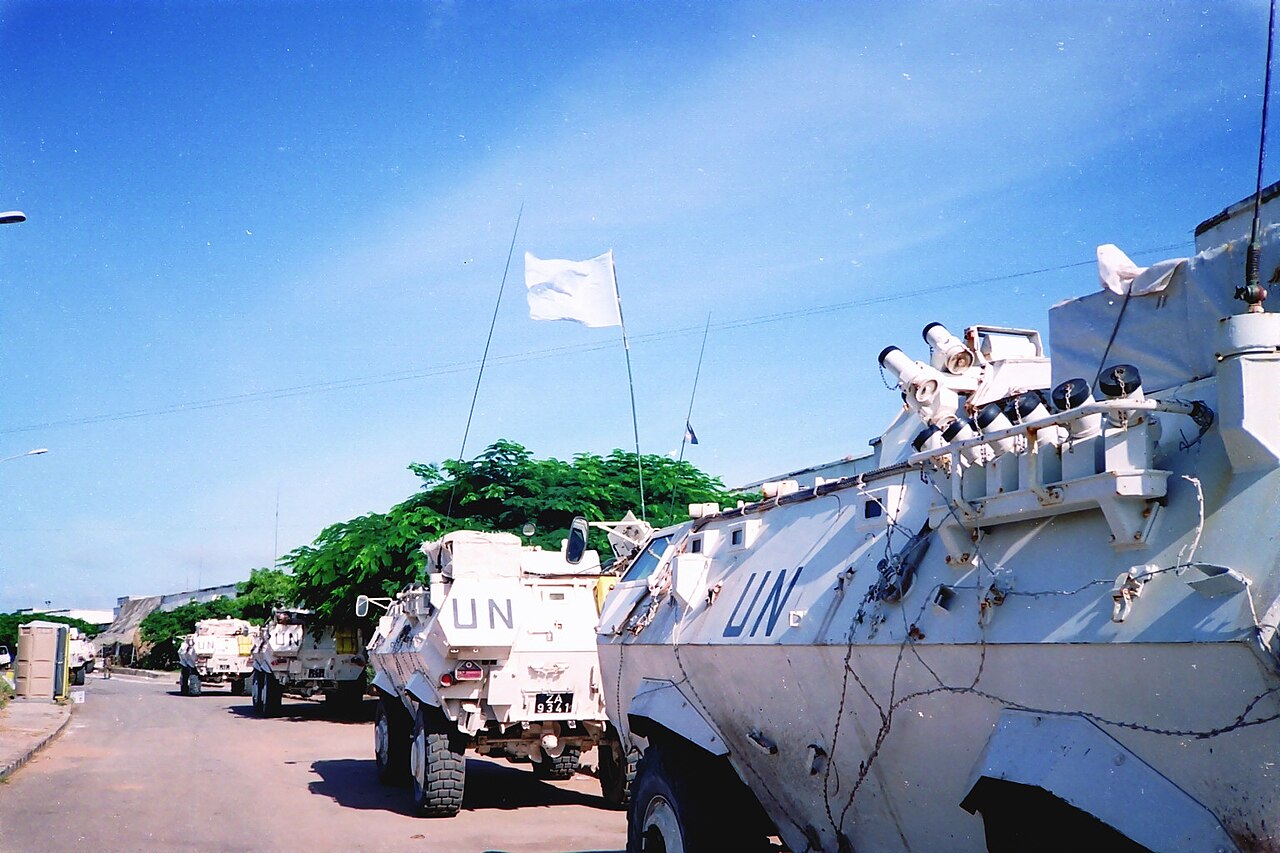 Photo 2. Malaysian Condor APCs near the university compound in Mogadishu (around 1992–93). US infantry in the combined column rode in these vehicles — Photo: CT Snow, CC BY 2.0, via Wikimedia Commons
Take command of the QRF battalion in the "Mogadishu" scenario and make these decisions yourself.
Sources
- US Army Combat Studies Institute (CSI), "My Clan Against the World": US and Coalition Forces in Somalia, 1992–1994 (2004), chs. 4–6 (esp. ch. 5, pp. 139–163, Map 10). US Government work. https://webarchive.library.unt.edu/web/20161019025705mp_/http://www.benning.army.mil/Library/content/Clan.pdf (accessed 2026-10-13)
- UN Peacekeeping, UNOSOM II background (Resolutions 814 and 837, US withdrawal deadline, end of mission). https://peacekeeping.un.org/mission/past/unosom2backgr2.html (accessed 2026-10-13)
- US Army (army.mil), 10th Mountain Division marks the 20th anniversary of the Battle of Mogadishu (2013-10-10). https://www.army.mil/article/112963/10th_mountain_division_remembers_battle_of_mogadishu_20_years_later (accessed 2026-10-13)
- Military.com, commentary on the UN contingents' role in the Mogadishu rescue (updated 2026-09). https://www.military.com/daily-news/opinions/32-years-ago-un-troops-came-rescue-mogadishu-during-black-hawk-down.html (accessed 2026-10-13)
- Wikipedia, Battle of Mogadishu (1993), for cross-checking. https://en.wikipedia.org/wiki/Battle_of_Mogadishu_(1993) (accessed 2026-10-13)
- Wikimedia Commons, K-4 circle photo file page (public domain, US DoD). https://commons.wikimedia.org/wiki/File:SomaliaStrassenkreuzung1993.jpg (accessed 2026-10-13)
- Wikimedia Commons, Malaysian Condor APC photo file page (CC BY 2.0). https://commons.wikimedia.org/wiki/File:UNOSOM_Somalia_tanks.jpg (accessed 2026-10-13)