Battle Analysis
Robotyne (July–August 2023): An Offensive That Crossed the Minefields on Foot
· 2023-07-26 – 2023-08-28
Overview (BLUF)
Ukraine's southern offensive, launched in June 2023, made the axis from Orikhiv toward Tokmak in Zaporizhzhia oblast its main effort. The June mechanised breaches repeatedly stalled in the minefields. On 26 July a large mechanised attack toward Robotyne began again (ISW), and from then on the advance was carried by dismounted assault groups of experienced troops and by engineers clearing mines by hand. Fighting inside the village began around 11 August, the national flag went up on the administrative building on 23 August, and Ukrainian officials formally announced its liberation on 28 August.
Taking Robotyne was one of the offensive's clearest tactical results. But RUSI judged that the objective of the whole offensive, a breakthrough to Tokmak, was never reached, and that the best chance of one came in early August (July 2024). The case shows how junior echelons kept an advance going after the mechanised breach failed, and why that method never produced operational tempo.
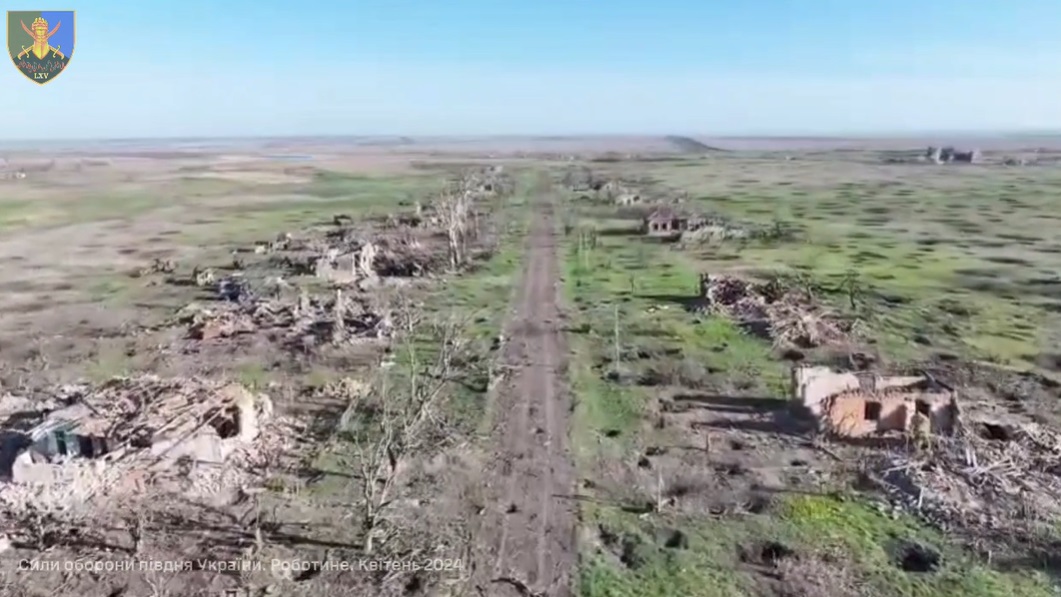 Photo 1. Robotyne from the air, April 2024: flat terrain of fields divided by tree lines — Photo: Defence Forces of the South of Ukraine (65th Mechanised Brigade), CC BY 4.0, via Wikimedia Commons (original source ArmyInform)
Background and Strategic Context
According to RUSI, the original plan was for 12 brigades to breach the defence lines on a 30 km front within seven days, isolate Tokmak and then exploit toward Melitopol. The offensive was in fact carried out by three tactical groups called "corps" (the 9th, 10th and "Maroon" Corps), whose equipment and readiness could not support the planned tempo. Russia had read Ukrainian intentions in advance and concentrated its defences on this axis.
In the offensive that opened on 3 June (RUSI), brigades of the 9th Corps made repeated company-level mechanised breaches. The cleared lanes were so narrow that when the lead vehicle stopped, vehicles trying to turn or bypass it hit mines. In July Ukrainian command had to decide whether to halt the offensive or commit the Maroon Corps, its exploitation reserve, and keep pushing. It chose to continue south with the objective reduced to Tokmak (RUSI).
Terrain and Weather
South of Orikhiv lies flat farmland divided into a grid by windbreaks (tree lines) (Photo 1). Robotyne is a little over 10 km south of Orikhiv. Each time an attack crossed one tree line it stalled again in the open field before the next. RUSI notes that the axis of advance became canalised between two pieces of high ground about 7 km apart, exposing troops to plunging fire from the flanks (Figure 1). Minefields had been deepened from the doctrinal 120 m to as much as 500 m, sometimes with anti-tank mines laid two together (RUSI "Stormbreak", September 2023). In high summer the weather did little to restrict movement, but concealment depended on the tree lines alone.
Forces and Dispositions
- Ukraine: The 9th Corps (including the 47th, 65th and 33rd Brigades) opened the offensive; the 10th and Maroon Corps were committed from July. The corps had about ten mine-clearing vehicles, most of which were lost. Each battalion had at best about two fully capable assault platoons (RUSI). Tanks and breaching equipment were often borrowed from other brigades, so a single company attack might draw support elements from three brigades.
- Russia: The 42nd Motor Rifle Division and the 7th Airborne Division of the 58th Combined Arms Army held the first line. The second line held three motor rifle regiments and a naval infantry brigade, and the 76th Airborne Division among others could be brought up as reserves (RUSI; designations are command elements). The defence comprised a disruption zone, a main line and a reserve line, about 30 km deep in total.
Course of the Action
 Figure 1. Schematic of the Robotyne axis (26 Jul – 30 Aug 2023). Positions, boundaries and scale are approximate and do not show the current situation — own work, based on the scenario map, RUSI reports (sources 1, 2) and ISW summaries (sources 3–6)
- Mechanised attack resumed (26 July): ISW assessed that Ukrainian forces had broken through some prepared Russian positions south of Orikhiv, while noting that conflicting claims left the actual results and losses unclear.
- Dismounted assaults and hand clearing (late July – early August): Engineers opened lanes by hand at night and assault groups attacked one tree line at a time. Russian forces shelled abandoned positions once Ukrainian troops occupied them and counterattacked at night with infantry supported by armour. Positions were taken, lost and retaken.
- Edge of the village and fighting inside it (11–23 August): Fighting inside the village began around 11 August. Russian sources claimed to have pushed Ukrainian troops out, but ISW confirmed from footage of 17–18 August that they still held positions in the north-east. On the 22nd ISW assessed that only a limited Russian presence remained, and on the 23rd the 47th Mechanised Brigade raised the flag.
- Liberation announced and after (28–30 August): On the 28th Ukrainian officials formally announced the liberation. ISW assessed that Russia continued to commit relatively elite airborne forces. The southern outskirts remained contested into late August or early September, and on the 30th Ukrainian forces entered the north-western outskirts of Verbove.
 Figure 2. Timeline of the Robotyne axis. Colour shows the nature of the information (blue: Ukrainian statements and actions, orange: independent ISW and RUSI assessments) — own work, based on sources 1, 3–6 and 8
Decision Point Analysis
 Figure 3. Options and choices at each decision point. Orange borders mark the option actually taken. Decisions 3 and 4 follow the company decisions in the scenario — own work, based on the analysis above and sources 1 and 2
Decision 1: Whether to continue the offensive (Ukrainian command, July)
The options were (a) halt the offensive and preserve forces, (b) commit the Maroon Corps and continue with the objective reduced to Tokmak, or (c) shift forces to the Bakhmut axis in the east. Option (b) was chosen. RUSI judges that halting seemed politically unacceptable and that there was hope Russian resistance would falter under sustained pressure. Once the Maroon Corps was committed and the frontage narrowed from 30 km to 10 km, small tactical actions began to succeed. The cost was the loss of any exploitation force, and Russia, no longer worried about other axes, could replace worn regiments with fresh units. RUSI concluded that in hindsight committing these reserves may have been a mistake.
Decision 2: How to hold (Russian 58th Combined Arms Army, June–August)
At first, following doctrine, Russian troops pulled back from disruption-zone positions and counterattacked before Ukrainian troops could consolidate. These counterattacks were disorderly and cost losses to Ukrainian artillery. Russian forces then shifted to holding their positions, emplacing ATGM teams on the flanks of tree lines and counterattacking aggressively with armour. Some trenches were prepared for demolition. Decisive was the continuous rotation of regiments under each division, which kept fresh troops in the line. When Robotyne was threatened, airborne forces were brought in.
Decision 3: How to cross the minefield (assault company, late July)
This is scenario decision 1. The options were (a) remount with the remaining mine-plough tanks, (b) engineers clear lanes by hand while assault platoons attack one tree line at a time on foot, (c) wait for replacement breaching vehicles, or (d) a long artillery preparation followed by a mounted assault. The pattern public analysis shows is (b). Most breaching equipment had been lost and morale among troops mounted in BMPs had fallen. The advance continued, but every attack became a deliberate assault. Once a position was taken, resupply was the problem: at night it was too dangerous because of scatterable mines and scarce night-vision equipment, so it had to be done in daylight, exposed to FPV drones and attack helicopters (scenario decision 3).
Decision 4: Whether to go straight into the village (assault company, around 10 August)
This is scenario decision 4. The options were (a) push straight down the road into the centre, (b) clear the flanking tree lines first and then enter in small groups, (c) bypass the village toward Verbove, or (d) halt at the edge and dig in. RUSI records that every gain required its flanks to be secured first. The pattern was (b): entering the narrow axis with ATGM teams still on the flanking high ground and tree lines meant fire from both sides. The village was secured over about two weeks. At that pace, however, Russia always had time to rebuild the next line of defence.
Lessons
- Combined arms and breaching: Without breaching equipment, smoke and counterbattery fire moving together, a mechanised breach stalls in narrow lanes. Mixing borrowed equipment between units that have not trained together leads to friendly fire.
- Mission command: The initiative of small assault groups kept the advance moving. But each battalion had about two proven assault platoons and no troops to relieve them, so they were used up quickly.
- Sustainment: Last-mile resupply is a combined-arms operation in its own right. Resupply was only possible with counterbattery fire and counter-drone measures layered over the route.
- Drones and precision fires: With Lancet and FPV drones hunting artillery and supply routes, guns could not be moved forward, leaving Russian artillery free to cover the axis.
- Surprise and intelligence: With the direction of the offensive known in advance and the axis unchanged, the defender could concentrate and use its reserves as planned.
Unresolved Questions
- When exactly the offensive shifted from mechanised to mainly dismounted varies between sources; it appears to have been gradual from late June into July.
- ISW (Kreminna direction) and Estonian intelligence (Lyman direction) give different origins for the Russian airborne reinforcements.
- Loss figures on both sides exist only as claims and are not used here. Individual episodes reported by RUSI, such as the "15-person assault group", rely on Ukrainian sources.
- Later events: in July 2024 ISW assessed that Russian forces had likely taken all of Robotyne; the Ukrainian side said there were no major changes.
To make the assault company commander's decisions yourself, open the Robotyne on Foot scenario.
Sources
- RUSI Special Report, "Preliminary Lessons from Ukraine's Offensive Operations, 2022–23" (2024-07-18), pp. 15–24, 39–40. https://static.rusi.org/lessons-learned-ukraine-offensive-2022-23.pdf (accessed 2026-10-13)
- RUSI Special Report, "Stormbreak: Fighting Through Russian Defences in Ukraine's 2023 Offensive" (2023-09-04), pp. 15–23. https://static.rusi.org/Stormbreak-Special-Report-web-final_0.pdf (accessed 2026-10-13)
- Kyiv Post, summary of ISW's 26 July assessment (mechanised attack toward Robotyne). https://www.kyivpost.com/amp/post/19879 (accessed 2026-10-13)
- Euromaidan Press, summary of ISW's 18 August assessment (positions held in north-eastern Robotyne) (2023-08-19). https://euromaidanpress.com/2023/08/19/ukrainian-soldiers-continue-to-advance-in-zaporizhzhia-oblast-isw/ (accessed 2026-10-13)
- Kyiv Post, summary of ISW's 22 August assessment (limited Russian presence in the village). https://www.kyivpost.com/amp/post/20827 (accessed 2026-10-13)
- Kyiv Post, summary of ISW's 28 August assessment (liberation formally announced, airborne forces committed). https://www.kyivpost.com/amp/post/21013 (accessed 2026-10-13)
- Novaya Gazeta Europe, summary of a Washington Post report on the shift to advancing on foot and clearing mines by hand (2023-07-16). https://novayagazeta.eu/amp/en/articles/2023/07/16/wp-ukraine-changes-counteroffensive-tactic-to-clear-russian-minefields-en-news (accessed 2026-10-13)
- Wikipedia, "2023 Ukrainian counteroffensive" (cross-check for the dates of urban fighting, the flag-raising and the Verbove entry). https://en.wikipedia.org/wiki/2023_Ukrainian_counteroffensive (accessed 2026-10-13)
- Kyiv Independent, ISW's July 2024 assessment of Robotyne and the Ukrainian response (2024-07-29). https://kyivindependent.com/robotyne-isw/ (accessed 2026-10-13)
- Wikimedia Commons, file page for the April 2024 aerial photo of Robotyne (CC BY 4.0). https://commons.wikimedia.org/wiki/File:Robotyne,_avril_2024.jpg (accessed 2026-10-13)