Battle Analysis
Defending Vuhledar (January–February 2023): An Open Track, Mined Fields and a Stalled Armoured Offensive
· 2023-01-24 – 2023-02-23
Overview (BLUF)
On the night of 24 January 2023, naval infantry brigades of Russia's Pacific Fleet attacked Vuhledar, a coal-mining town in south-western Donetsk Oblast. Ukrainian forces lost part of their forward line south-east of the town in the first assault but held the town itself. Over the next four weeks Russian forces attacked again and again with armoured columns and then infantry, but could not get through the engagement area the defenders had prepared. On 10 February the UK Ministry of Defence assessed that after one failed assault Russian troops had likely abandoned at least 30 mostly intact armoured vehicles. The town was still in Ukrainian hands at the end of February.
The battle shows how a defence that ties obstacles and fires into a single plan stops a mechanised attack. It is equally a case study of an attacker failing by repeating the same attack along the same routes.
 Photo 1. Coal mine and slag heap at Vuhledar (before 2014, prewar). The surrounding land is flat, almost treeless grassland — Photo: V&A Dudush, CC BY 3.0, via Wikimedia Commons (originally from Panoramio)
Background and Strategic Context
Vuhledar had about 14,000 inhabitants before the full-scale invasion; its high-rise blocks stand above flat farmland. According to RFE/RL, the town's elevation let artillery threaten Pavlivka to the south, the T-0509 road and a railway used to supply the Donetsk and Mariupol areas. Russian forces took Pavlivka in November 2022, but their attack on Vuhledar failed.
The late-January offensive came in the run-up to the invasion's first anniversary on 24 February. The Atlantic Council's DFRLab suggested Russia may have wanted to show gains before that date. The attack was led by the 155th and 40th Naval Infantry Brigades with a mobilised battalion. According to The New York Times (NYT), the elite units had been depleted in earlier fighting and refilled with newly mobilised soldiers.
Terrain and Weather
South and east of the town lie open farmland and dirt tracks divided by windbreak tree lines. The high ground and tall buildings gave the defenders observation and fire over the whole plain. Attackers had to cross kilometres of open fields with no cover, and their vehicles were channelled onto a few dirt tracks (Figure 1). The fighting took place in midwinter, but day-by-day weather records were not confirmed.
 Figure 1. Vuhledar defence, schematic (24 Jan – 23 Feb 2023). Positions and boundaries are approximate and the scale indicative; shown only up to February 2023, this is not the current situation — Own work, based on the NYT (source 1), RFE/RL (source 2) and UK MoD summaries (sources 4–7)
Forces and Dispositions
- Ukraine: A mechanised brigade held the town and its outer positions. Its artillery had US-supplied Remote Anti-Armor Mine (RAAM) rounds. Drone observation teams watched the fields, and Javelin and Stugna-P anti-tank teams hid in the tree lines. Special operations forces were also active in the area.
- Russia: Two naval infantry brigades formed the main force, with a mobilised battalion and motor rifle units. The NYT reported that some tanks had been taken out of storage and that many crews were newly mobilised soldiers unfamiliar with ambush tactics.
Course of the Action
- Night assault and loss of forward positions (24–26 Jan): Naval infantry in BMP-3s attacked under covering fire. A war correspondent reported that defenders gave up part of their forward line south-east of town and pulled back to its edge (single source). Russian forces took some ground but could not hold it under continued fire. On 27 January the UK MoD assessed these as probing attacks with no substantive gains.
- Engagement area rebuilt under fire (27 Jan – 6 Feb): The town came under heavy bombardment, including thermobaric rockets (Wikipedia cross-check). The defenders left the dirt track clear of mines while seeding the fields on either side, hid anti-tank teams in the tree lines and registered artillery on the track (NYT).
- Armoured column attacks (around 6–10 Feb): A drone feed showed a column of about 15 tanks and armoured personnel carriers. Once the column was inside the engagement area, the defenders ordered fire by radio. Vehicles that swerved off the track ran into the mined fields and blocked those behind, and artillery then struck the halted column. Remote mines were at times fired over and behind advancing Russian units, throwing their withdrawal into disarray.
- Infantry attacks and a northern flank (10–23 Feb): Having lost much of their armour, Russian forces switched to infantry attacks under artillery cover and tried to go around to the north, without success. On 23 February the UK MoD assessed that the commander of Russia's Eastern Group of Forces was under pressure to deliver but probably lacked the strike force for a breakthrough (Figure 2).
 Figure 2. Vuhledar defence timeline. Red marks phases driven by Russia, blue the Ukrainian reorganisation. Dates follow public assessments and reporting and are approximate — Own work, based on sources 1, 3–5 and 8
Decision Point Analysis
Decision 1: Retake the lost forward positions? (Ukrainian battalion, 25 January)
The options were (a) an immediate counterattack with the reserve, (b) pulling back into the buildings on the edge of town and hitting the lost positions with artillery from the heights, (c) pushing the reserve forward to hold the remaining forward positions, or (d) recommending withdrawal from the town. What happened was close to (b). A counterattack across open ground would have handed the defenders the attacker's weakness; using the observation advantage of the heights appears to have been judged the better option. Russian forces could not hold what they had taken. This corresponds to phase 1 of the scenario.
Decision 2: How to build the engagement area, and when to fire (Ukrainian battalion and brigade, late January – 8 February)
The defenders could have mined the track too and sealed every approach. Instead they left it clear and mined the verges and fields, channelling vehicles onto the track. When a column appeared, they held fire rather than shelling it at long range or sending out their own tanks, waiting until the whole column was inside the engagement area. Lead and rear vehicles were trapped together. The decision applied a basic principle: obstacles exist to serve fires, and fires cover the obstacles. This corresponds to phases 2 and 4 of the scenario.
Decision 3: Keep making the same attack after failure? (Russian group command, February)
The options were (a) attacking again only after preparing engineer breaching and reconnaissance, (b) shifting effort to another axis, or (c) repeating the same kind of attack. As the NYT put it, Russia repeated earlier mistakes: in effect it chose (c), and after losing its armour it attacked with infantry alone. Political pressure ahead of the anniversary and rigid command in units filled with mobilised soldiers appear to explain the choice. The UK MoD assessed that inexperienced replacements worsened officers' tendency to micromanage, reducing operational agility.
Decision 4: Counterattack a tired enemy? (Ukrainian battalion, mid to late February)
The defenders could have crossed the fields to counterattack while the enemy was worn down. Instead they held their positions, re-seeded breached minefields with remote mines and kept the drone–artillery link running. The same logic applied to both sides: whoever crosses the open fields loses. The town held to the end of February. This corresponds to phases 5–8 of the scenario.
Lessons
- Integrating obstacles and fires: Mines on their own only buy time. The decisive design was leaving a track open to concentrate the enemy, then laying anti-tank weapons and artillery onto it.
- Fire control and mission command: The restraint of waiting until the whole column was in multiplied the effect. Battalion leadership set the moment of fire while watching the drone feed.
- Intelligence and surveillance: Drone observation gave defenders the column's size and position in real time; the attacker had no way to hide it.
- Remote mines and persistence: Remote anti-armour mines closed breached lanes within minutes and cut off routes of withdrawal.
- Lessons for the attacker: Repeating the same route without engineer breaching, reconnaissance or experienced crews only piles up losses. Political deadlines must not override tactical judgement.
Unresolved Questions
- Russian armoured vehicle losses: Ukraine's General Staff claimed at least 130, including 36 tanks. The NYT could not verify this; open-source tallies suggested 20–40.
- The exact extent of the forward line lost on 25 January rests on a single report.
- The report that special operations forces and the brigade stopped a tank in an ambush on 3 February is a Ukrainian claim.
- Reports that the 155th and 40th Naval Infantry Brigades were merged cite ISW without showing its sourcing.
- Ukrainian losses were not published.
Vuhledar went on to hold for more than a year and a half. In October 2024, as flanking attacks raised the risk of encirclement, Ukrainian forces withdrew from the town to preserve personnel and equipment.
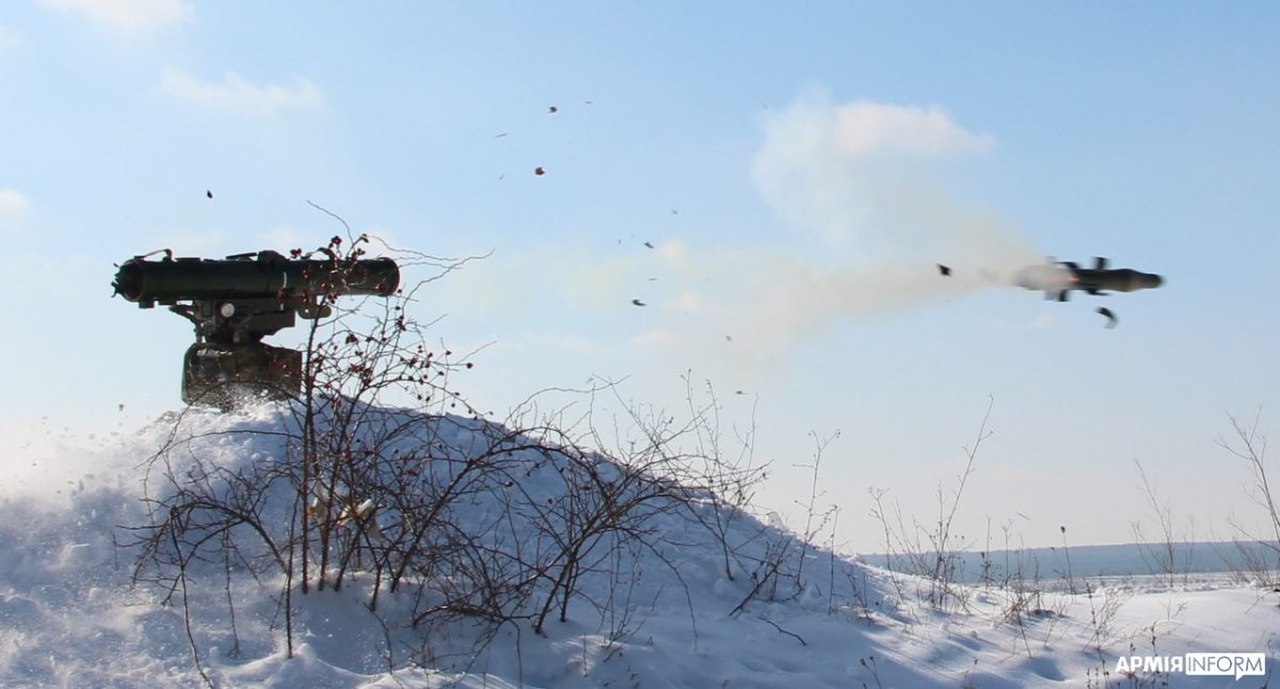 Photo 2. A Stugna-P anti-tank missile fired by remote control from a concealed position during winter training (March 2021; a training photo unrelated to the battle of Vuhledar) — Photo: ArmyInform, CC BY 4.0, via Wikimedia Commons
To make these decisions yourself, take command of the battalion for a month in the training scenario "Vuhledar Defence".
Sources
- The New York Times, reprinted in The Boston Globe: analysis of the tank battle at Vuhledar (2023-03-01). https://www.bostonglobe.com/2023/03/01/world/an-epic-battle-tanks-russia-was-routed-repeating-earlier-mistakes (accessed 2026-10-13)
- RFE/RL, "The Battle of Vuhledar" (2023-02-20). https://www.rferl.org/a/ukraine-russia-battle-vuhledar/32276547.html (accessed 2026-10-13)
- The War Zone, situation report on the fighting for Vuhledar, citing the UK MoD assessment of 27 January (2023-01-28). https://www.twz.com/ukraine-situation-report-heavy-fighting-as-battle-for-vuhledar-rages (accessed 2026-10-13)
- Ukrinform, summary of the UK MoD assessment of 10 February: at least 30 vehicles abandoned (2023-02-10). https://ukrinform.net/rubric-ato/3668281-russian-troops-likely-abandoned-at-least-30-armored-vehicles-after-failed-assault-on-vuhledar-uk-intelligence.html (accessed 2026-10-13)
- Euromaidan Press, summary of the UK MoD assessment of 23 February (2023-02-23). https://euromaidanpress.com/2023/02/23/russian-command-under-pressure-to-deliver-success-at-vuhledar-but-this-is-unlikely-british-intelligence/ (accessed 2026-10-13)
- Novaya Gazeta Europe, summary of a UK MoD assessment: 155th Naval Infantry Brigade losses and replacements (2023-02-26). https://novayagazeta.eu/articles/2023/02/26/uk-intel-russian-elite-infantry-apparently-suffered-extremely-high-casualties-at-vuhledar-en-news (accessed 2026-10-13)
- Novaya Gazeta Europe, summary of a UK MoD assessment: remote anti-armour mines (RAAM) (2023-03-16). https://novayagazeta.eu/en/articles/2023/03/16/uk-intel-russia-suffered-heavy-losses-at-vuhledar-due-to-ukraines-use-of-raam-anti-tank-mines-en-news (accessed 2026-10-13)
- Atlantic Council DFRLab, Russian War Report: failed Russian push on Vuhledar (2023-02-17). https://www.atlanticcouncil.org/blogs/new-atlanticist/russian-war-report-failed-russian-push-on-vuhledar-results-in-losses-as-moscow-increases-troops/ (accessed 2026-10-13)
- Hudson Institute, Ukraine Military Situation Report (2023-02-15). https://hudson.org/defense-strategy/ukraine-military-situation-report-february-15-2023 (accessed 2026-10-13)
- Ukrainska Pravda, Ukrainian claim of a special forces and brigade tank ambush (2023-02-03). https://www.pravda.com.ua/eng/news/2023/02/03/7387764/ (accessed 2026-10-13)
- Ukrainska Pravda, announcement of the withdrawal from Vuhledar (2024-10-02). https://www.pravda.com.ua/eng/news/2024/10/2/7477778/ (accessed 2026-10-13)
- Wikipedia, Battle of Vuhledar (cross-check only). https://en.wikipedia.org/wiki/Battle_of_Vuhledar (accessed 2026-10-13)
- Wikimedia Commons, file page for the Vuhledar coal mine photo (CC BY 3.0). https://commons.wikimedia.org/wiki/File:%D0%A8%D0%B0%D1%85%D1%82%D0%B0_%D0%AE%D0%B6%D0%BD%D0%BE_%D0%94%D0%BE%D0%BD%D0%B1%D0%B0%D1%81%D1%81%D0%BA%D0%B0%D1%8F_%E2%84%961.jpg (accessed 2026-10-13)
- Wikimedia Commons, file page for the Stugna-P firing photo (CC BY 4.0). https://commons.wikimedia.org/wiki/File:Ukrainian_Stugna-P_ATGM_Firing_in_Winter.jpg (accessed 2026-10-13)