Battle Analysis
Yeongcheon (September 1950): Retaking a Broken Corridor by Shifting Regiments
· 1950-09-05 – 1950-09-13
Overview (BLUF)
In early September 1950 the North Korean (NK) 15th Division attacked the ROK 8th Division and within four days reached Yeongcheon, the road and rail hub of the lateral corridor between Taegu and P'ohang–Gyeongju. Holding it, the enemy could turn west into the rear of the forces around Taegu or southeast toward Gyeongju. On 5 September the ROK Army moved the 8th Division to II Corps and attached the 5th Regiment of the 7th Division; on the 8th it brought the 11th Regiment of the 1st Division across from the Taegu front. While the two regiments retook the town, the 8th Division was reorganized with help from the Korea Military Advisory Group (KMAG), and on 9–10 September ROK forces surrounded the enemy on the hills southeast of the town and reopened the Yeongcheon–Gyeongju road.
The US Army official history (Appleman) calls this perhaps the most critical period of the fighting in the east and credits the rapid shift of regiments from two widely separated sectors with stopping the enemy before he could exploit the breakthrough. Korean sources see the battle as the point where the ROK Army turned from defence to offence.
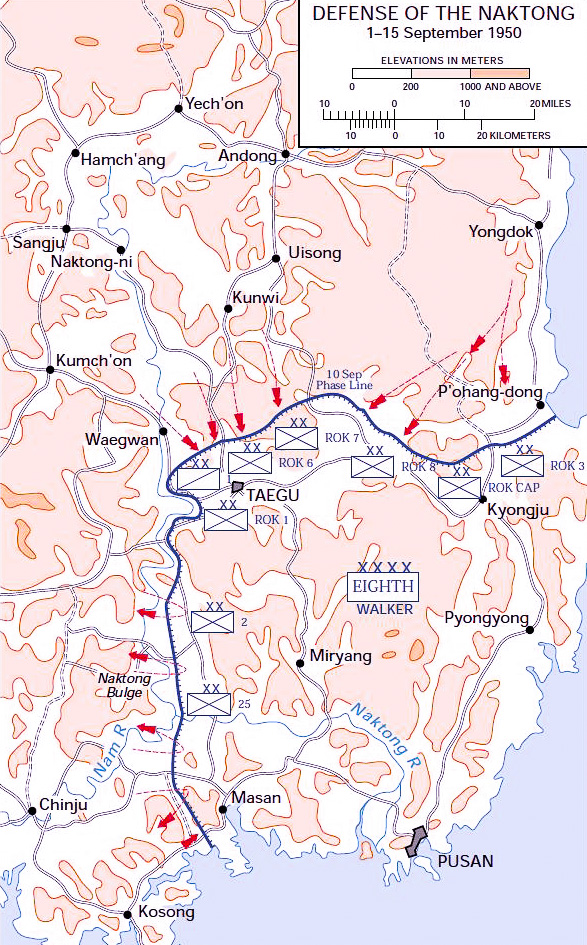 Photo 1. Defence of the Naktong, 1–15 September 1950. The ROK 8th Division (ROK 8) front between Taegu and Kyongju faces the Yeongcheon area — Map by the US Army Center of Military History (CMH), public domain (PD-USGov-Military-Army), via Wikimedia Commons
Background and Strategic Context
With its August attacks on Tabu-dong and Taegu stopped, North Korea launched a renewed general offensive along the Naktong perimeter in early September. In the east, alongside the Kigye–P'ohang attack, the NK 8th Division struck toward Hayang and the 15th Division toward Yeongcheon to cut the Taegu–P'ohang corridor. The 15th Division had moved via Uisong to the Yeongcheon front and was ready to attack on 1 September. According to the official history, its commander was ordered to take Yeongcheon at all costs.
At about the same time Eighth Army, with the Taegu front under pressure, considered falling back to a line further to the rear, but around 5 September decided not to withdraw.
Terrain and Weather
Yeongcheon sits on the Geumho River. The road and railway from Taegu pass through the town and continue southeast to Gyeongju, while a road from the Uisong–Sinnyeong direction comes down from the north (Figure 1). North of the town hill country rises toward Bohyeonsan (1,124 m); southeast of it, hills overlook the Taegu–Gyeongju road. Whoever held those hills and the road, more than the town itself, decided the fate of the corridor.
The NK attack on 5 September came in rain. The official history notes that typhoon rains and low cloud limited air support in the eastern hills until the 10th.
Forces and Dispositions
- ROK: The 8th Division held the line around Bohyeonsan. At 1030 on 5 September it passed from I Corps to II Corps and received the 5th Regiment of the newly activated 7th Division. On the 8th the 11th Regiment of the 1st Division arrived from the Taegu front. Korean sources say one regiment each was taken from the 1st and 6th Divisions. Each ROK division had one US 105-mm battalion in support, but only about a quarter of a US division's artillery.
- North Korea: The 15th Division (three regiments) had an artillery regiment and a few tanks. Prisoners put the three regiments at only about 3,600 men. To the west, the NK 8th Division attacked toward Hayang at the same time.
Course of the Action
 Figure 1. Yeongcheon, schematic (5–12 Sep 1950). Positions and distances are approximate and the northern hills are compressed; regimental axes on 9–10 September are unknown and shown together — our own work, based on the scenario map and sources 1–3
- Breakthrough (2–6 September): The NK division struck the 8th Division from the 2nd and stepped up its attack on three axes in the rain on the 5th. When an enemy tank got behind one ROK regiment, the regiment broke. On the afternoon of the 6th enemy elements were in and south of Yeongcheon, but instead of holding the town they climbed onto the hills overlooking the Taegu–Gyeongju road.
- First recapture (7 September): The 5th Regiment attacked along the corridor from the east, cleared the town and took up a defence north of it. The same day the enemy set a roadblock about 5.6 km southeast of the town. KMAG advisers gathered stragglers and helped rebuild the 8th Division.
- Lost and retaken (8 September): Enemy follow-on units took the town again. That afternoon the 11th Regiment, arriving from the Taegu front, counterattacked and cleared most of it; the enemy kept the railway station area to the southeast.
- Encirclement (9–10 September): The NK artillery regiment, which had run ahead of its infantry and used up its ammunition, was largely destroyed by ROK counter-battery fire. The 5th and 11th Regiments and the reorganized 8th Division surrounded the enemy on the southeastern hills from the south, west and north. On the 10th the Yeongcheon–Gyeongju road was opened; the NK division had lost its chief of staff and other senior officers, who fell in the fighting, and was virtually finished as a fighting force.
- Advance (12–13 September): The 8th Division and the 5th Regiment advanced about 13 km north of the town against little resistance.
 Figure 2. Timeline of Yeongcheon (September 1950). Blue marks ROK actions, red marks North Korean actions — our own work, based on sources 1–2
Decision Point Analysis
 Figure 3. Options and choices at each decision point. Orange borders mark the choice actually made; deciders are given by echelon — our own work, based on the analysis below and sources 1–2
Decision 1: Right after the breakthrough (ROK 8th Division, afternoon of 6 September)
The options were (a) form a new line south of the town, (b) commit the newly attached 5th Regiment at once to retake it, (c) fall back toward Gyeongju to cover the approach to Pusan, or (d) hold the 5th Regiment until the division had reorganized and then attack together. In practice it was (b): the 5th Regiment cleared the town while the division regrouped behind it. The reasoning appears to have been that the town had to be retaken before the enemy could consolidate the corridor, if both Taegu and Gyeongju were to be covered. This is the second decision of our scenario.
Decision 2: Hold the town or push on? (NK 15th Division, 6–8 September)
Of (a) holding the town, (b) turning west on Taegu, and (c) taking the southeastern hills and pushing toward Gyeongju, the enemy chose (c), putting its effort into the hills overlooking the road and a roadblock rather than the town. For a division reduced to around 3,600 men this was too much. Its artillery regiment ran ahead of the infantry, used up its ammunition and was left exposed to ROK counter-battery fire.
Decision 3: Take a regiment from the Taegu front? (Eighth Army and ROK command, 8 September)
The 11th Regiment could (a) go straight into a counterattack on the town as it arrived, (b) be posted on the Taegu road against a westward turn, (c) wait while artillery was massed first, or (d) the 5th Regiment could be pulled back to consolidate. Option (a) was chosen. The official history singles out the army commander's judgment in moving regiments from two widely separated sectors. With the Taegu front itself under pressure, the shift was a calculated risk.
Decision 4: The enemy on the southeastern hills (ROK 8th Division, 9–10 September)
Of (a) encircling from the south, west and north, (b) pushing straight down the Gyeongju road, (c) holding the town and waiting for the enemy to leave, and (d) counter-battery fire first, the division chose (a). With the enemy artillery already broken, ROK forces could close on infantry alone from several directions. The road opened on the 10th.
Lessons
- Use of reserves and tempo: Two regiments were taken from other fronts and committed before the enemy could widen the breach. The official history counts this as a notable command achievement.
- Continuity of command and reorganization: Rebuilding the scattered division with advisers turned the time bought by the two regiments into a counterattack.
- Fires and sustainment: The North Korean artillery outran its infantry and its ammunition. Firepower only tells when supply and protection keep up.
- Terrain: The corridor was decided by the hills over the road more than by the town.
- Coalition support: US artillery support and KMAG help with reorganization aided the ROK division's recovery.
Unresolved Questions
- Which regiment attacked from which direction on 9–10 September could not be confirmed (Figure 1 shows them together).
- The number of the regiment Korean sources say came from the 6th Division could not be matched to the official history, which names only the 5th and 11th Regiments.
- The official history dates the attack from 2 September; Korean sources give 5–13 September.
- Loss figures for both sides appear only in press reports without a stated source, so they are not used.
- The Korean Institute for Military History's official history (vol. 5) could not be consulted directly.
 Photo 2. A 105-mm howitzer in an ROK position north of Taegu (18 September 1950). It shows the kind of artillery supporting ROK divisions at the time of Yeongcheon; it is not a photo of Yeongcheon itself — Photo: US Army Signal Corps (SC 348630, via Signal Corps Archive), public domain (PD-USGov-Military-Army), via Wikimedia Commons
To take command of the division on the day the Yeongcheon corridor broke, open the training scenario. It starts with the attack in the rain on the morning of 5 September.
Sources
- US Army Center of Military History, South to the Naktong, North to the Yalu (1961), ch. XXII "Perimeter Battle" (the Yongch'on breakthrough). https://history.army.mil/html/books/020/20-2-1/CMH_Pub_20-2-1.pdf (online transcription https://www.koreanwaronline.com/history/Appleman/Chapter22.htm) (accessed 2026-10-13)
- Academy of Korean Studies, Encyclopedia of Korean Culture, "Yeongcheon Battle" (citing MND Institute for Military History, The Korean War vol. 5, 2008). https://encykorea.aks.ac.kr/Article/E0037758 (accessed 2026-10-13)
- Kyongbuk Maeil, "Holding the Naktong line and opening the counterattack" (2020-06-16). https://kbmaeil.com/article/202006150280993 (accessed 2026-10-13)
- Wikimedia Commons, file page for the Naktong defence map (PD-USGov-Military-Army). https://commons.wikimedia.org/wiki/File:Naktong_Defense.jpg (accessed 2026-10-13)
- Wikimedia Commons, file page for the ROK 105-mm howitzer photo (PD-USGov-Military-Army). https://commons.wikimedia.org/wiki/File:SC_348630_-_A_well-camouflaged_105mm_howitzer_of_the_15th_Regt.,_1st_ROK_Div.,_in_readiness_for_action_against_the_North_Korean_forces_north_of_Taegu._18_September,_1950._(52514890825).jpg (accessed 2026-10-13)