Battle Analysis
In depth | Duc Co — how did a company in a shallow trench hold for six hours?
· 1966-08-09 – 1966-08-10
Overview
Part 1: Duc Co (August 1966) covered the broad lines: listening posts, all-round defence and Korean–US fire coordination. This piece takes the same night hour by hour. The perimeter was about 200 by 170 m and its trench about two feet deep [3], yet one infantry company and five tanks held off a PAVN battalion for some six hours and only one attacker got inside [1][2]. Below: ground and weather in numbers, the scenario's phases p1–p8 (with the what-if p4x), and the sources where they disagree.
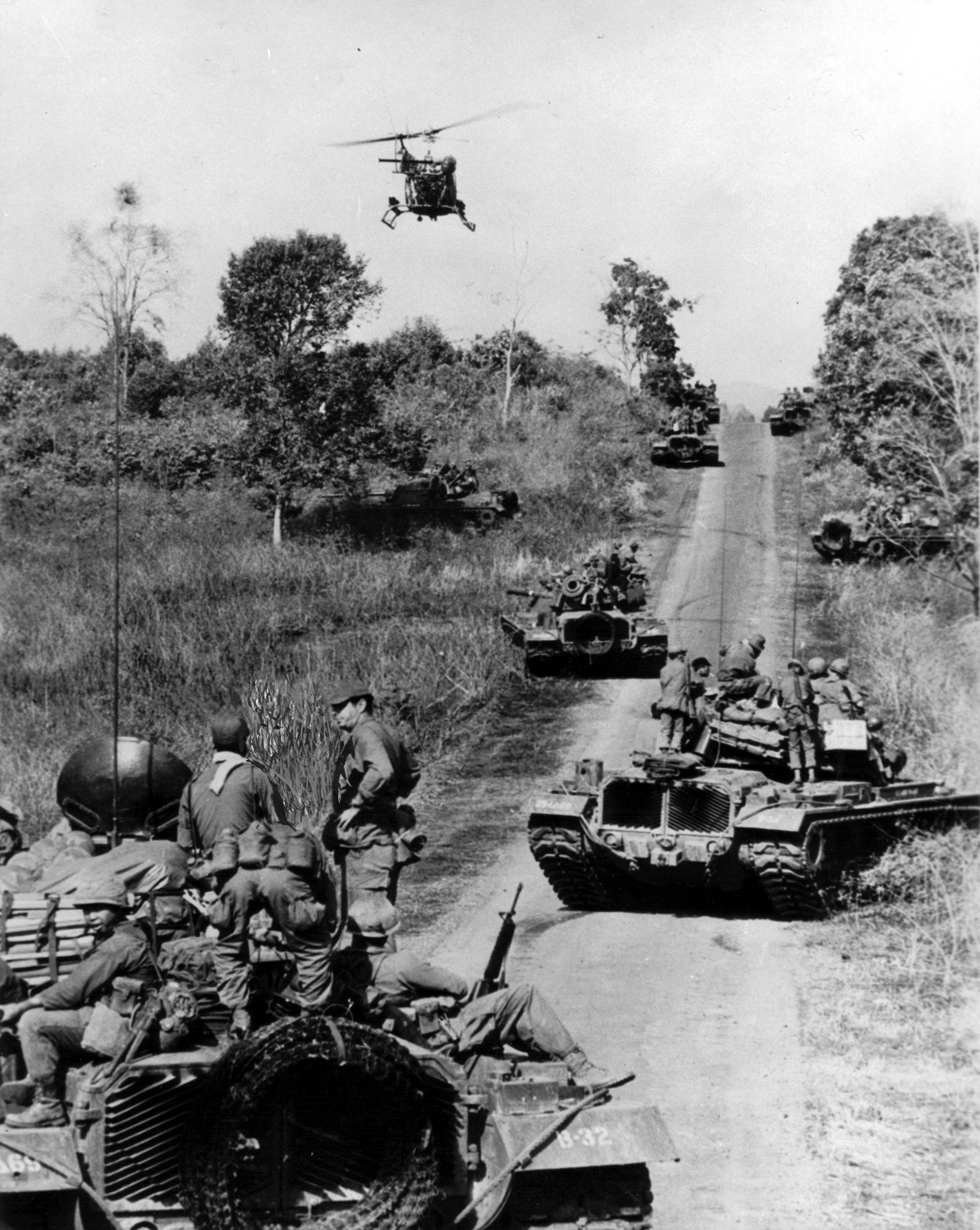 Photo 1. M48 tanks of the 1st Battalion, 69th Armor in herringbone formation on a road west of Pleiku, 1 April 1966. Four months later this battalion sent a platoon to LZ 27 Victor — Photo: US Army (author unknown), public domain, via Wikimedia Commons [13]
Strategic and operational context
From May 1966 the 3rd Brigade, US 25th Infantry Division was cutting PAVN infiltration routes in Pleiku and Kontum provinces [7]. In Paul Revere II (1–15 August) the 1st Cavalry Division moved into the Chu Pong area, and on 8 August a US company at LZ Juliet fought a reinforced PAVN battalion [7]. LZ 27 Victor was hit the next night.
The 3rd Battalion of the Tiger Division's Cavalry Regiment had worked under the 3rd Brigade's operational control since 9 July, about 8 km south of Duc Co [3][4]. No government-level agreement ever defined US control of Korean troops: the Korean commander in Vietnam, Major General Chae Myung Shin, promised to act as if under Westmoreland's operational control, and the Americans relied on that de facto arrangement [5]. On 27 July the 9th Company occupied LZ 27 Victor to watch the approaches; the US Army history puts it about 6 km from the Cambodian border [3]. Measured from its position on the Paul Revere operations map (about 13.685°N, 107.592°E), the straight-line distance to the border is only about 3.3 km [16]. The 1st Battalion, 69th Armor, which had traded its petrol M48A2Cs for diesel M48A3s before deploying [6], rotated a tank platoon to it weekly [3].
Korean sources say the battle won allied acceptance for the company tactical base, which the Americans then studied as a "fire base" [4]. US intelligence analysts later suggested the attack may have been a diversion covering units withdrawing through Chu Pong and the Ia Drang [3].
Terrain and weather (OAKOC)
 Figure 1. LZ 27 Victor in detail (approximate). Only perimeter size, wire distance and LP distance come from sources — own work, based on sources 1–3 and 7
Observation and fields of fire. Elevation data put the LZ at about 276 m and the Duc Co camp at about 360 m [12]: a low rise on the plateau, not a commanding height. The ground was open, but a tree line close to the south gave the enemy a firing position [3]. At night the field of fire reached only as far as the light.
Avenues of approach. The ground to the border, about 3.3 km in a straight line (6 km in the history), was for men on foot [3][16]. The enemy dug in from the west, set mortars to the north-west and assaulted from the west, north and south [3]. Open on every side, the position could be approached from any direction; no assault is recorded from the east, toward Duc Co.
Key terrain. The landing zone itself. FM 3-90 notes that holding a landing zone restricts positioning inside a perimeter and makes depth hard to achieve (para 9-68) [9], which is why this position had almost none.
Obstacles. Concertina about 20 m out, trip flares and claymores beyond [3]. The enemy digging toward the wire suggests he knew where the warning devices were (author's inference).
Cover and concealment. A two-foot trench barely covered a prone man [3]; a lit searchlight made its tank a target [2][3].
Weather and moon. ERA5 reanalysis for a nearby grid point (13.74°N, 107.62°E, about 7 km north-east of the LZ) gives 28.8°C/22°C on 9 August, 11.4 mm of rain that day and 18.3 mm on the 10th, 97–100% cloud through the night and light rain from about midnight [11]. Last quarter fell at 12:55 UT on 9 August [10], 20:55 on the South Vietnamese clock (UTC+8); a half moon rising near midnight was probably hidden by cloud. Sunrise was about 06:35 local (author's conversion of the UTC+7 reanalysis values) [11]. Nearly all the light that night was man-made.
Task organization and command relationships
No primary source describes positions below company level; "Estimate" marks those cells.
| Side |
Echelon |
Unit / element |
Role, equipment |
Source |
| US |
Brigade |
3rd Bde, 25th Infantry Division |
Interdiction; OPCON of 3rd Bn from 9 July |
[3][7] |
| ROK |
Battalion |
3rd Bn, Cavalry Regt, Tiger Division |
South of Duc Co; guns at battalion base |
[3][4] |
| ROK |
Company |
9th Company |
Defends LZ 27V; three LPs, half on alert |
[1][3] |
| ROK |
Platoon |
Rifle and weapons platoons |
Along the trench; number and strength unknown |
Estimate |
| ROK |
Section |
Company mortars |
About 1,500 rounds |
[3] |
| US |
Platoon |
1st Plt, Co A (or B), 1-69 Armor |
Five M48A3s among the MG posts |
[2][3] |
| US |
— |
Two searchlight tanks |
Knocked out during the night |
[2][3] |
| US/ROK |
Artillery |
Battalion base; three US batteries at Duc Co |
About 1,900 HE rounds |
[3] |
| USAF |
Air |
Flare ships |
Light after the searchlights |
[3] |
| PAVN |
Battalion |
5th Bn, 88th Regiment |
Recoilless rifles, mortars, rockets |
[1][3][4] |
| PAVN |
Reinforcement |
About 300 incl. sappers |
Korean claim |
[4] |
The US tank platoon was under a Korean company commander's control; its citation says "a Korean officer" alerted a tank commander to the digging [2]. The guns came from two places and two armies [3]. Radio and prior coordination, not a signed agreement [5], tied it together (author's assessment).
Hour by hour
9 July – 8 August
The battalion patrolled north of Chu Pong almost daily [3][4]; the 9th Company dug in at LZ 27 Victor from 27 July, and a new tank platoon rotated in on 5 August [3].
9 August, to 2300
The company had returned that day from a two-day border mission. Three listening posts went out about 200 m before dark, with half the men on alert (scenario data, from [3]). About an hour before midnight [1][2] the south-west LP reported digging and a trip flare went off on the west side [3].
2300–0130
The commander pulled in the LPs. A tank lit its searchlight and fired its machine gun; the enemy replied from the southern tree line and with mortars from the north-west, lightly wounding three Americans including the platoon leader [2][3]. Three tanks fired antipersonnel rounds into the tree line, the rest covered the south-west [3]. Both searchlight tanks were knocked out during the night, and artillery flares and USAF flare ships took over [2][3].
0130–0200
The fire slackened [3]. No source records what the company did in the lull.
0200–0400
A western assault reached about 50 m and was driven back by tank and machine-gun fire; two more came from the north and south [3]. Some attackers got within a few metres of the wire, and the one man who got inside was stopped by a Korean soldier with the bayonet [1]. The tanks fired 33 rounds of canister, 24 of HE and nearly 17,000 machine-gun rounds [3]; so little canister from five tanks suggests they fought mainly with machine guns (author's inference).
0600 onward
The firing stopped about 0600, in light rain under full cloud [3][11]. A combined tank-infantry patrol went beyond the wire, met PAVN soldiers who fought to the end and cleared the ground [3]. Both citations judge the enemy battalion virtually finished as a fighting unit [1][2]. On 26 August Korea's Daehan News no. 585 reported the fight, calling the enemy "Viet Cong" as Korean reports then did [8].
 Photo 2. UH-1Ds of Company A, 229th Assault Helicopter Battalion at the Duc Co Special Forces camp, 14 January 1966. LZ 27 Victor lay south of this camp — Photo: SP6 Billy A. McBride (US Army), public domain, via Wikimedia Commons [14]
Decision points in depth
Phase titles follow the scenario. p4x opens if p4 fails; p8 assumes a timeline that did not happen (Figure 2).
 Figure 2. Decision flow and the night's fire. Phases and times from the training scenario; round counts from Carland via Wikipedia [3] — own work
p1 Digging beyond the wire (9 Aug, 2300)
Known: digging, a trip flare, numbers unknown; a tired company; a searchlight that would expose its tank. Options: LPs in and check by fire; leave the LPs out; unobserved artillery; a squad search. Decision: LPs in, searchlight and machine gun [1][2]. Otherwise: LPs left out would have masked the west side's fire, and since the enemy had already dug close [3], a squad would have walked into a force ready to attack. The recon by fire made him open up early.
p2 Fire on the searchlight (2330)
Known: fire from the tree line and north-west mortars, three Americans hit [3]; guns and flare ships available; a rumour of "hundreds." Options: split the tanks and call guns and flares; douse the lights; mass guns on the mortars; pull the tanks to the centre. Decision: three tanks on the tree line, the rest south-west, guns and light requested [3]. Otherwise: pulling tanks in would empty their sides; chasing muzzle flashes rarely fixes mortars; dousing the lights would have kept the tree line dark until the flare ship came.
p3 The lull (0130)
Known: fire slackening, dragging sounds to the west, talk of an enemy withdrawal. Options: hold all round and redistribute ammunition; shift men west; patrol; drop to half alert. Decision: not recorded; the company met the next assault with its position intact [3]. Otherwise: shifting west would have thinned the north and south just before both were attacked.
p4 Assault from the west (0200)
Known: an assault 50 m from the west wire, no searchlights, movement to the south. Options: hold the trench and fire everything to one plan; reinforce the west; counterattack outside; hold fire until the wire. Decision: every platoon held and tank and machine-gun fire broke the assault [3]. Otherwise: a counterattack gives up wire, trench and fire plan at once; holding fire leaves no room for guns and mortars; reinforcing the west would have opened the sides hit next.
p4x Enemy in the trench (0215, what-if)
Situation: a few attackers in one stretch of trench, its machine gun silent, tanks unable to fire inside. Recommended: the next squad clears along the trench with the bayonet; every other post stays put. Basis: one man actually got in and was stopped with the bayonet [1]; FM 3-90 keeps the reserve central to meet a penetration anywhere (9-61) [9].
p5 North and south (0230–0400)
Known: assaults to within a few metres, canister running low, a claim the north was a feint. Options: hold all round and split the guns; mass on the south; machine guns only; shift men south. Decision: fire was shifted, men were not; both assaults failed [3]. Otherwise: staking everything on the south would have let the northern assault come closer.
p6 First light (0600)
Known: firing stopped; men and ammunition worn down; the tree line unknown. Options: tank-infantry sweep; wait inside; pursue to the border; fire on withdrawal routes. Decision: the combined patrol went out [3]. Otherwise: a pursuit of several kilometres to the border strips the base; staying in leaves holdouts on the doorstep.
p7 Holdouts in the tree line (0630)
Known: fire from a few spots; few mortar rounds left. Options: tanks lead, infantry clear stretch by stretch; pull back and shell; infantry rush; break contact. Decision: the patrol fought holdouts and cleared the area [3], the citation's "mop-up" [1]. Otherwise: infantry ahead of tanks meet hidden riflemen without cover.
p8 Unchecked ground (0730, what-if)
Situation: the sweep was put off; movement in the tree line. Recommended: send the tank-infantry patrol now. Basis: the real patrol found holdouts soon after 0600 [3]; FM 3-90 makes aggressive patrolling outside a prerequisite of perimeter defence (9-60) [9].
Reading it through doctrine
Perimeter defence (FM 3-90, 9-59 to 9-62). A perimeter is for a unit that must face all directions or cannot tie in with neighbours, a firebase being the manual's example; combat power sits on the perimeter, the reserve central, and the most vulnerable sector is reinforced once the main direction of attack is determined [9]. The 9th Company met the first conditions and never reinforced, because the main direction never became clear. "Once determined" was the crux of the night.
Vehicles and depth (9-67, 9-68). Vehicles on a perimeter cover mounted approaches [9]; at LZ 27 Victor there were none, and the tanks served as fire posts with lights, machine guns and canister. The manual warns that landing-zone perimeters lack depth and prescribes early warning and obstacles [9]: the LPs, trip flares, claymores and wire.
Security and light (9-70, 13-6, 8-81, 1-122). OPs forward of a perimeter coordinate their passage back in, and at night serve as listening posts [9]; the 2300 recall was exactly that. Defensive illumination should fall on or behind the enemy and leave defenders dark (8-81), and plans need alternates for equipment failure (1-122) [9]. The searchlights lit both sides; flares and flare ships, which kept the light going when they failed, fit the manual better.
Obstacles and final protective fires (8-74, 9-72). Protective wire is tied to final protective fires [9]. The fire plan behind 1,900 artillery and 1,500 mortar rounds [3] is not recorded, but a position that held with attackers 5 m out suggests fire was ready to land just beyond the wire (author's inference).
 Photo 3. Sandbagged trench and wire at a Tiger Division field command post near Pleiku, 27 March 1970. The original caption says the unit set up concertina and claymores round each new position. This is four years after Duc Co — Photo: SP4 Vest (US Army), public domain, via Wikimedia Commons [15]
 Figure 3. Phase by phase (18-second loop; with reduced motion only the final situation shows). Approximate — own work, based on sources 1–3
Weighing the sources
Which tank company. The tank citation says Company B [2]; Carland, as cited on Wikipedia, says Company A's 1st Platoon rotated in on 5 August [3]. Both are specific; the question stays open.
US wounded. Three lightly wounded in the first exchange [3] against a quarter of the platoon [2]. These need not conflict: one counts the opening fire, the other the night. Five tanks with four crew each make about 20 men, so a quarter is about five (author's estimate).
Korean losses. Seven dead (Carland via Wikipedia), seven dead and fifteen wounded (VirtualWall) [3][7]. The Korean encyclopedia gives none [4].
Enemy strength and losses. The allied count is 197 dead [3][7]; the Korean entry claims about 700 attackers (the 5th Battalion's 400-plus and some 300 reinforcements) and over 500 casualties [4]. One counts bodies, the other dead and wounded together, and the entry gives no basis for the reinforcements. 197 is the confirmed figure; the rest are claims.
The same battle? Allied Participation in Vietnam (1975) describes a Korean battalion with the US 4th Infantry Division whose northernmost company outpost, on the battalion's sixth night in the highlands, beat off a North Vietnamese battalion, losing seven men and counting 182 enemy dead, with three US tanks in support [5]. Seven dead, a night battalion attack and US tanks match Duc Co; the US formation, enemy regiment (101st vs 88th), tank count, enemy toll and timing do not. We leave open whether it is the same fight.
Dates and "fire base." The 1968 award dates [1][2] likely explain web pages that put the battle in 1968. Korean sources credit Duc Co with the "fire base" idea [4], but the US armour history already calls Ap Bau Bang (November 1965) an early combined arms defence of a night position [6]. The Korean account reads best as proof of the isolated company base, not the invention of the perimeter.
Lessons
- Once warned, bring the security elements in. A listening post left out masks your own fire.
- Don't pick the main effort from one noise. The assaults came west, north, then south; the perimeter held because it moved fire, not men.
- Light before fire. Decide in advance what lights the ground when the searchlight goes out.
- Coordinate attachments through people. Without a signed agreement, a Korean officer and an American tank commander still turned a warning into fire within minutes.
- At first light, check your own perimeter first. The holdouts were just outside the wire.
Open questions
- The tank platoon's parent company, and where the searchlight tanks stood.
- What the company did in the 0130 lull; its strength, layout and commander's name.
- The basis for the Korean figures of 700 attackers and 500-plus casualties.
- Whether the Allied Participation battle is Duc Co.
- Stemming the Tide (PDF returns 403) and the Korean official history were not consulted directly.
Further reading and viewing
▶Daehan News no. 585, Vietnam news — report on the 9th Company, 3rd Battalion, Tiger Cavalry RegimentVideo: Daehan News no. 585 'News from Vietnam' (made 26 August 1966): the 9th Company's fight in the border area, a jungle patrol and an interview with a wounded platoon leader; in Korean · KTV Archive (Korea Government broadcaster)
- The two Presidential Unit Citations [1][2].
- Starry, Mounted Combat in Vietnam, chapter III [6], on how US armour learned night defence.
- FM 3-90 Tactics (2023), chapter 9 [9].
- The training scenario "Duc Co" starts at 2300 on 9 August, the moment the digging is heard.
Sources
- Presidential Unit Citation (Army), 9th Company, 3d Battalion, 1st Cavalry Regiment, Capital ROK Infantry Division, 26 July 1968. The American Presidency Project, UC Santa Barbara. https://www.presidency.ucsb.edu/documents/presidential-unit-citation-awarded-the-9th-company-3d-battalion-1st-cavalry-regiment (accessed 2026-10-14)
- Presidential Unit Citation (Army), 1st Platoon, Company B, 1st Battalion, 69th Armor, 20 June 1968. The American Presidency Project, UC Santa Barbara. https://www.presidency.ucsb.edu/node/237028 (accessed 2026-10-14)
- John M. Carland, Combat Operations: Stemming the Tide, May 1965 to October 1966, US Army Center of Military History, 2000, pp. 292, 297–301. Original PDF returned 403; checked through the citations in Wikipedia, "Battle of Đức Cơ". https://en.wikipedia.org/wiki/Battle_of_%C4%90%E1%BB%A9c_C%C6%A1 (accessed 2026-10-14)
- Yang Young-jo, "Maengho Budae (Tiger Division)", Encyclopedia of Korean Culture, Academy of Korean Studies, 2013 (rev. 2023). https://encykorea.aks.ac.kr/Article/E0018093 (accessed 2026-10-14)
- Stanley R. Larsen and James L. Collins Jr., Allied Participation in Vietnam (Vietnam Studies), Department of the Army, 1975, chapter VI "The Republic of Korea" (copy of the CMH online edition). https://webdoc.sub.gwdg.de/ebook/p/2005/CMH_2/www.army.mil/cmh-pg/books/vietnam/allied/ch06.htm (accessed 2026-10-14)
- Donn A. Starry, Mounted Combat in Vietnam (Vietnam Studies), Department of the Army, 1978, chapter III "Growth of U.S. Armored Forces in Vietnam" (copy of the CMH online edition). https://webdoc.sub.gwdg.de/ebook/p/2005/CMH_2/www.army.mil/cmh-pg/books/vietnam/mounted/chapter3.htm (accessed 2026-10-14)
- The Virtual Wall, "Operation Paul Revere II, August 1–15, 1966", VirtualWall.org, updated 2014. https://virtualwall.org/units/ChuPong.htm (accessed 2026-10-14)
- KTV Archive (Korea Policy Broadcasting Service), Daehan News no. 585, "News from Vietnam" (made 26 August 1966), YouTube. https://www.youtube.com/watch?v=kZ4gN3ghmKw (accessed 2026-10-14)
- Headquarters, Department of the Army, FM 3-90 Tactics, 1 May 2023 (paras 1-106, 1-122, 8-74, 8-81, 9-59 to 9-62, 9-67, 9-68, 9-70, 9-72, 13-6). https://armypubs.army.mil/epubs/DR_pubs/DR_a/ARN38160-FM_3-90-000-WEB-1.pdf (accessed 2026-10-14)
- NASA Goddard Space Flight Center, Phases of the Moon: 1901 to 2000 (August 1966). https://eclipse.gsfc.nasa.gov/phase/phases1901.html (accessed 2026-10-14)
- Open-Meteo, Historical Weather API (ERA5 reanalysis), nearby grid point about 7 km north-east of LZ 27 Victor (13.74°N, 107.62°E), 7–11 August 1966, daily and hourly temperature, precipitation, cloud cover, sunrise and sunset. https://archive-api.open-meteo.com/v1/archive?latitude=13.74&longitude=107.62&start_date=1966-08-07&end_date=1966-08-11&daily=temperature_2m_max,temperature_2m_min,precipitation_sum,sunrise,sunset&hourly=precipitation,cloud_cover&timezone=Asia%2FBangkok (accessed 2026-10-14)
- Open-Meteo, Elevation API, LZ 27 Victor and Duc Co area. https://api.open-meteo.com/v1/elevation?latitude=13.685,13.74,13.79,13.62,13.80&longitude=107.592,107.62,107.68,107.70,107.52 (accessed 2026-10-14)
- Wikimedia Commons, File:M48 Tanks in Herringbone Formation.jpg (public domain). https://commons.wikimedia.org/wiki/File:M48_Tanks_in_Herringbone_Formation.jpg (accessed 2026-10-14)
- Wikimedia Commons, File:Company A, 229th Helicopter Assault Battalion UH-1Ds take off from Duc Co.jpg (NARA 111-CCV-378-CC33045, public domain). https://commons.wikimedia.org/wiki/File:Company_A,_229th_Helicopter_Assault_Battalion_UH-1Ds_take_off_from_Duc_Co.jpg (accessed 2026-10-14)
- Wikimedia Commons, File:ROK Tiger Division field command post near Pleiku.jpg (NARA 111-CCV-534-CC65020, public domain). https://commons.wikimedia.org/wiki/File:ROK_Tiger_Division_field_command_post_near_Pleiku.jpg (accessed 2026-10-14)
- Wikimedia Commons, file page for the Paul Revere I and II operations map (CMH, public domain), and the OpenStreetMap Cambodia–Vietnam border line (used to measure LZ 27 Victor's distance). https://commons.wikimedia.org/wiki/File:Operations_Paul_Revere_I_and_II_May-August_1966.jpg (accessed 2026-10-14)