Battle Analysis
In depth | Hyeon-ri — who held the only way out first?
· 1951-05-16 – 1951-05-20
Overview
Part 1: Hyeon-ri (May 1951) covered a corps that rested on a single road. This piece takes that story hour by hour. Before dawn on 17 May 1951 a Chinese battalion took Omachi pass south-west of Hyeon-ri. The ROK III Corps (3rd and 9th Divisions) tried twice to reopen the road, then broke into the mountains, leaving every remaining gun and over 300 vehicles [1][3]. On 20 May the men gathered at Hajinbu-ri came to 40% of the 9th Division and 34.2% of the 3rd [3]. Below, the terrain is re-read with data, the scenario's phases p1–p8 (with what-if phases x1 and x3) are taken in turn, and the record is checked against doctrine.
 Photo 1. The Soyang valley, September 1951, four months after the battle; the country north of Hyeon-ri — Photo: official USMC photograph (Ronald H. Welsh Collection, Archives Branch, USMC History Division), CC BY 2.0, via Wikimedia Commons
Strategic and operational context
After the April offensive stalled, Eighth Army commander Lieutenant General James Van Fleet drew an unnamed line, soon called No Name line, from above Seoul to the east coast on 26 April, and on 28 April issued a fallback line, Waco, "for planning purposes only" [2]. The National Archives of Korea dates the Chinese Fifth Offensive 22 April–10 June and places its May effort on the eastern front between Yanggu and Inje [7].
The Chinese shifted five armies east between 10 and 16 May and crossed the Soyang on the 16th [6]. The Korean encyclopedia names III Corps as the main target [3]. The CPV 27th Army struck the seam between the ROK 5th and 7th Divisions of US X Corps and III Corps, while the North Korean V Corps (6th and 12th Divisions) pressed III Corps from the north [1]. III Corps' fate thus hung on its western flank and the one road behind it. The Army's short history puts it bluntly: the 5th and 7th Divisions were gone within hours, and III Corps failed to extract its two divisions [6].
Terrain and weather in detail (OAKOC)
 Figure 1. The Hyeon-ri area in detail (sketch, partly estimated). Villages from OSM [15], heights from Open-Meteo [12]; Omachi pass, Habae-jae and the control lines are placed from written accounts — Own work, after sources 1, 2, 3
Observation and fields of fire. Hyeon-ri sits at about 290 m, Sangnam-ri beyond the pass at about 563 m, and an estimated point on the pass road at about 513 m [12]. Whoever held the ridges above the climb saw and fired along the whole defile; Mossman describes the artillery being let into a "narrow defile" and fired on from above [1]. From the Hyeon-ri basin the pass was hard to watch.
Avenues of approach. Vehicles had one road, the "single route" serving the corps sector [1]. The Chinese, on foot, came through ground the ROK 7th Division had abandoned and later used the mountain road from Sangnam-ri through Habae-jae to Soksa-ri [1].
Key terrain. Omachi pass fits the doctrinal definition of decisive terrain, ground that must be held for the mission to succeed [10]. Hyeon-ri and Sangnam-ri are about 11.6 km apart [15]; the block lay about six miles behind No Name line [1].
Obstacles. East of the road, ridges rise past 1,000 m; Bangtaesan reaches about 1,432 m [12]. They became the escape route on 18 May but no gun or truck could cross them. Hyeon-ri to Hajinbu-ri is about 41 km in a straight line [15]; the route walked was about 60 km [3].
Cover and concealment. Dense forest and narrow valleys hid infantry moving on the ridges at night. ERA5 reanalysis gives highs of 12.2–18.7 °C and lows of 4.5–10.7 °C for 16–20 May, no rain on the 17th, sunrise about 0515 and sunset about 1930 [13]. First quarter fell on 14 May and full moon on 21 May [14], so on 16–18 May a gibbous moon lit the evening trails and set after midnight (my calculation). The 0400 seizure of the pass fits the dark between moonset and dawn; that link is my inference.
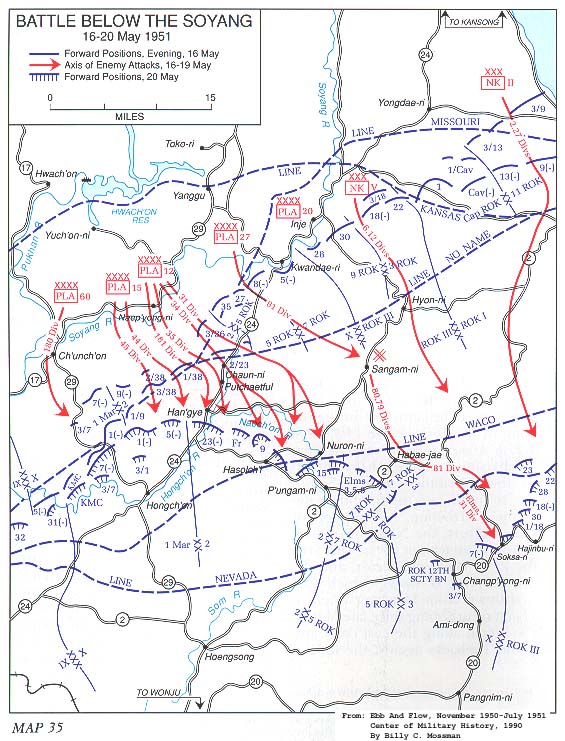 Photo 2. Map 35, 'Battle Below the Soyang, 16–20 May 1951', from Ebb and Flow, showing the block above Sangam-ni and the 81st Division's axis through Habae-jae — Map: Billy C. Mossman, US Army Center of Military History (1990), public domain, via Wikimedia Commons
Organisation and command relationships
| Side |
Echelon |
Unit |
Role / situation |
Source |
| UN |
Army |
US Eighth Army (Lt Gen Van Fleet) |
17 May: withdraw to Waco, clear the block |
[1] |
| US |
Corps |
X Corps (Almond) |
About midnight 16–17 May let ROK 5th, 7th Divs withdraw |
[1] |
| ROK |
Army HQ |
Forward CP, Gangneung |
Morning 17 May: III and I Corps back to No Name line |
[1][5] |
| ROK |
Corps |
III Corps (Yu Jae-hung) |
3rd and 9th Divs |
[1][9] |
| ROK |
Regiment |
9th Div regiment, number not confirmed |
Corps reserve; attacked south 17 May |
[1] |
| ROK |
Battalion |
30th FA Bn (9th Div), 11th FA Bn (3rd Div) |
30th ambushed in the defile; both back near Hyeon-ri that evening |
[1] |
| ROK |
Regiment |
7th Div 3rd Regt, two bns |
Near Sangnam-ri at noon 17 May |
[1] |
| ROK |
Regt / Bn |
7th Div 5th Regt; Capital Div 1/1st |
Crowded into Hyeon-ri 17 May |
[3] |
| CPV |
Army |
27th Army: 81st Div leading, 79th, 80th following |
Block, then south-east via Habae-jae |
[1] |
| CPV |
Battalion |
20th Army, 60th Div, 178th Regt, 2nd Bn |
Took the pass 0400/0700 (Korean encyclopedia) |
[3] |
| NK |
Corps |
V Corps: 6th, 12th Divs |
Pursued toward Hyeon-ri |
[1] |
| US |
Division |
3d Infantry Division |
Moved east 19–20 May; recon company to Hajinbu-ri |
[1] |
Two points stand out. The flank was held by a neighbouring corps whose withdrawal X Corps authorised at midnight, while ROK Army headquarters followed only in the morning [1]: two chains of command on one road moved on different clocks. And by the afternoon of 17 May units of at least four divisions were mixed at Hyeon-ri [3], exactly the situation in which doctrine wants one commander over everyone inside [10].
Hour-by-hour account
16 May, 1600–2400: the flank gives way
The offensive opened about 1600 behind a heavy barrage. At about 2000 the ROK 7th Division's forward regiments lost their positions and contact [3]. That evening the 27th Army crossed the Soyang north-west of Kwandae-ri; around midnight Almond authorised the 5th and 7th Divisions to fall back [1].
17 May, 0400–1300: the pass is blocked
A Chinese point company took the pass at 0400, its battalion at 0700 [3]. That morning III Corps was ordered back to No Name line and its divisions pulled back above Hyeon-ri just ahead of the North Koreans [1]. The 9th Division's 30th Field Artillery Battalion, moving south, was let into the defile and fired on from both sides; only its tail battery saved its guns [1].
17 May, 1300 to night: the failed breakout
From about 1300 units from several divisions crowded into Hyeon-ri and unrest spread [3]. The corps reserve regiment attacked south; the encyclopedia dates the attempt to about 1730 and puts about two Chinese divisions on the pass and at Chimgyo [3]. Van Fleet ordered III Corps back to Waco and told it to clear the block to save its vehicles and weapons, allowing "no option" [1].
18 May: the second attack and the break
The 9th Division led against the block, the 3rd covered the rear [1]. The corps commander lost radio contact early. By mid-morning the block held and the NK 6th and 12th Divisions were closing; both divisions broke into the heights, leaving all remaining artillery and over 300 vehicles [1]. Orders were dropped from the air, straggler lines went up near Soksa-ri, and by nightfall the corps controlled "little more than battalion strength" [1].
19–26 May: Hajinbu-ri and the end of the corps
On 19 May men trickled onto Route 20; none stopped on Waco, and there was no contact [1]. A US 3d Division reconnaissance company met III Corps troops at Hajinbu-ri while the 27th Army came down through Habae-jae [1]. On 21 May Van Fleet, meeting Paik Sun-yup of ROK I Corps on the Yeongpyeong airstrip, spoke of a "huge pocket" in the line and ordered attacks from both sides [4]. He forbade further withdrawal from Hajinbu-ri, but III Corps fell back toward Yeongwol [3][5]. On 25 May he announced the corps' disbandment at Gangneung and cut back ROK Army headquarters' operational role [5].
 Figure 2. Manoeuvre by phase (18-second loop; reduced motion shows only the final situation). Sketch, partly estimated — Own work, from OSM positions, Mossman ch. XXV and the Korean encyclopedia
Decision points in depth
Phase titles and times follow the training scenario; x1 and x3 are what-if phases.
 Figure 3. Decision flow and strength regathered on 20 May. Phases from the training scenario; shares from the Encyclopedia of Korean Culture [3] — Own work
p1 The only road (16 May, 2300)
Known: The front held, but the division to the west had been out of contact since 2000 and its withdrawal was coming apart [1][3]. Options: hold the regiment at Hyeon-ri; send one battalion to the pass ridges and keep two; move the whole regiment; send a patrol first. Decision: The reserve stayed at Hyeon-ri; whether anyone guarded the pass is not confirmed. Five hours later a point company held it [3]. Otherwise: A battalion leaving at 2300 could have reached the ridges first. With the 27th Army behind [1] it would not have held long, but it might have bought hours for the guns and trucks.
x1 Dawn on the pass (17 May, 0500, what if)
Advised: hold the ridges and let the enemy come. Pushing guns into the defile works only while the ridges are firmly held; the battalion that actually drove in first was fired on from both sides [1].
p2 Block in the defile (17 May, 1300)
Known: Both ridges were held, by at least a battalion; corps wanted the road open [1]. Options: attack down the road; take the ridges first; perimeter and dawn attack; fix the mouth and scout east. Decision: An attack along the road, begun about 1730, got nowhere [1][3]. Otherwise: With sunset at 1930 [13], a 1300 decision left six hours of light for the ridges; instead the block grew while units were sorted. Doctrine wants a breakout before the enemy consolidates, but against his weak points rather than the obvious route [10].
p3 The attack stalls (17 May, 1930)
Decision: The attack ended and the corps spent the night bunched around Hyeon-ri, its two surviving artillery battalions back in action [1]. Otherwise: A night climb under the moon [14] would have used the enemy's own method, but it was a large gamble for tired troops; the scenario rates no option here "high".
p4 Night at Hyeon-ri (17 May, 2300)
Known: Two divisions and strays were mixed in the valley, vehicles lined the road, a withdrawal order was likely [1][3]. Decision: The 9th was to lead and the 3rd to cover next day [1]; no plan for routes or rally points if the attack failed is recorded. Otherwise: This was the last night to prepare. Doctrine has the senior commander reorganise fragmented units and centralise artillery [10]; the 1941 manual wants assembly areas set and demolition of abandoned materiel planned in advance [11]. Both could have run alongside the attack plan.
p5 Back to the pass (18 May, 0700)
Known: Higher command ordered a withdrawal with vehicles and weapons, which assumed an open road [1]. Decision: The 9th Division attacked the block again; by mid-morning it still held [1]. Otherwise: There was no plan for failure. The scenario rates a planned mountain withdrawal "high" for its timing and order, not because abandoning equipment is good; doctrine puts destruction criteria in the breakout plan [10].
p6 Into the hills (18 May, 1000)
Decision: Both divisions broke east, leaving guns and trucks [1]. Otherwise: The difference was structure. The 1941 manual has the least-engaged units leave first and the hardest-pressed cover the rest [11]; FM 3-90 splits a withdrawing force into security force, main body and reserve, with an advance guard if the enemy can get ahead [10]. None of that appears in the record.
x3 Rear guard on the ridge (18 May, 1400, what if)
Advised: take stragglers in by battalion under regimental officers and slow down. No pursuit contact is recorded that day [1]; the threat was dissolution. Doctrine puts separated soldiers under other units and has leaders keep men informed to stop rumours [10].
p7 Radio silence (18 May, 2000)
Decision: Groups kept drifting south-east; by nightfall the corps held little more than a battalion [1]. Otherwise: A quiet night [1] allowed a halt to regroup, though lows near 5 °C [13] and no food limited it.
p8 To Hajinbu-ri (19 May, 0800)
Decision: No unit stopped on Waco; the US reconnaissance company met III Corps men at Hajinbu-ri [1]. Otherwise: With the 27th Army heading for Soksa-ri [1], an empty line north of the collection points left a road open. A shared picture with the Americans was the most urgent need.
Doctrine re-read
Decisive terrain and route security (FM 3-90, para 3-21; paras 13-125 to 13-132). Commanders designate decisive terrain; securing supply routes is called one of the greatest security challenges in an area of operations [10].
Reserves (para 9-10). A defence should succeed without its reserve, whose usual task is a prepared counterattack [10]. Nothing in the record shows a prepared task for the road behind.
Withdrawal (paras 11-75 to 11-80). Plan every withdrawal as under pressure, organise security force, main body and reserve, and safeguard the routes [10].
Encircled forces and breakout (Appendix C, paras C-29 to C-49). Form a perimeter, put one senior commander over everyone, rebuild the chain of command and centralise artillery (C-30 to C-32). Break out when ordered or when combat power, terrain or supply run short (C-36), with a rupture force of one-third to two-thirds of the total, a follow-and-assume force, main body and rear guard (C-37, C-40), destruction criteria for what stays behind (C-39), early and at weak points even by a less direct route (C-48, C-49) [10]. The 17 May attack was early but obvious; the 18 May attack repeated it.
Through 1951 eyes (FM 100-5, 1941, ch. 11). Daylight withdrawals are costly, so hold until dark (para 706); leave small detachments in contact at night (716–717); re-form in assembly areas (719); plan demolitions in advance (700) [11]. The break of 18 May came at mid-morning without a plan.
 Photo 3. General James Van Fleet (front left) inspects 3rd Battalion, Royal Australian Regiment, 4 December 1951; after Hyeon-ri he disbanded III Corps — Photo: Phillip Oliver Hobson (Australian War Memorial), public domain, via Wikimedia Commons
Source criticism
Who blocked the road. The Korean encyclopedia credits a battalion of the CPV 20th Army's 60th Division [3]; Mossman names the 27th Army's 81st Division, "just above Sangam-ni", and places the 20th Army in reserve [1]. The first battalion on the pass need not be the division that later held the block; Figure 1 marks both.
Size. The encyclopedia gives about two divisions by 1730 [3]; Mossman gives no figure [1]. A battalion at dawn and division-sized forces by evening fits both.
Waco line. Mossman's chapter 24 puts it nine to eighteen miles behind No Name line [2], chapter 25 twelve to eighteen [1].
Dates. This series uses 16–20 May; a press report uses 16–22 May [8]. The disbandment was announced on 25 May [5][9]; the encyclopedia gives 26 May [3], which may be the effective date.
Losses. Confirmed are equipment and the regathered shares [1][3]. A North Korean officer's figure of about 1,200 prisoners is only an enemy claim in Mossman's notes [1]. No source checked here gives a well-founded death toll.
An anecdote. Newstapa repeats a popular story of Van Fleet asking the corps commander where his corps was [9], without a primary source; it is not treated as established here.
Lessons
- The way out is a front. Plan the one pass behind you with the weight of the forward positions.
- A reserve can be split. Part on the line of retreat, the rest kept back, is using the reserve.
- Never the same way twice. After a failed attack up a defile, change route, time or method.
- Decide the night before what you will leave. Destruction criteria, rear guard and rally points keep battalions together when radios fail.
- One commander for mixed units. Organise a crowded valley by sector, not parent unit.
- A quiet night is information. Use it to regroup, then tell the neighbours where the gap is.
Unresolved questions
- The reserve regiment's number, and whether the pass was guarded on 16 May.
- The exact locations of Omachi pass and Chimgyo, absent from OSM.
- Whether the first Chinese battalion on the pass was from the 20th or 27th Army.
- Whether the 18 May break was ordered by corps or decided by division.
Further reading and viewing
▶KFN 'Station Cafe' episode 143: the Hyeon-ri battle we must not forgetVideo: 'Yeokjeon Dabang 143 — the Hyeon-ri battle we must not forget' (Korean, about 47 min), with maps of the Gangwon terrain and the withdrawal-route problem · Korea Defense TV (KFN), Ministry of National Defense, 2024
- Mossman, Ebb and Flow, chapters 24–25 [2][1].
- FM 3-90 Tactics (2023), chapters 3, 9, 11, 13 and Appendix C [10].
- In the training scenario "Hyeon-ri" you command the corps reserve regiment from the night of 16 May.
Sources
- Billy C. Mossman, Ebb and Flow, November 1950–July 1951, US Army Center of Military History, 1990, ch. XXV "Battle Below the Soyang" (Korean War Online transcription). https://www.koreanwaronline.com/history/EbbAndFlow/Ch25.htm (accessed 2026-10-14)
- Billy C. Mossman, same work, ch. XXIV (Korean War Online transcription). https://www.koreanwaronline.com/history/EbbAndFlow/Ch24.htm (accessed 2026-10-14)
- Park Dong-chan, "Hyeon-ri jeontu" (Battle of Hyeon-ri), Encyclopedia of Korean Culture, Academy of Korean Studies, 2013 (revised 2024). https://encykorea.aks.ac.kr/Article/E0063324 (accessed 2026-10-14)
- Paik Sun-yup, "[The front line] PLA loses bid to take Gangneung" (series 60 years with the military), Korea JoongAng Daily, 2010-12-05. https://www.koreajoongangdaily.com/lifestyle/the-front-linepla-loses-bid-to-take-gangneung/10486855 (accessed 2026-10-14)
- Paik Sun-yup, "[The front line] U.S. disbands ROK's 3rd Corps" (series 60 years with the military), Korea JoongAng Daily, 2010-12-12. https://www.koreajoongangdaily.com/lifestyle/the-front-lineus-disbands-roks-3rd-corps/10610006 (accessed 2026-10-14)
- US Army Center of Military History, The Korean War: Restoring the Balance, 25 January–8 July 1951 (CMH Pub 19-9; Korean War Online transcription). https://koreanwaronline.com/history/CMH%20MilitaryHistory/RestoringTheBalance.htm (accessed 2026-10-14)
- National Archives of Korea, "The course of the Korean War: Chinese intervention and the UN counteroffensive (19 Oct 1950–9 Jul 1951)" (in Korean). https://theme.archives.go.kr/next/625/process/china-intervention.do (accessed 2026-10-14)
- Kim Dae-ho (Kangwon Ilbo), "[70 years since the armistice] The last war: the battle of White Horse Hill" (in Korean), Jeonbuk Ilbo online, 2023-05-22. https://www.jjan.kr/article/20230522580339 (accessed 2026-10-14)
- Kim Jin-hyeok, "Wartime operational control and three presidents" (in Korean), Newstapa, 2014-11-19. https://newstapa.org/article/V_XIA (accessed 2026-10-14)
- Headquarters, Department of the Army, FM 3-90 Tactics, 1 May 2023 (ch. 3 para 3-21; ch. 9 para 9-10; ch. 11 paras 11-75 to 11-80; ch. 13 paras 13-125 to 13-132; App. C paras C-29 to C-49 and C-73). https://armypubs.army.mil/epubs/DR_pubs/DR_a/ARN38160-FM_3-90-000-WEB-1.pdf (accessed 2026-10-14)
- War Department, FM 100-5 Operations, May 1941, ch. 11 "Retrograde Movements" (paras 700, 706, 713, 716–719, 745; HyperWar transcription). https://ibiblio.org/hyperwar/USA/ref/FM/FM100-5/FM-100-5-11.html (accessed 2026-10-14)
- Open-Meteo, Elevation API: Hyeon-ri, Sangnam-ri, estimated pass point, Bangtaesan, Soksa-ri, Hajinbu-ri. https://api.open-meteo.com/v1/elevation?latitude=37.9490,37.8656,37.9050,37.8882,37.6542,37.6313,37.9000&longitude=128.3139,128.2350,128.2750,128.3902,128.4876,128.5472,128.2600 (accessed 2026-10-14)
- Open-Meteo, Historical Weather API (ERA5 reanalysis), Hyeon-ri grid, daily temperature, precipitation, sunrise and sunset, 15–21 May 1951. https://archive-api.open-meteo.com/v1/archive?latitude=37.95&longitude=128.31&start_date=1951-05-15&end_date=1951-05-21&daily=temperature_2m_max,temperature_2m_min,precipitation_sum,sunrise,sunset&timezone=Asia%2FSeoul (accessed 2026-10-14)
- NASA Goddard Space Flight Center, Phases of the Moon: 1901 to 2000 (May 1951). https://eclipse.gsfc.nasa.gov/phase/phases1901.html (accessed 2026-10-14)
- OpenStreetMap data via the Photon geocoder: Hyeon-ri, Sangnam-ri, Soksa-ri, Hajinbu-ri, Bangtaesan. https://photon.komoot.io/api/?limit=3&lat=37.9&lon=128.3&q=%ED%98%84%EB%A6%AC%20%EC%9D%B8%EC%A0%9C (accessed 2026-10-14)
- Korea Defense TV (KFN), "Yeokjeon Dabang 143: the Hyeon-ri battle we must not forget, Korean War ep. 35" (in Korean), YouTube, 2024-05-08. https://www.youtube.com/watch?v=rVZqPaqIyxQ (accessed 2026-10-14)
- Wikimedia Commons, File:Soyang River Valley, September 1951.jpg (CC BY 2.0, USMC History Division). https://commons.wikimedia.org/wiki/File:Soyang_River_Valley,_September_1951.jpg (accessed 2026-10-14)
- Wikimedia Commons, File:Battle of Soyang River map.jpg (public domain; Mossman 1990, map 35). https://commons.wikimedia.org/wiki/File:Battle_of_Soyang_River_map.jpg (accessed 2026-10-14)
- Wikimedia Commons, File:General James Van Fleet inspects 3RAR.jpg (public domain; Australian War Memorial). https://commons.wikimedia.org/wiki/File:General_James_Van_Fleet_inspects_3RAR.jpg (accessed 2026-10-14)