Battle Analysis
In depth | Hostomel Airport — how a lost airfield still denied Russia its air bridge
· 2022-02-24 – 2022-02-25
Overview
Part 1: Hostomel Airport (February 2022) told the story of the battle; this piece looks at the decisions inside it. On 24 February 2022 Russian airborne troops (VDV) took Hostomel airport by helicopter assault, were pushed off most of it that evening and retook it the next day when a mechanised column arrived [2]. The airfield never served as an air bridge: the transport wave turned back, and the runway was shelled and then cratered [1][2][4]. Below, the scenario's ten phases are taken in turn and the sources weighed where they disagree.
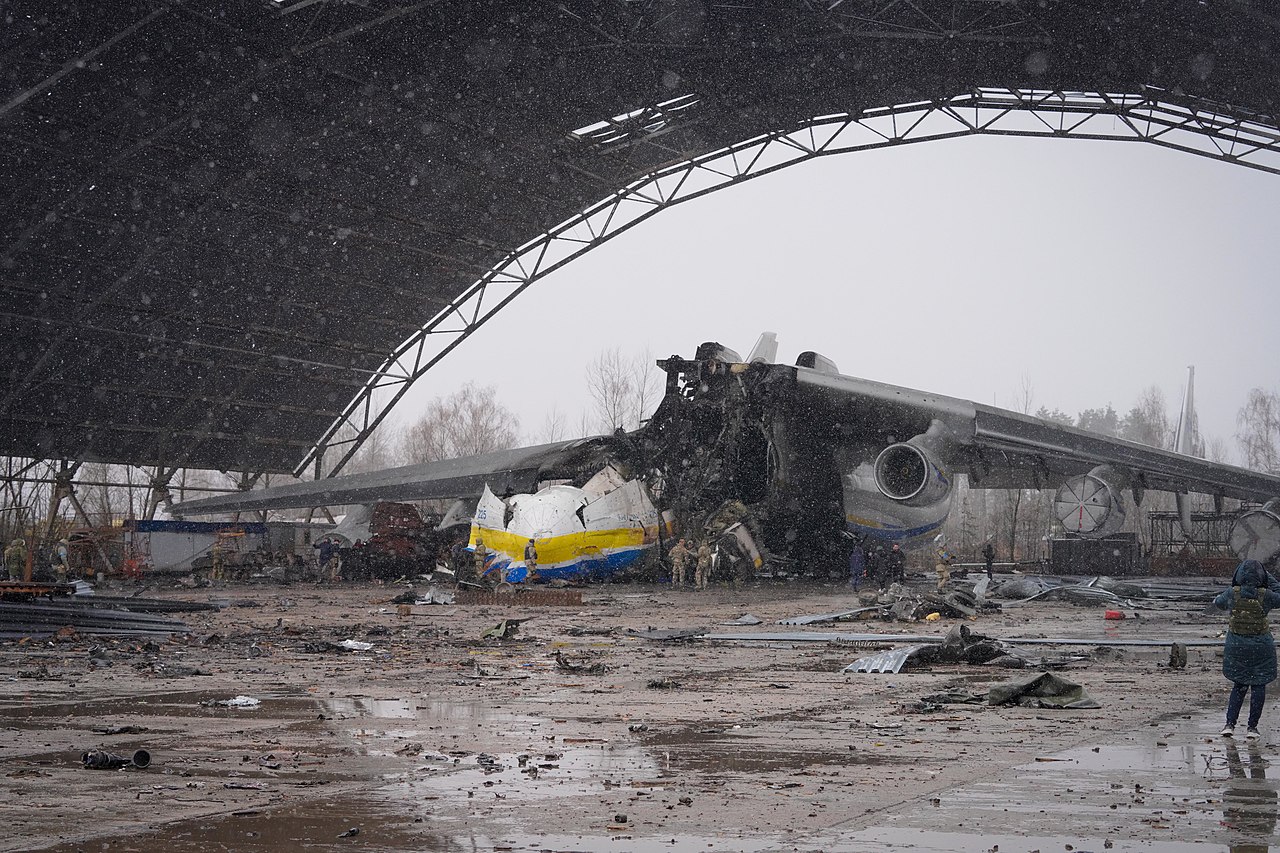 Photo 1. The An-225 in its hangar at Hostomel, 3 April 2022, days after Russian forces left the area — Photo: Oleksandr Ratushniak, CC BY-SA 4.0, via Wikimedia Commons
Strategic and operational context
RUSI describes a separate Russian line of effort for special forces and air assault troops: seizing airfields, power stations and other key sites while ground forces advanced on several axes [1]. Hostomel's 3.5 km runway could take the heaviest transports, so once held it could receive a large airborne force within hours, about 20–25 km from central Kyiv [2][4]. The mechanised forces meant to link up crossed from Belarus at about 0400–0500 and had to use the narrow Chornobyl–Ivankiv corridor [2][4].
Two conditions opened the helicopter route. Missile strikes destroyed two air-defence sites screening the Dnipro from the north, leaving a gap below radar cover [1]. And the garrison was thin: the National Guard's 4th Rapid Reaction Brigade had sent its main body east [2][8].
Areh reports US warnings in January that Hostomel was a target, and airport management kept the National Guard from fortifying it [4][8].
Terrain and weather in detail (OAKOC)
 Figure 1. Hostomel airfield in detail (sketch). Runway, aprons and places from OpenStreetMap [13]; unit positions and routes are estimates — Own work, after sources 1, 2, 4, 6, 7
Observation and fields of fire. OpenStreetMap gives runway 15/33 as 3,500 m by 50 m [13]. The ground is flat, at about 158 m [12]. Defenders on the edges could see the whole runway, and so could attack helicopters. Areh argues that the blocks of flats east of the cantonment would have made better firing positions [4].
Avenues of approach. The helicopters flew south low over the Kyiv Reservoir, then turned west at the Kyiv hydroelectric dam, about 20 km east of the airfield [2][4]. Wide water kept them out of reach of shoulder-fired missiles, but the dam was a predictable turning point and two helicopters were lost there [2][4]. On the ground the Russian column had one usable route, from Ivankiv through Demydiv and Ozera [2]. Ukrainian reinforcements came by helicopter from Zhytomyr and by road from Bila Tserkva [2][4].
Key terrain. The runway, because its usability was the point of the battle; the control tower and administration; the cantonment about 400 m east of the runway, nine large buildings with the town beginning to the south [4]; and the northern radar post.
Obstacles. Trucks parked on the runway before sunrise [2][4]. The VDV could not clear the burning wrecks, says the Swiss wargame study [5]. The perimeter wall later slowed the Ukrainian counterattack; spotters climbed it and dug under it to evacuate wounded [6].
Cover and concealment. Pine woods west and north were the VDV's only nearby refuge, and they withdrew into them that night [2][3]. Inside the perimeter only hangars and buildings gave cover (Photo 2).
Weather and light. ERA5 reanalysis shows low cloud at 83–100% from dawn to late afternoon and 4–5°C around the landing [12]; witnesses describe a cold, overcast day with light rain but good visibility [4]. Sunrise was at 06:54 and sunset at 17:31 [12]. The cloud fits the defenders' account of hearing rotors before seeing them [6]; the counterattack went in almost exactly at sunset (Figure 2).
Organisation and command relationships
Neither side published company-level dispositions.
| Side |
Echelon |
Unit / element |
Role and equipment |
Source |
| Ukraine |
Brigade (remnant) |
4th Rapid Reaction Bde, National Guard |
c. 200, mostly conscripts and rear-echelon troops |
[2] |
| Ukraine |
Platoon |
Northern radar post |
c. 20, ZU-23-2 |
[2][4] |
| Ukraine |
Platoon |
Composite air-defence missile platoon |
Igla, ZU-23-2 |
[8] |
| Ukraine |
Brigades (elements) |
80th, 95th Air Assault; 72nd Mech |
Counterattack and fire |
[2] |
| Ukraine |
Regiment |
3rd Special Purpose Regiment |
Counterattack |
[2] |
| Ukraine |
Detachment |
Air assault troops on three Mi-8 |
c. 48–50, arrived c. 2200 |
[4][6] |
| Ukraine |
Fires / air |
72nd Mech artillery incl. 2S3; Su-24M |
Runway shelled and bombed |
[2][4] |
| Russia |
Brigades (elements) |
31st Guards Air Assault; 45th Guards Spetsnaz |
Landing force, 200–300 |
[2] |
| Russia |
Air |
c. 34 helicopters (Mi-8, Ka-52, Mi-24/35) |
Two waves of 10 transports |
[1][2][4] |
| Russia |
Follow-on |
18 Il-76, c. 1,000 troops (or c. 15 aircraft) |
Turned back in the air |
[2][8] |
| Russia |
Ground |
Mechanised column via Ivankiv |
Reached the airfield 25 Feb |
[2][4] |
MWI names the 11th Guards Air Assault Brigade and the 76th Guards Air Assault Division instead [3].
Command mattered more than numbers. The Ukrainian units used different radios (Motorola and Harris in the National Guard, Harris only in special forces), no single headquarters ran the fight, and there was friendly fire after dark [4][7].
Hour-by-hour account
24 February, 0500–0900: alert and missiles
The base commander was woken at 0530; two groups manned positions, AA guns covered the radar and trucks went onto the runway [4]. Cruise missiles struck around 0600–0700 and missed the military targets [2][4]. Omega was recalled at about 0900 [7].
0930–1100: approach
The helicopters left Bolshoy Bokov in Belarus, about 170 km away, around 0930 [2][4]. Two were brought down near the Kyiv dam at about 1030 [2].
1100–1300: landing and withdrawal
Attack helicopters went north against the AA positions; transports went south [2]. An Igla brought down a Ka-52 on the runway [2]. After about an hour most defenders had no ammunition left and no stocks at their positions; they withdrew [4]. The roughly 20 at the radar post stayed and were captured [2][4]. Troop landings are dated between about 1100 and 1320; WOTR has the airfield secured at about 1300 [2][4][6].
1300–1700: Russian control, Ukrainian fire
At about 1530 Ukraine's president said the paratroopers were blocked [2]. By 1600 a CNN team saw VDV preparing blocking positions [2]. The Il-76 wave turned back that afternoon [2].
1700–2200: shelling and counterattack
From about 1700 artillery, including two 2S3 guns, shelled the runway and two Su-24s bombed it [4]. The ground counterattack went in at about 1730 [2]. By about 2200 the VDV had pulled back into the woods [2][3], and three Mi-8s brought about 50 air assault troops to stop any Il-76 landing [4][6].
Night of 24–25 February and 25 February
As the column approached, Ukrainian forces cratered the runway and began to pull back early on the 25th [2][4]. Russian armour arrived in the morning (WOTR) or around noon (Areh's witnesses) [2][4]. That day Ukraine's defence minister said the airfield was too damaged to use [2].
 Figure 2. Decision points, light and cloud. Weather: ERA5 reanalysis for the airfield [12]; decision times follow the training scenario; what-if phases dashed — Own work
Decision points in depth
The headings follow the training scenario; p3f, p5f and p7b are what-if phases.
p1 Helicopters low over the river (24 Feb, 1040)
Knew: about thirty mixed helicopters coming down the river (B2); transports might follow (B3); only small arms, Igla and AA guns. Options: stand to in prepared positions, concentrate in the cantonment, push MANPADS to the riverbank, or leave. Decision: positions were manned and the runway stayed blocked [2]. Otherwise: concentrating would have left the north end unwatched; at the riverbank the water protected the helicopters.
p2 Rotors over the runway (1100)
Knew: attack helicopters were hitting the AA positions; transports were landing in waves. Options: Igla on attack helicopters, everything on transports, hide, or rush the landing zone. Decision: they fired at both; the Ka-52 they hit came down on the runway [2]. Otherwise: hiding would have saved ammunition but let the VDV land undisturbed.
p3 Running out of ammunition (1245)
Knew: ammunition nearly gone; the north post cut off; no enemy tanks or artillery. Options: hold to the last round, break through to the north post, slip away by a side street, or hold and call for fire. Decision: the defenders left by a narrow street [2]. Otherwise: a breakout across open fields under helicopter fire was the costliest choice. Areh notes the withdrawing troops did not see the landing itself and calls this a tactical error [4].
p3f Trapped in the cantonment (1330, what-if)
Situation: the ring closes faster and a machine gun covers the street. Recommended: small groups slip out through thin parts of the ring to a rally point. In reality some soldiers did leave in small groups, helped by residents [4].
p4 The enemy holds the runway (1430)
Knew: the VDV were digging in on open ground without vehicles; counterattack forces were hours away. Options: bring artillery onto the airfield, raid it, observe, or block the roads into town. Decision: the airfield came under artillery and air attack [1][4]. Otherwise: a raid by a spent company had little chance; observation alone would have left the runway open to transports.
p5 Counterattack at dusk (1730)
Knew: strikes had just landed; enemy blocking positions were poorly sited; light was going. Options: go in at once, strike the hangars again, wait for full dark, or hold a cut-off line. Decision: the attack went in at sunset and the VDV were pushed into the woods [2]. Otherwise: Areh says the VDV had no night-vision devices [4], so darkness cut both ways; but the Ukrainian units had no common radios, and after dark came confusion and friendly fire [4].
p5f Stalled among the hangars (1900, what-if)
Situation: the attack stalls; units are mixed and frequencies differ. Recommended: sort out units, agree recognition signals, fire on the hangars, then attack again. In reality the attack succeeded by 2200, with friendly fire along the way [4][7].
p6 The runway retaken (2100)
Knew: a mechanised column was coming from Ivankiv; no transports had landed. Options: dig in, crater the runway and pull back, pursue into the woods, or patrol north first. Decision: the runway was cratered and the force pulled back [2][4]. Otherwise: holding open ground against armour risked losing the force and leaving the runway intact.
p7 A column on a broken runway (25 Feb, 0700)
Knew: the column was entering; the runway was cratered. Options: yield and observe, hold the south end, ambush the approaches, or shell again. Decision: the airfield was given up and the defence moved to the Irpin River [4]. Otherwise: holding the south end on flat ground was the least promising choice.
p7b A runway still usable (25 Feb, 0700, what-if)
Situation: the runway is intact as the column arrives. Recommended: pull back and crater it with artillery and air. In reality it was already cratered [2].
 Figure 3. Manoeuvre by phase (18-second loop; reduced motion shows only the final situation). Positions sketched and partly estimated — Own work
Doctrine re-read
The lodgment (JP 3-18, ch. I, para 1.a). A forcible entry seizes a lodgment that "makes the continuous landing of troops and materiel possible" [10]. Hostomel was taken but never did that, and Ukraine achieved this without holding the ground.
Control of the air (ch. I, para 3.b). The joint force must at least neutralise enemy air defences over the lodgment [10]. Russia opened a gap along the river [1] but not over the objective: MANPADS and AA guns stayed active and Ukrainian Su-24s still reached the runway [2][4].
Isolating the lodgment (ch. I, para 3.g). Indirect-fire systems that can range the lodgment are among the threats to neutralise [10]. Ukrainian artillery ranged Hostomel all afternoon; RUSI concludes that air assault against positions rather than axes is "extremely dangerous" [1].
Where and when to land (ATTP 3-18.12, ch. 2; ch. 4, paras 4-2, 4-3, 4-17). US doctrine favours landing on the objective only when intelligence is accurate, shaping has set conditions and the population is supportive [11]. None held. It also notes that simple air defences rely on visual tracking, so darkness protects helicopters [11]; the Russians came by day.
Abort criteria (paras 2-59 to 2-62). Commanders set conditions that, if unmet, stop the operation [11]. The Il-76 wave behaved as if one had been triggered. That was sound; the error was landing a light force that could not hold without it.
Friendly fire prevention (JP 3-18, ch. II, para 9). It relies on friendly force tracking, fire support coordination and liaison [10], none of which the converging Ukrainian units shared [4][7].
 Photo 2. A damaged hangar at Hostomel airport, 8 April 2022 — Photo: Kyiv City State Administration / Oleksii Samsonov, CC BY 4.0, via Wikimedia Commons
Source criticism
Defenders. WOTR gives about 200 [2]; the base commander told Global News about 120 [6]; Ukrinform, a few dozen regulars plus about 200 conscripts [8]; the Swiss wargame uses about 130 [5]. They probably count different groups.
Helicopter losses. RUSI confirms two downed by MANPADS in the first wave [1]. WOTR estimates six or seven in all [2]; MWI two Ka-52 and three Mi-8 [3]; the base commander about six plus two damaged [6]; a platoon commander six [8]; Areh, citing a wreckage analysis, one Mi-8, one Mi-28 and four Ka-52 [4]. RUSI's figure is a confirmed minimum; the rest rely on participants.
Landing time. 1100 (WOTR) [2], about 1200 (Areh) [4], 1320 on Russian video (Global News) [6]. Troops probably landed in waves over two hours.
The withdrawal. WOTR describes an orderly move down a street without fatalities [2]; Areh describes a collapse, with soldiers changing into civilian clothes [4]. Both may be true of different groups.
Who blocked the runway. WOTR and Areh credit the soldiers [2][4]; a Kyiv Independent opinion column credits Antonov staff [9]. The first two rest on interviews with participants.
The counterattack. WOTR lists brigades and special forces [2]; MWI credits the defending brigade [3]; Ukrinform mentions no counterattack [8]; the Swiss study argues it mainly prolonged the disruption [5]. WOTR's list probably includes units that arrived over the night and next day.
The Il-76 wave. WOTR: 18 aircraft from Pskov [2]; Ukrinform: about fifteen from Tula, diverted to Mazyr [8]. The reason is not documented.
Lessons
- Deny the use of ground you cannot hold. Denial reached the operational aim after the airfield was lost.
- Keep ammunition where the fight is. The defenders broke contact because stocks were not at their positions [4].
- Keep watching while you withdraw. A unit breaking contact still owes higher a report on what it saw.
- Agree radios and recognition signals before mixed units meet. The night problems came from that [4][7].
- Keep fire and manoeuvre close together. The sunset assault followed the strikes directly.
Unresolved questions
- The exact strength of the defenders and of the counterattack force.
- Total helicopter losses by type.
- Why, and from where, the Il-76 wave turned back.
- When and how the runway was cratered.
- When the last Ukrainian units left: evening of the 25th [4] or of the 26th [7].
Further reading and viewing
▶Footage of Russian helicopters being hit over the Dnipro near Kyiv on 24 February 2022Video: Russian helicopters reportedly brought down over the Dnipro, 24 February 2022 (short; shows aircraft being hit) · Bloomberg Television, 2022
 Photo 3. Rocket remains in concrete at Hostomel, 8 April 2022; who fired it, and when, is not recorded — Photo: Kyiv City State Administration / Oleksii Samsonov, CC BY 4.0, via Wikimedia Commons
- Areh [4] gives the most detailed eyewitness account; the Swiss wargame [5] tests the alternatives.
- Command the defenders yourself in the training scenario "Hostomel Airport".
Sources
- Mykhaylo Zabrodskyi, Jack Watling, Oleksandr V. Danylyuk and Nick Reynolds, Preliminary Lessons in Conventional Warfighting from Russia's Invasion of Ukraine: February–July 2022, RUSI Special Report, 2022-11-30, pp. 8, 25–26. https://static.rusi.org/359-SR-Ukraine-Preliminary-Lessons-Feb-July-2022-web-final.pdf (accessed 2026-10-13)
- Liam Collins, Michael Kofman and John Spencer, "The Battle of Hostomel Airport: A Key Moment in Russia's Defeat in Kyiv", War on the Rocks, 2023-08-10. https://warontherocks.com/the-battle-of-hostomel-airport-a-key-moment-in-russias-defeat-in-kyiv/ (accessed 2026-10-13)
- Jeremy Kofsky, "An Airfield Too Far: Failures at Market Garden and Antonov Airfield", Modern War Institute at West Point, 2022-05-05. https://mwi.westpoint.edu/an-airfield-too-far-failures-at-market-garden-and-antonov-airfield/ (accessed 2026-10-13)
- Valentin Areh, "On the Front Lines of Kyiv: Tactical Insights from the Battle for Hostomel Airport", Contemporary Military Challenges 28(1), 2026-03, pp. 101–120, doi:10.2478/cmc-2026-0007. https://reference-global.com/article/10.2478/cmc-2026-0007 (accessed 2026-10-13)
- Nicolas Penseyres, "HOSTOMEL, Was it Really Lost in Advance? A Study of Combat Through the Use of a Manual Tactical Wargame", Stratos digital #107, Swiss Armed Forces, 2025-04-24. https://www.vtg.admin.ch/dam/de/sd-web/WfgDeMJM2yLE/stratos_digital_107_Penseyres_HOSTOMEL_def2.pdf (accessed 2026-10-13)
- Ashleigh Stewart, "The battle of Hostomel: How Ukraine's unlikely victory changed the course of the war", Global News, 2023-02-18. https://globalnews.ca/news/9491396/ukraine-hostomel-battle-antonov-airport/ (accessed 2026-10-13)
- Oleksandr Yan, "Defending Kyiv Region: Interview with Omega Special Unit Operator", Militarnyi, 2023-06-10. https://militarnyi.com/en/articles/defending-kyiv-region-interview-with-omega-special-unit-operator/ (accessed 2026-10-13)
- Ivan Stupak, "Hostomel: 3,502 meters that broke the 'Kyiv in three days' plan", Ukrinform, 2026-02-27. https://www.ukrinform.net/rubric-ato/4096065-hostomel-3502-meters-that-broke-the-kyiv-in-three-days-plan.html (accessed 2026-10-13)
- Tim Mak, "The Counteroffensive: Russia's failure to take Kyiv was luck and timing" (opinion), Kyiv Independent, 2024-02-27. https://kyivindependent.com/opinion-russias-failure-to-take-kyiv-was-pure-luck/ (accessed 2026-10-13)
- Joint Chiefs of Staff, JP 3-18 Joint Forcible Entry Operations, 2012-11-27 (ch. I paras 1.a, 3.b, 3.g; ch. II para 9). https://edocs.nps.edu/2012/December/joint%20pub%203_18.pdf (accessed 2026-10-13)
- Headquarters, Department of the Army, ATTP 3-18.12 Air Assault Operations, 2011-03-01 (ch. 2 planning considerations and paras 2-59 to 2-62; ch. 4 paras 4-2, 4-3, 4-17). https://irp.fas.org/doddir/army/attp3-18-12.pdf (accessed 2026-10-13)
- Open-Meteo, Historical Weather API (ERA5 reanalysis), airfield grid cell, hourly low cloud cover and temperature, sunrise and sunset, 24–25 Feb 2022 (times in UTC; local = UTC+2). https://archive-api.open-meteo.com/v1/archive?latitude=50.60&longitude=30.19&start_date=2022-02-24&end_date=2022-02-25&hourly=temperature_2m,cloud_cover_low,cloud_cover&daily=sunrise,sunset&timezone=UTC (accessed 2026-10-13)
- OpenStreetMap Nominatim and Overpass API, Antonov International Airport and runway 15/33 geometry. https://nominatim.openstreetmap.org/search?q=Hostomel+Airport&format=json&limit=3 (accessed 2026-10-13)
- Wikimedia Commons, File:An-225 Mriya after Russian invasion of Ukraine.jpg (Oleksandr Ratushniak, CC BY-SA 4.0). https://commons.wikimedia.org/wiki/File:An-225_Mriya_after_Russian_invasion_of_Ukraine.jpg (accessed 2026-10-13)
- Wikimedia Commons, File:Hostomel after the battle (962438).jpg (Kyiv City State Administration, CC BY 4.0). https://commons.wikimedia.org/wiki/File:Hostomel_after_the_battle_(962438).jpg (accessed 2026-10-13)
- Wikimedia Commons, File:Hostomel after the battle (962456).jpg (Kyiv City State Administration, CC BY 4.0). https://commons.wikimedia.org/wiki/File:Hostomel_after_the_battle_(962456).jpg (accessed 2026-10-13)