Battle Analysis
In depth | Kharkiv Counteroffensive — how far can an exploitation run on one road?
· 2022-09-06 – 2022-09-16
Overview
Part 1: The Kharkiv Counteroffensive (September 2022) told the story of the breakthrough; this piece looks at the mechanics of the exploitation. Just after 03:30 on 6 September 2022 Ukrainian columns went through a thin Russian line at Verbivka, and within four days the Kupiansk rail and road hub was partly in Ukrainian hands and the Izium grouping was leaving [2][4]. The question here is how far a brigade can run on one paved road before fuel, rivers and rain stop it. Below, terrain and weather are re-read through data and the scenario's phases p1–p7 and what-if phases x2, x4 and x7 are taken in turn.
 Photo 1. A Ukrainian MT-LB with a VMK turret, probably captured earlier, during the Kharkiv breakthrough, 9 September 2022 (still from a General Staff video) — General Staff of the Armed Forces of Ukraine (mil.gov.ua), CC BY 4.0, via Wikimedia Commons
Strategic and operational context
By summer 2022 Russia's invasion force was too small to hold the whole front with sufficient density, and the Kherson operation drew Russian reserves south [1]. Russia saw the build-up on the Kharkiv axis but had nothing left to answer it with; Ukraine achieved surprise in timing, not intention [1]. A New York Times report, as summarised by Babel, said Ukraine shared its plans with Washington and received information on Russian command posts and depots [14].
The Washington Post's reconstruction from more than 35 interviews says the Ground Forces commander proposed a deep, fast strike between Izium and Balakliia, rehearsed on a 3D-printed terrain model, and that the Izium grouping, about 18,000 troops at its peak, had been at least halved by August [4]. Izium's supply ran through Kupiansk [3]; cutting it would threaten the salient without a frontal fight.
Terrain and weather in detail (OAKOC)
 Figure 1. The Kharkiv exploitation in detail (sketch; unit positions and axis assignments estimated; to 23 September 2022 only). Places from OSM and Open-Meteo geocoding [22], elevations from Open-Meteo [21] — Own work, after sources 2–4, 6–11
Observation. Elevation data put Verbivka at about 86–98 m and Balakliia at 101 m, while Shevchenkove sits on a watershed plateau at about 173 m; Kupiansk lies at 79–92 m and the Oskil near Senkove at about 78 m [21]. From the plateau the ground falls some 90 m to the river over open farmland. On 6 September the sun rose at 05:53 [20]; the attack began more than two hours earlier, in darkness [4].
Avenues of approach. The P07 was the only good east–west road. Straight-line distances are 17 km from Verbivka to Volokhiv Yar, 18 km on to Shevchenkove and 32 km to Kupiansk, 62 km in all [22], against the 75 km by road that Jamestown reports for the first three days [2]. From Shevchenkove secondary roads run 40 km to Senkove and 43 km to Velykyi Burluk [22].
Key terrain. Volokhiv Yar was a junction from which two highways into Izium and Balakliia could be blocked [4]; Shevchenkove was the fork; Kupiansk combined the rail hub, the P07 and the bridges over the Oskil.
Obstacles. The Siverskyi Donets covered the southern flank. To the east the Oskil and its reservoir run north–south from Kupiansk to Izium; a Ukrainian analyst noted that the reservoir shielded the Ukrainian flank but also limited Ukraine's own options [13]. The road bridge at Kupiansk was down by late September (Photo 3).
Cover and concealment. Woods lie mainly along the Donets; elsewhere tree lines are the only cover. ERA5 gives no rain from 6 to 11 September and lows of 5–10°C, then about 41 mm between 12 and 16 September [20]. Dry ground favoured movement off the road in the first week; the rain coincided with the halt at the river (Figure 2). That link is an inference, not a reported cause.
Organisation and command relationships
Neither side has published which brigade took which axis; "est." marks estimates.
| Side |
Echelon |
Unit / element |
Role and equipment |
Source |
| Ukraine |
Direction |
Ground Forces commander |
Proposed the deep strike |
[4] |
| Ukraine |
Brigades |
14th, 92nd Mech; 25th, 80th Air Assault; 3rd and 4th brigades |
Balakliia sector; axis assignments unknown |
[3] |
| Ukraine |
Brigade |
Possibly 10th Mountain Assault |
Balakliia sector (unconfirmed) |
[3] |
| Ukraine |
Company |
One 25th Air Assault company, about 100 soldiers |
Columns of three IFVs; Volokhiv Yar day 1, later Izium |
[4] |
| Ukraine |
Battalion |
214th Separate Rifle Battalion |
Balakliia sector |
[3] |
| Ukraine |
Follow-on |
112th and 113th Territorial Defence Brigades |
Bypassed strongpoints, rear security (est.) |
[3] |
| Ukraine |
Raid groups |
Military intelligence and SBU units |
Part of the exploitation echelon (claim) |
[13] |
| Ukraine |
Fires |
M270; at least eight M777 per attacking brigade |
Hours of fire before 03:30; c. 32,500 rounds in five days |
[4] |
| Russia |
Front line |
DNR/LNR units (LWJ) or SOBR, Rosgvardia (Jamestown) |
Single thin line |
[2][3] |
| Russia |
Second line |
Two Rosgvardia units |
Poor coordination with artillery |
[3] |
| Russia |
Fires |
288th Artillery Brigade, 1st Guards Tank Army |
Supported Balakliia sector |
[3] |
| Russia |
Manoeuvre |
Elements of 144th and 18th Motor Rifle Divisions, 26th Tank Regiment |
Understrength after spring fighting |
[3] |
| Russia |
Grouping |
Izium grouping |
c. 18,000 at peak, halved by August |
[4] |
| Russia |
Reserves |
Elements of 90th Guards Tank Division, possibly 3rd Army Corps |
Arrived too late |
[3] |
The decisive asymmetry was depth: probably one Russian defensive line [13] against a Ukrainian breakthrough group, exploitation echelon and follow-on brigades [2].
Day-by-day account
6 September, 03:30 to evening: breach
M270 launchers had fired on Russian positions for hours. Just after 03:30 a 25th Air Assault company went forward in columns of three infantry fighting vehicles [4]. The company met little resistance and by evening was at Volokhiv Yar, about 18 km in [4]. Russian Telegram channels reported the attacks near Balakliia that day [16]. Ukraine's General Staff reported Russian airstrikes in the area on the 6th but none afterwards [3].
7–8 September: east on the P07
The exploitation echelon bypassed settlements and kept to the roads [2][13]. On the 8th a Ukrainian spokesman claimed a 50 km advance and 20 settlements, the president about 1,000 km², and Ukrainian forces claimed Shevchenkove [5]. The Kharkiv governor said the flag had been raised in Balakliia [6]; Jamestown has the town fully secured that day [2].
9 September: Kupiansk in reach
Forward units reached Kupiansk while separate formations moved south-east to the Oskil crossings at Senkove and Horokhovatka [2]. ISW judged Kupiansk likely to fall within days; Russia's MoD released video of armour moving toward Kharkiv [5].
10 September: the hub falls, Izium empties
The UK Ministry of Defence claimed a 50 km advance, probable surprise and an increasingly isolated force at Izium [8]. Part of Kupiansk was taken [3], and Russia's MoD announced a "regrouping" of forces from the Balakliia and Izium areas toward Donetsk [6]. Reuters called the loss of Izium Moscow's worst defeat since Kyiv [7]. Territorial defence troops were photographed in Shevchenkove that day (Photo 2).
 Photo 2. Territorial Defence Forces soldiers at the repainted entrance sign of Shevchenkove, 10 September 2022. Follow-on brigades like these took over the ground the lead bypassed — Territorial Defence Forces of Ukraine (mil.gov.ua), CC BY 4.0, via Wikimedia Commons
11–12 September: to the border
The 25th's company entered central Izium without losses and found working tanks, guns, fuel tankers and ammunition [4]; verified videos showed abandoned equipment roughly a tank company in size [12]. Other formations reached Velykyi Burluk and Vovchansk near the border by the 12th [2]. Rain began that day [20].
13–16 September: Kupiansk whole
ISW assessed the whole of Kupiansk, including the eastern districts, under Ukrainian control by the 16th; a Ukrainian official said both banks within the city were taken [11].
17–23 September: across the Oskil
On the 18th the Luhansk governor said Ukrainian forces had crossed the Oskil; UK intelligence described a Russian line between the east bank and Svatove [10]. On the 23rd the UK MoD claimed bridgeheads had been secured on the east bank over the previous three days and that Russia was trying to make the river a defensive line [9]. In early October armour crossed on two pontoon bridges under artillery threat [15].
Decision points in depth
The headings follow the training scenario; x2, x4 and x7 are what-if phases reached on a failed choice (Figure 2).
 Figure 2. Decision points and weather. Weather: ERA5 reanalysis for a grid cell near Shevchenkove [20]; phases and choices follow the training scenario — Own work
p1 Behind the start line (6 Sep, 03:30)
Knew: the line ahead was thin and largely Rosgvardia (B2); a rumour of armoured reserves (F6). Options: pass through at once, wait for an orderly breach, join the assault, or reconnoitre a second lane. Decision: columns followed hours of rocket fire into the breach before dawn [4]. Otherwise: RUSI ties success to surprise in timing [1]; waiting spends exactly that. Joining the assault breaks FM 3-90's rule that the units creating the conditions should not be expected to exploit in depth [17].
x2 Column stuck in the breach (7 Sep, afternoon, what-if)
Situation: queued vehicles, shelling from Balakliia, fuel short. Recommended: keep the lead moving, push traffic control forward and let the follow-on brigade fix Balakliia. In reality no such stall is reported [2].
p2 The breach is open (7 Sep, morning)
Knew: P07 east was empty; a garrison remained in Balakliia; the territorial defence brigade was following. Options: clear Balakliia first, bypass, halt for fuel, or widen the shoulders. Decision: bypass; the exploitation echelon kept to the roads and Balakliia was secured on the 8th [2][6]. Otherwise: clearing the town hands Russia a day to move reserves. Bypassing works only with a follow-and-support unit to take over [17], the role of the 112th and 113th (est.) [3].
p3 The fork at Shevchenkove (8 Sep, noon)
Knew: fuel tight; the Izium grouping to the south. Options: main effort on Kupiansk with one task force to Senkove, turn on Izium, everything to Kupiansk, or halt a day. Decision: Kupiansk plus the crossings at Senkove and Horokhovatka [2]. Otherwise: turning south meets the strongest Russian force head-on; even halved it outnumbered a brigade [4]. FM 3-90 wants exploitation "on at least two axes" [17].
p4 Short of Kupiansk (9 Sep)
Knew: some 75 km covered [2]; a long single corridor; reserves reportedly moving [5]. Options: halt, clear block by block, seize the west bank and river line with flank risk accepted, or swing north. Decision: the west bank was taken on the 10th [3]. Otherwise: a halt would have given time to reserves that, as it was, arrived too late [3].
x4 The corridor wobbles (night 9–10 Sep, what-if)
Situation: small groups firing on the road, reserves of unclear size, fuel trucks lost. Recommended: keep pressure on Kupiansk and hand the corridor to adjacent and follow-on brigades. In reality no counterattack seriously threatened the flank [3].
p5 The Izium grouping breaks (10 Sep)
Knew: Russia announced a "regrouping"; troops were hurrying to crossings. Options: pursue to the Oskil, block the crossings south, consolidate, or shell the columns. Decision: pursuit along the west bank; Izium was abandoned with much equipment [7][12]. Otherwise: blocking the crossings is a combination pursuit, needing an encircling force as mobile as the enemy and strong enough to hold [17]. LWJ thinks the reserves may have helped Izium's troops escape [3].
p6 The Oskil (12–13 Sep)
Knew: a supply line over 70 km; vehicles needing repair; Russian guns settling east of the river; rain from the 12th [20]. Options: assault crossing in Kupiansk, small bridgeheads while the main body refits, defend, or clear north. Decision: crossings at several points; dates range from the 13th to about the 22nd (section 8). Otherwise: FM 3-90 lists friendly losses and enemy reserves as reasons for culmination [17]; an assault into Kupiansk across a broken bridge (Photo 3) would have met both.
p7 The east bank (16 Sep)
Knew: some Russians held eastern Kupiansk; the bridgeheads saw their flank. Options: clear from the south then secure, push on to Svatove, or cordon and hand over. Decision: eastern Kupiansk was assessed taken on the 16th [11]. Otherwise: a push to Svatove with a tired brigade invites the culmination FM 3-90 warns of [17].
x7 Bridgeheads under fire (14–15 Sep, what-if)
Situation: small groups pinned, engineers not yet forward. Recommended: concentrate on the strongest bridgehead and bring the engineers there. In reality bridgeheads were reported secured by 23 September [9], and pontoon crossings ran under artillery threat into October [15].
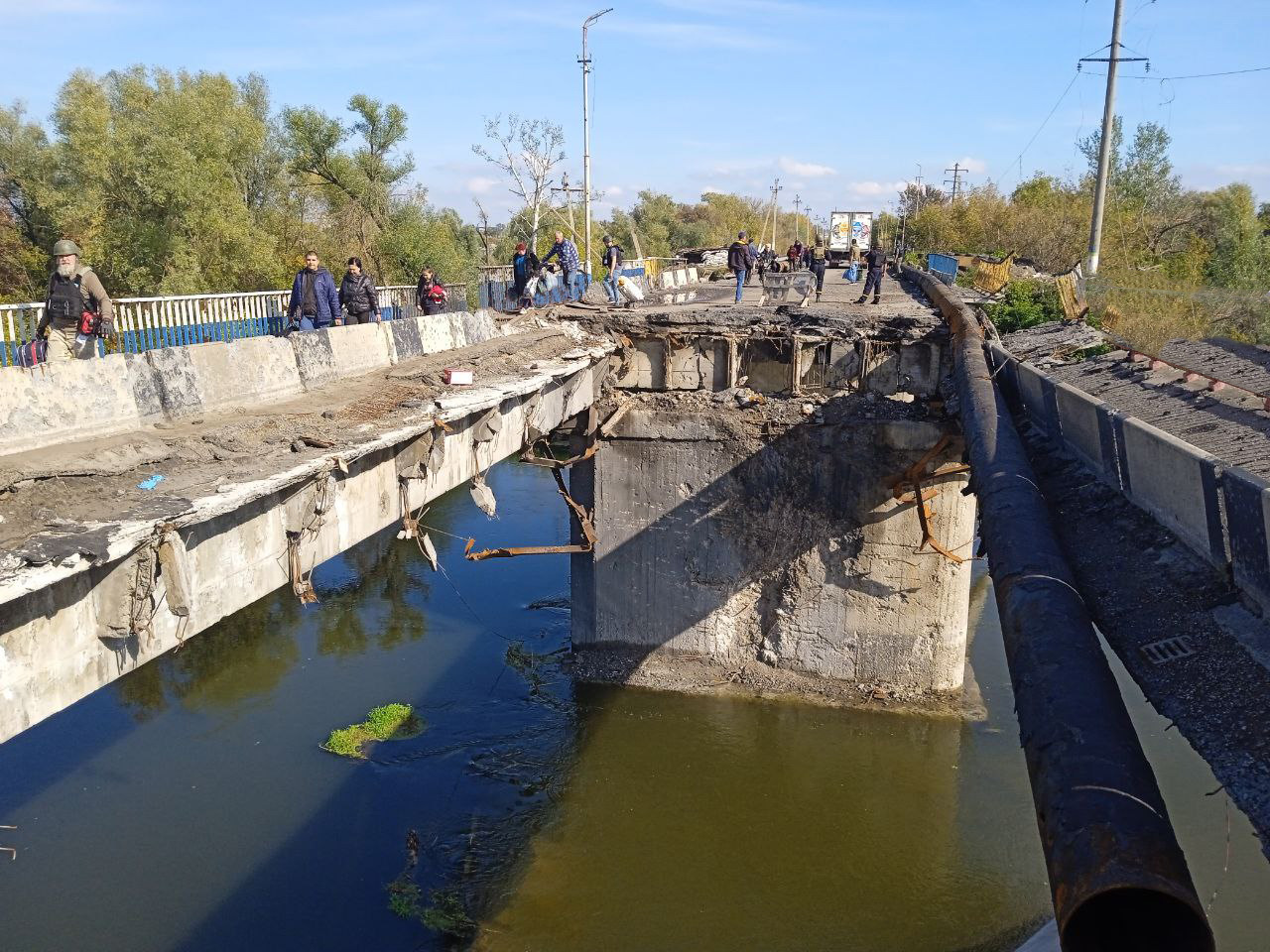 Photo 3. The P07 road bridge over the Oskil in Kupiansk, 29 September 2022. Emergency workers carried aid across on foot — State Emergency Service of Ukraine (dsns.gov.ua), CC BY 4.0, via Wikimedia Commons
Doctrine re-read
Who exploits (FM 3-90, ch. 6, paras 6-4, 6-5, 6-37, 6-38). Brigades and larger units normally exploit with forces other than those that made the breach, passed "around, over, or through" them; follow-and-support units relieve the exploiting force of tasks that would slow it [17]. Ukraine's breakthrough group, exploitation echelon and territorial defence brigades map onto this closely [2][3].
Control and bypass (paras 4-21, 6-14, 6-20). Exploitation uses few control measures; commanders state bypass criteria and subordinates follow the intent "even if they lose communications" [17]. Bypassing settlements along main roads [2] implies broad criteria, though none are published.
Sustainment (paras 6-26 to 6-29). Planners focus on fuel and maintenance and keep the supply route flexible [17]; the single P07 corridor is what x2 and x4 probe.
Pursuit and culmination (para 6-50; ch. 7, paras 7-1, 7-3, 7-4, 7-6). An exploitation ends either in culmination or in pursuit. Pursuit needs a deliberate decision and has two forms, frontal and combination; the combination is generally more effective [17]. After 10 September Ukraine applied direct pressure to the Oskil, but no encircling force closed the crossings. Russian doctrine was not consulted; Jamestown's comparison with Second World War echelonment [2] stands in.
 Figure 3. Manoeuvre by phase (18-second loop; reduced motion shows only the final situation). Positions sketched and partly estimated — Own work
Source criticism
Who held the line. Jamestown names Rosgvardia SOBR units [2]; LWJ puts DNR/LNR troops in front and Rosgvardia behind [3]. LWJ is later and more specific; both agree the line was thin.
Force ratio. The "eight to one" figure comes from the Russian-installed head of the Kharkiv region [3], a party with reason to excuse defeat. The Post's figures come from interviews [4]. Neither counts the Balakliia sector.
Dates. Senkove: the scenario puts the river there on the 8th; Jamestown has the crossings taken on the 9th [2]. Oskil crossings: about the 13th (Part 1 and the scenario, from a Wikipedia cross-check), the 17th per Ukrainian communications reported on the 18th [10], or within the three days before 23 September per the UK MoD [9]. The UK date is an outside assessment and the latest; small crossings may have come earlier.
Equipment. LWJ cites Oryx's count of more than 580 visually confirmed Russian equipment losses for 7–13 September [3]; one verified Izium video shows about a tank company's worth [12]. The first is a floor, the second a single scene; neither separates abandoned from destroyed.
Area. About 1,000 km² (Ukrainian claim, 8 Sep) [5], 2,500 km² (ISW, by the 9th–10th) [6], more than 6,000 km² (Jamestown, by about 12 Sep) [2] and almost 11,500 km² with nearly 500 settlements for the whole autumn operation (Ukrainian study) [18]. They measure different periods.
Causes. RUSI warns that later planners mistook a collapse caused by too few troops for one caused by morale [1]; the Ukrainian interview stresses concentration and deception [13]; the Post adds US targeting intelligence and an ammunition gamble [4]. These fit together; morale alone does not.
Lessons
- Keep the exploitation force out of the breach fight. Its value is the strength it still has when the gap opens.
- Bypassing works only with someone to hand off to. Name the follow-on unit and the hand-off point before the attack.
- Plan sustainment to the limit of advance. On one road, fuel trucks and maintenance decide the depth, not the enemy.
- Hit what the strong force needs, not the force. Kupiansk emptied Izium.
- Watch for culmination. A river, rain and a week of movement are reasons to switch from pursuit to bridgeheads and refit.
Unresolved questions
- Which brigades formed the breakthrough and exploitation echelons, and who took Kupiansk.
- The exact dates of the Senkove and Oskil crossings and how many Oskil bridges were destroyed.
- How much of the Izium grouping escaped and by which crossings.
- Fuel and maintenance figures for the exploiting units.
- Personnel losses on both sides; ISW's original pages returned 403 and were read through other outlets [5][6][11].
Further reading and viewing
▶Ukrainian soldiers describe their part in the Kharkiv counteroffensiveVideo: The Inside Story Of Ukraine's Kharkiv Counteroffensive (about 3 min) · Radio Free Europe/Radio Liberty, 2022
- RFE/RL's page for the video [19]; the Washington Post reconstruction [4]; US Army FM 3-90 Tactics (2023), chapters 6 and 7 [17].
- Command the exploitation brigade yourself in the training scenario "Kharkiv Counteroffensive".
Sources
- Jack Watling, Oleksandr V Danylyuk and Nick Reynolds, Preliminary Lessons from Ukraine's Offensive Operations, 2022–23, RUSI, 2024-07 (pp. 9, 10, 28, 30, 33). https://static.rusi.org/lessons-learned-ukraine-offensive-2022-23.pdf (accessed 2026-10-13)
- Mykola Bielieskov, "Ukrainian Balakliya-Kupyansk Offensive: Sequence of Events, Mechanics and Consequences", Eurasia Daily Monitor 19/133, Jamestown Foundation, 2022-09-13. https://jamestown.org/ukrainian-balakliya-kupyansk-offensive-sequence-of-events-mechanics-and-consequences/ (accessed 2026-10-13)
- John Hardie, "Ukraine's Counteroffensives in Kharkiv and Kherson and the Road Ahead", FDD's Long War Journal, 2022-09-16. https://www.longwarjournal.org/archives/2022/09/ukraines-counteroffensives-in-kharkiv-and-kherson-and-the-road-ahead.php (accessed 2026-10-13)
- Isabelle Khurshudyan, Paul Sonne, Serhiy Morgunov and Kamila Hrabchuk, reconstruction of the Kharkiv and Kherson counteroffensives from more than 35 interviews, The Washington Post (via Stars and Stripes), 2022-12-29. https://www.stripes.com/theaters/europe/2022-12-29/inside-ukrainian-counteroffensive-war-8577177.html (accessed 2026-10-13)
- Marc Champion, "Ukraine army's breakthrough in north threatens Russian grip", Bloomberg (via Stars and Stripes), 2022-09-09. https://www.stripes.com/theaters/europe/2022-09-09/ukraine-army-breakthrough-threatens-russian-grip-7269640.html (accessed 2026-10-13)
- Associated Press (via MPR News), "Russia announces troop pullback from Ukraine's Kharkiv area", 2022-09-10. https://www.mprnews.org/story/2022/09/10/russia-announces-troop-pullback-from-ukraines-kharkiv-area (accessed 2026-10-13)
- Max Hunder and Vitalii Hnidyi, "Russia gives up key towns as Ukrainian forces advance", Reuters (via The Jakarta Post), 2022-09-11. https://www.thejakartapost.com/paper/2022/09/11/russia-gives-up-key-towns-as-ukrainian-forces-advance (accessed 2026-10-13)
- European Pravda (via Ukrainska Pravda), report of the UK MoD intelligence update of 10 September: troops likely surprised, Izium isolated, 2022-09-10. https://www.pravda.com.ua/eng/news/2022/09/10/7366875/ (accessed 2026-10-13)
- ANSA, report of the UK MoD intelligence update of 23 September: Oskil bridgeheads, 2022-09-23. https://www.ansa.it/nuova_europa/en/news/countries/ukraine/2022/09/23/ukraine-putting-pressure-on-essential-territory-for-russia_7edbd36b-63c4-4f41-b2f3-94f409a193a8.html (accessed 2026-10-13)
- The Kyiv Independent, "Governor: Ukrainian forces cross Oskil River", 2022-09-18. https://kyivindependent.com/governor-ukrainian-forces-cross-oskil-river (accessed 2026-10-13)
- Novaya Gazeta Europe, "ISW: Ukraine captures all of Kupiansk", 2022-09-17. https://novayagazeta.eu/en/articles/2022/09/17/isw-ukraine-captures-all-of-kupiansk-news (accessed 2026-10-13)
- Samuel Oakford and Alex Horton, verified videos of Russian equipment left at Izium, The Washington Post (via Stars and Stripes), 2022-09-14. https://stripes.com/theaters/europe/2022-09-14/russia-surrender-izyum-tanks-7329753.html (accessed 2026-10-13)
- Alya Shandra, "Ukraine's counteroffensive near Kharkiv: what enabled the Balakliia blitzkrieg" (interview with a National Institute for Strategic Studies researcher), Euromaidan Press, 2022-09-11. https://euromaidanpress.com/2022/09/11/ukraines-counteroffensive-near-kharkiv-what-made-the-blitzkrieg-possible/ (accessed 2026-10-13)
- Babel, summary of a New York Times report on plan sharing and intelligence before the counteroffensive, 2022-09-11. https://babel.ua/en/news/84093-nyt-ukrainian-military-shared-counteroffensive-plans-with-us-intelligence-to-gain-more-support (accessed 2026-10-13)
- Scott Peterson, "When war came it was time to go. Stories on the Kupiansk bridge", The Christian Science Monitor, 2022-10-03. https://www.csmonitor.com/World/Europe/2022/1003/When-war-came-it-was-time-to-go.-Stories-on-the-Kupiansk-bridge (accessed 2026-10-13)
- Howard Altman, "Ukraine Situation Report: Kharkiv Counter-Offensive May Have Begun", The War Zone, 2022-09-06. https://www.twz.com/ukraine-situation-report-kharkiv-counter-offensive-may-have-begun (accessed 2026-10-13)
- Headquarters, Department of the Army, FM 3-90 Tactics, 2023-05-01 (ch. 4 para 4-21; ch. 6 paras 6-1, 6-4, 6-5, 6-14, 6-20, 6-23, 6-26 to 6-29, 6-37, 6-38, 6-50; ch. 7 paras 7-1 to 7-4, 7-6 to 7-9). https://armypubs.army.mil/epubs/DR_pubs/DR_a/ARN38160-FM_3-90-000-WEB-1.pdf (accessed 2026-10-13)
- Central Research Institute of the Armed Forces of Ukraine, Kharkiv Offensive Operation 2022, Berlin Story Verlag (publisher's page). https://www.berlinstory-verlag.de/kharkiv-offensive-operation-2022/ (accessed 2026-10-13)
- Radio Free Europe/Radio Liberty, "The Inside Story Of Ukraine's Kharkiv Counteroffensive" (video page), 2022-09-21. https://www.rferl.org/a/ukraine-izyum-war-russia-counteroffensive-/32044921.html (accessed 2026-10-13)
- Open-Meteo, Historical Weather API (ERA5 reanalysis), grid cell near Shevchenkove, daily temperature, precipitation, sunrise and sunset, 6–23 September 2022. https://archive-api.open-meteo.com/v1/archive?latitude=49.60&longitude=37.20&start_date=2022-09-06&end_date=2022-09-23&daily=temperature_2m_max,temperature_2m_min,precipitation_sum,sunrise,sunset&timezone=Europe%2FKyiv (accessed 2026-10-13)
- Open-Meteo, Elevation API, elevations for Balakliia, Verbivka, Volokhiv Yar, Shevchenkove, Kupiansk, Senkove and Izium. https://api.open-meteo.com/v1/elevation?latitude=49.452,49.487,49.601,49.695,49.710,49.525,49.207,49.190,49.71,49.80&longitude=36.840,36.830,36.978,37.176,37.616,37.673,37.277,37.300,37.70,37.40 (accessed 2026-10-13)
- OpenStreetMap Nominatim and Open-Meteo Geocoding API, place searches for Verbivka, Balakliia, Volokhiv Yar, Shevchenkove, Kupiansk, Senkove, Horokhovatka, Borova, Izium and Velykyi Burluk. https://nominatim.openstreetmap.org/search?q=Kupiansk&format=json&limit=1&countrycodes=ua , https://geocoding-api.open-meteo.com/v1/search?name=Senkove&count=10&language=en&format=json (accessed 2026-10-13)
- Wikimedia Commons, File:Ukrainian MT-LBVMK in Kharkiv region breakthrough.png (General Staff of the Armed Forces of Ukraine, CC BY 4.0). https://commons.wikimedia.org/wiki/File:Ukrainian_MT-LBVMK_in_Kharkiv_region_breakthrough.png (accessed 2026-10-13)
- Wikimedia Commons, File:UA TDF in liberated Shevchenkove.jpg (Territorial Defence Forces of Ukraine, CC BY 4.0). https://commons.wikimedia.org/wiki/File:UA_TDF_in_liberated_Shevchenkove.jpg (accessed 2026-10-13)
- Wikimedia Commons, File:Bridge in Kupiansk after the battle, 2022-09-29 (01).jpg (State Emergency Service of Ukraine, CC BY 4.0). https://commons.wikimedia.org/wiki/File:Bridge_in_Kupiansk_after_the_battle,_2022-09-29_(01).jpg (accessed 2026-10-13)