Battle Analysis
In depth | Mogadishu — why did a relief force need eight hours to cover three kilometres?
· 1993-10-03 – 1993-10-04
Overview
Part 1: Mogadishu (October 1993) told the story of the relief column; this piece looks inside its decisions. The New Port, where the combined column formed, lies about 2.8 km in a straight line from the Olympic Hotel [13], yet the first relief set out at 1747 on 3 October and the linkup at crash site 1 came only at 0155 on 4 October [1][2]. Below, the night is rebuilt hour by hour, the scenario's phases are taken in turn, and the official accounts are tested against each other.
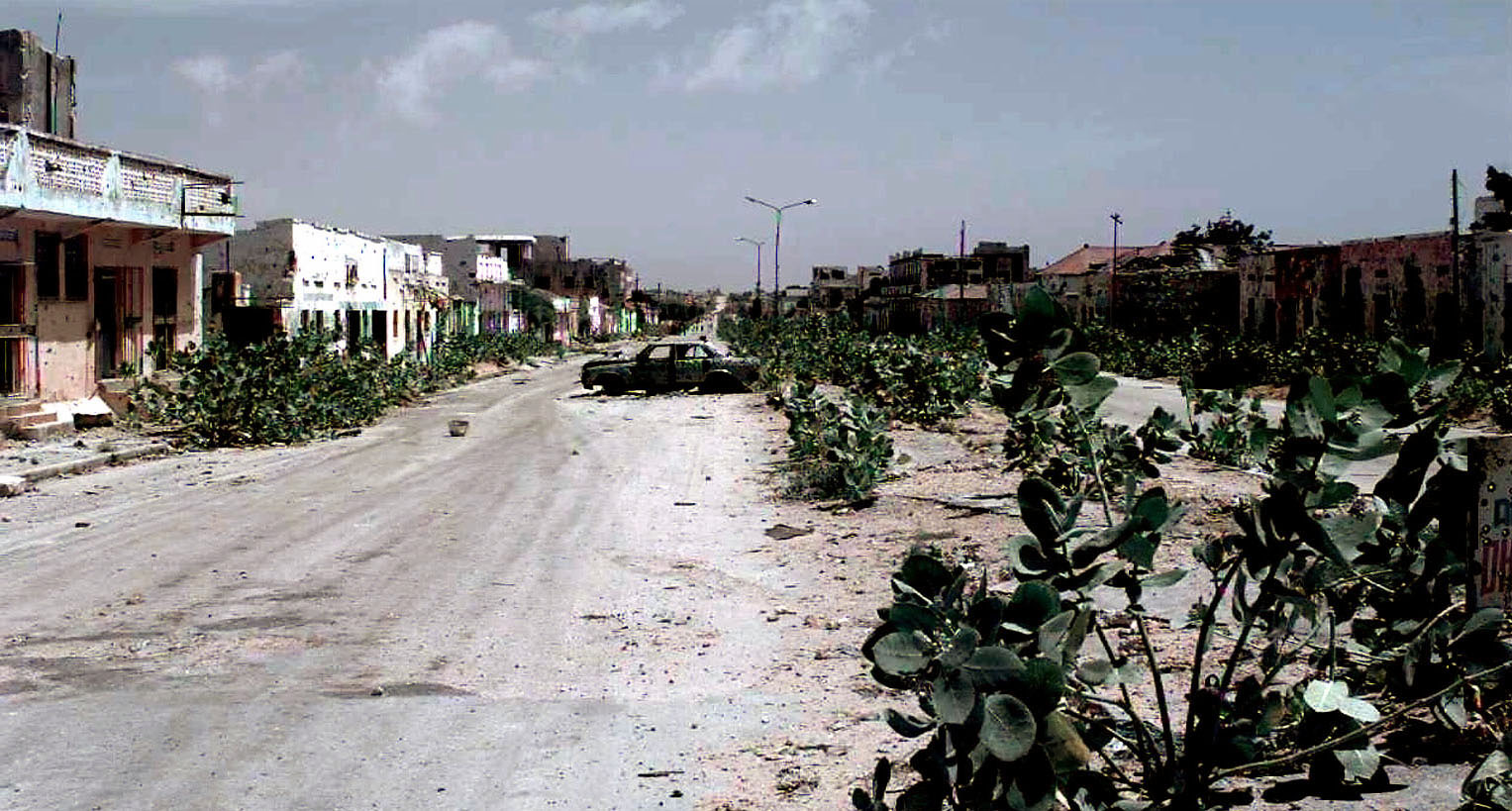 Photo 1. The Green Line between north and south Mogadishu, 19 January 1993. Not on the 3 October routes, but typical of the city's low buildings and wide main streets — Photo: PH1 R. Oriez (US DoD), public domain, via Wikimedia Commons
Strategic and operational context
UNOSOM II took over on 4 May 1993 with a Chapter VII mandate (Resolution 814); after 25 Pakistani soldiers died on 5 June, Resolution 837 called for those responsible to be arrested [4]. The US quick reaction force (QRF), about 1,100 soldiers, answered to Central Command (CENTCOM), with tactical control delegated to the commander of US Forces Somalia, who was also the UN deputy force commander [3]. Its ground element, Task Force 2-14 Infantry of the 10th Mountain Division, was the only US manoeuvre unit in the country [8]. TF Ranger arrived in late August and reported to CENTCOM separately, so there were in effect three parallel chains of command [1, pp. 139, 156–157]. 3 October was its seventh mission [2, p. 19].
After an RPG brought down a Black Hawk on 25 September, flights over the central district were suspended [1, p. 144], and in late September the Secretary of Defense refused a request for a mechanised team with tanks [2, p. 22]. The only armour in the city was Pakistani and Malaysian [1, p. 150].
Terrain and weather in detail (OAKOC)
 Figure 1. The city centre on 3–4 October (sketch). Places and roads from OpenStreetMap [13][14]; crash sites, New Port, checkpoint and routes estimated — Own work, after sources 1, 2, 5
Observation. Most buildings had one or two storeys; a few, the Olympic Hotel among them, had four or five [5]. The lead platoon was caught in a crossfire between the hotel and nearby buildings [1, p. 153]. The airfield was visible from rooftops less than 1 km outside it [1, p. 149].
Avenues of approach. A rough grid of dirt streets, many closed to vehicles by shelters, with a few paved main roads [5]. National Street was the obvious axis, which is why the militia expected it [1, pp. 145, 152]. On OpenStreetMap the airfield is about 2.4 km from K-4 and the university compound 2.6 km west of it [13][14].
Key terrain. K-4 circle; the junction of National Street and Hawlwadaag Road near the Olympic Hotel, where the column halted and split [5]; the stadium, the nearest secure base.
Obstacles. Burning tyres at almost every intersection, and the fear of mines under them [5][1, p. 151].
Cover and concealment. Mud and adobe walls gave little cover even against small arms [5]. A circular perimeter does not fit a street grid, so the Ranger perimeter followed the blocks and left the wreck on its edge [1, p. 154].
Weather and light. ERA5 gives a high of 28.5°C and a night low of about 23.6°C, with humidity above 90% at night; sunset at 1750, sunrise at 0544 [12]. The first relief left three minutes before sunset; the withdrawal began at sunrise. The Rangers had left their night-vision goggles behind for a raid planned to last under an hour [1, p. 142]. By our own rough calculation the moon was waning gibbous, about 90% lit (estimate).
Organisation and command relationships
Where sources disagree, both figures are given.
| Side |
Echelon |
Unit / element |
Role and equipment |
Source |
| US |
Joint task force |
TF Ranger |
About 160 men, 19 aircraft, 12 vehicles; reported to CENTCOM |
[1] |
| US |
Company |
B Co, 3-75 Rangers (four chalks) |
Blocking positions, then perimeter at crash site 1 |
[1] |
| US |
Brigade |
10th Mountain Division QRF |
About 1,100 soldiers; tactical control to US Forces Somalia |
[3] |
| US |
Battalion |
TF 2-14 Infantry |
Ground QRF; its commander led both relief attempts |
[1][8] |
| US |
Company |
A Co, 2-14 Inf |
Main effort to crash site 1 |
[1][6] |
| US |
Company |
C Co, 2-14 Inf |
Ready company; first relief; crash site 2 and the cut-off squad |
[1][7] |
| US |
Company |
B Co, 2-14 Inf |
Standby |
[6] |
| US |
Aviation |
QRF aviation (TF 2-25, TF Raven) |
Cobras and scouts; 14 crews rotated over 7 hours |
[1] |
| US |
Other |
4 HMMWVs, a Ranger platoon, volunteers |
Joined the column |
[1] |
| Malaysia |
Battalion |
MALBATT (19th Bn, Royal Malay Regiment, mech.) |
UNOSOM II mechanised reserve |
[3][9] |
| Malaysia |
Company |
Two mechanised companies |
32 Condor APCs [1] or 24 [5]; 114 soldiers [9] |
[1][5][9] |
| Pakistan |
Platoon |
M48 tanks |
Four tanks; "company" in CSI, platoon in the AAR |
[1][3] |
| Somali |
Militia |
Habr Gidr clan militia (SNA) |
Organised by neighbourhood; fire teams and squads; many RPGs |
[1] |
Nothing tied TF Ranger, the QRF and the UN contingents together below the generals; the QRF's liaison officer knew only the general area of the raid [1, p. 148].
Hour by hour
 Figure 2. Timeline and decision points. Sunset and sunrise from ERA5 [12]; decision times follow the training scenario, some estimated — Own work, after sources 1, 2, 5
3 October, 1530–1745: raid, two crashes
The raid launched around 1530 and was on the target by 1542 [2, p. 19]. Super 61 fell to an RPG perhaps half an hour later, a second Black Hawk about a mile away; the Ranger convoys lost their way and were back at the airfield by 1745 [1, pp. 143–148][5].
1600–2000: the alert and the first relief
The ready company took the long route to the airfield [1, p. 148]. The first relief left at 1747 via K-4, came under fire before its air cover arrived, was held on National Street for at least an hour and was recalled [1, p. 150][6].
2000–2323: building the column
Pakistan and Malaysia agreed at once to provide armour; Italian and Indian armour needed approval from home [1, p. 150]. By 2130 the force was at the New Port; order of march A Company, command group, C Company [1, p. 151][6].
2323–0155: fighting in
The column left at 2323, lost a squad with the strayed APCs, split near the Olympic Hotel and linked up at 0155 (details under p4–p6) [1, pp. 151–153].
0155–0630: holding on and getting out
Freeing the pilot's body took almost three hours [1, p. 153]. The force left at 0537 with 40 to 50 wounded, or 0542 by CMH, and reached the stadium at about 0630 [1, p. 154][2][5].
Decision points in depth
The headings follow the training scenario; x1 and x2 are what-if phases.
p1 The road to the airfield (3 Oct, late afternoon)
Knew: a raid, one aircraft down; no detail because of secrecy [1, p. 148]. Options: the fast route through hostile districts, a longer surer one, waiting for air cover, or straight to the crash site. Decision: told the perimeter was under pressure but not collapsing, the battalion commander took the longer route [1, p. 148]. Otherwise: the Ranger convoys had just been turned back in the same streets [1, p. 147]; a company stopped halfway would itself have needed rescue.
p2 First try on National Street (3 Oct, evening)
Knew: air cover overhead but kept out of the Ranger airspace [1, p. 156]; roadblocks going up ahead. Options: return, push on to crash site 2, or hold on National Street for armour. Decision: the QRF commander ordered it back [1, p. 150]. Otherwise: soft vehicles could not breach; a strongpoint would have made a second cut-off force.
x1 Pinned in the side streets (what-if)
Situation: the company boxed in between roadblocks. Recommended: break contact along the known route. In reality it broke contact and returned to the airfield [6].
p3 The combined column (2130)
Knew: two Malaysian companies, Pakistani tanks, three US companies; little shared language [1, p. 151]. Options: tanks in front with only US infantry in the APCs, each nation carrying its own infantry, trucks at once, or delay for drills. Decision: after consulting the assistant division commander, US infantry only, in Malaysian APCs behind the tanks [1, p. 151]. Otherwise: national limits would have stayed whatever the loading plan; drills would have pushed the linkup toward dawn.
p4 Past the last checkpoint (after 2323)
Knew: the tanks would go no further; APCs with a US squad gone and silent. Options: keep going, halt everything, detach a platoon, or task helicopters to find the squad. Decision: the A Company commander kept the column on the objective and left the missing men for later [1, p. 151]. Otherwise: halting sixty-plus vehicles [2] at night was what the militia wanted. A Cobra later fired on the stray APCs [1, p. 161], a sign of how hard an air search would have been.
p5 Two crash sites (night 3–4 Oct)
Knew: the Rangers at site 1; site 2 isolated, survivors unknown. Options: split, or stay together for one site. Decision: the force split near the Olympic Hotel [1, p. 152]. Otherwise: concentrating would have left one site unsearched for hours; splitting worked because the convoy held a rally point and only small groups moved [5].
p6 The last few hundred metres (night 3–4 Oct)
Knew: a roadblock, a driver who would not move, a crossfire, Ranger strobes close by. Options: walk, clear then ride, suppress first by air, or a side alley mounted. Decision: the company dismounted [1, pp. 152–153]. Otherwise: clearing under the hotel's fire would have left the column halted in the open, as at the first barricade.
x2 A column broken in the dark (what-if)
Situation: front and rear lose each other; flares light the way but blind pilots in night-vision goggles [1, p. 153]. Recommended: control the flares, fix positions by strobe and helicopter, push on foot. In reality the column held together apart from the strayed APCs.
p7 At the crash site (4 Oct, 0155)
 Photo 2. Remains of Super 61, the first Black Hawk down, on display in 2016 — Photo: Phil Konstantin, CC BY-SA 4.0, via Wikimedia Commons
Knew: dozens of wounded, a body trapped in the wreck, the squad unresolved. Options: stay until all are recovered, leave at once, send a platoon, or walk out. Decision: they stayed almost three hours, and the battalion commander ordered C Company to find the Malaysian platoon so that no one, Malaysian or American, was left behind [1, pp. 153–155]. Otherwise: leaving in darkness would have used the night for cover, at the price of the rule the force had set itself [1, p. 143].
p8 Out to the stadium (4 Oct, 0537)
Knew: 40–50 wounded, too few seats, dawn near [1, p. 154]. Options: wounded inside and the rest alongside, a shuttle, everyone packed on, or walking pace. Decision: the first [1, p. 154]. Otherwise: a shuttle would have left a small force in the city at daybreak; walking pace needed the drivers' agreement, never rehearsed.
Doctrine re-read
 Figure 3. Manoeuvre by phase (18-second loop; with reduced motion only the final situation is shown). Positions sketched and partly estimated — Own work, after sources 1, 2, 5
Linkup (FM 3-90, ch. 20). The headquarters ordering a linkup sets command relationships, the linkup method and recognition signals, such as infrared devices at night (paras 20-3, 20-4); the stationary force furnishes guides (para 20-28); after linkup a single commander is designated (para 20-30) [11]. The strobes and the Rangers riding with the column did the first two jobs [1, p. 153]; nobody had settled the third, and a brief dispute at the perimeter followed.
Rehearsal (paras 20-9, 20-18). With forces of other nations, extensive liaison and extra rehearsals may be needed; when time is short the commander walks the forces through the plan [11]. The 2130 briefing was that walk-through [1, p. 151]; it could not remove national limits on who led and how far.
Momentum (para 20-21). A stalled force is difficult to get moving again [11]. The column stopped three times on drivers' fear of mines [1, pp. 151–152].
Movement (ch. 2, paras 2-20 to 2-23). Bounding overwatch is the technique when contact is expected [11]; A Company's squads bounded by teams along National Street [1, p. 152].
Withdrawal (ch. 11, paras 11-72, 11-73, 11-88). Withdrawals under pressure are dangerous and best made when the enemy cannot observe, using night movement [11]. The force left at first light, trading darkness for a complete recovery.
Source criticism
Vehicles. CSI lists 32 Malaysian APCs on hand [1, pp. 150–151]; MWI puts 24 in a column of almost a hundred vehicles [5]; CMH says sixty-plus [2]. Neither count is shown. The tanks are a "company" in CSI but four tanks in the same text and a platoon in the AAR [1][3]; four is the firmer figure.
Who went to crash site 2. CSI, built on interviews with company officers, sends C Company [1, p. 154]; the CMH overview sends A Company less its 2nd Platoon [2]. Army reporting agrees with CSI [6][7].
Times. Departure 2323 [1] or 2324 [5]; withdrawal 0537 [1] or 0542 [2][5], perhaps leaving the site versus starting the run. A Malaysian veteran dates the end of the mission to 0400 [9], which fits neither.
Losses. US deaths are 18 in CSI, UN and PBS accounts [1][4][15]; CMH counts 16 from TF Ranger and 2 from 2-14 Infantry, plus one on 6 October [2]. Wounded run from 75 [4][15] to 84 [3]. For Malaysia the CMH volume gives two dead and seven wounded in one place and one dead and ten wounded in another [2][3]; Bernama names one fallen driver, Private Mat Aznan Awang [9]; MWI says two [5]. Estimates of Somali losses differ widely, even within the CMH volume, and are not repeated here.
Perspective. The US histories say little of the coalition crews beyond their hesitations; a former Malaysian officer objected that the film made them look like drivers only [10]. Malaysian and Pakistani reports were not available.
Causes. MWI blames the lack of contingency rehearsals with the coalition [5]; CSI stresses secrecy and split command [1, pp. 156–157]; CMH the refused armour [2]. The A Company commander noted that US tanks would also have been vulnerable in narrow alleys [1, p. 155]. The explanations complement each other.
Lessons
- Plan the rescue of the raid force before the raid. The ready company was 2.6 km on the wrong side of K-4 when needed [5][13].
- Settle national limits before moving. Who may lead, how far and who carries whom cannot be negotiated at a checkpoint at midnight.
- A vehicle that stops under fire in an intersection has made a decision, not paused. Agree in advance what drivers do under fire, in their own language.
- Agree who commands after linkup, and how everyone leaves. The dispute at the perimeter and the failed run beside the APCs had the same cause.
- Count everyone, including the coalition. The order to recover the Malaysian crews with the Americans is the part of the night most worth copying [1, p. 155].
Unresolved questions
- Exact positions of crash site 2, the last Pakistani checkpoint and the ambushed APCs (Figure 1 is estimated).
- How many Malaysian APCs were in the column and how many were lost: three in the AAR [3], two in Army reporting [6].
- Malaysian losses: one or two dead.
- Moonlight: the figure above is a rough calculation.
Further reading and viewing
▶News report on US policy in Africa twenty years after the battle of MogadishuVideo: The U.S. in Africa 20 Years After Black Hawk Down · The Wall Street Journal, 2013
 Photo 3. Mogadishu from an armed convoy during the UNOSOM years (1993–95) — Photo: CT Snow, CC BY 2.0, via Wikimedia Commons
- CSI, My Clan Against the World (2004), ch. 5 [1]; CMH, United States Forces, Somalia After Action Report and Historical Overview (2003) [3]; FM 3-90 Tactics (2023), chapters 2, 11 and 20 [11].
- Command the QRF battalion yourself in the training scenario "Mogadishu".
Sources
- Robert F. Baumann and Lawrence A. Yates with Versalle F. Washington, "My Clan Against the World": US and Coalition Forces in Somalia, 1992–1994, Combat Studies Institute Press, 2004, ch. 5 (pp. 139–163, Maps 10–11). https://webarchive.library.unt.edu/web/20161019025705mp_/http://www.benning.army.mil/Library/content/Clan.pdf (accessed 2026-10-13)
- Richard W. Stewart, The United States Army in Somalia, 1992–1994 (CMH Pub 70-81-1), US Army Center of Military History, 2002, pp. 19–24 (same text as the 2003 Historical Overview, pp. 10–13). https://upload.wikimedia.org/wikipedia/commons/3/37/US_Army_in_Somalia_%2870-81-1%29.pdf (accessed 2026-10-13)
- US Army Center of Military History, United States Forces, Somalia After Action Report and Historical Overview: The United States Army in Somalia, 1992–1994, 2003 (AAR pp. 105–106, 136; QRF terms of reference). https://api.army.mil/e2/c/downloads/314322.pdf (accessed 2026-10-13)
- United Nations Peacekeeping, Somalia – UNOSOM II, background. https://peacekeeping.un.org/mission/past/unosom2backgr2.html (accessed 2026-10-13)
- Liam Collins, Jayson Geroux and John Spencer, "Urban Case Study #9: The Battle of Mogadishu", Modern War Institute at West Point, 2024. https://mwi.westpoint.edu/urban-case-study-9-the-battle-of-mogadishu/ (accessed 2026-10-13)
- Steve Ghiringhelli, "'We didn't leave anybody behind': 10th Mountain Division veterans reflect on Mogadishu rescue mission", US Army, 2013-10-17. https://www.army.mil/article/113311/we_didnt_leave_anybody_behind_10th_mountain_division_veterans_reflect_on_mogadishu_rescue_missi (accessed 2026-10-13)
- Jennifer Bunn, "10th Mountain Division remembers Battle of Mogadishu 20 years later", US Army, 2013-10-10. https://www.army.mil/article/112963/10th_mountain_division_remembers_battle_of_mogadishu_20_years_later (accessed 2026-10-13)
- Small Wars Journal, "Creating a Supercharged Battalion" (personal account by the TF 2-14 commander, with an introduction), 2009-05-29. https://archive.smallwarsjournal.com/index.php/node/8087 (accessed 2026-10-13)
- Syed Azwan Syed Ali, "Don't let political tussle weaken the country - Black Hawk Down hero", Bernama, 2020-09-05. https://www.bernama.com/en/news.php?id=1876807 (accessed 2026-10-13)
- Noel Wong, "The true story of Malaysian soldiers saving American lives", Free Malaysia Today, 2023-08-25. https://www.freemalaysiatoday.com/category/leisure/2023/08/25/the-true-story-of-malaysian-soldiers-saving-american-lives (accessed 2026-10-13)
- Headquarters, Department of the Army, FM 3-90 Tactics, 2023-05-01 (ch. 2 paras 2-20 to 2-23; ch. 11 paras 11-71 to 11-73, 11-82, 11-88; ch. 20 paras 20-3, 20-4, 20-9, 20-18, 20-21, 20-28, 20-30). https://armypubs.army.mil/epubs/DR_pubs/DR_a/ARN38160-FM_3-90-000-WEB-1.pdf (accessed 2026-10-13)
- Open-Meteo, Historical Weather API (ERA5 reanalysis), Mogadishu grid cell, hourly temperature, humidity and cloud, daily sunrise and sunset, 3–4 October 1993. https://archive-api.open-meteo.com/v1/archive?latitude=2.05&longitude=45.32&start_date=1993-10-03&end_date=1993-10-04&daily=temperature_2m_max,temperature_2m_min,sunrise,sunset,precipitation_sum&hourly=temperature_2m,relative_humidity_2m,cloud_cover&timezone=Africa%2FMogadishu (accessed 2026-10-13)
- OpenStreetMap Nominatim, place search for the Olympic Hotel, Bakara Market, Mogadishu Stadium, Somali National University and Aden Adde airport. https://nominatim.openstreetmap.org/search?q=Olympic%20Hotel%20Mogadishu&format=json&limit=3 (accessed 2026-10-13)
- OpenStreetMap contributors, coastline, runway and main roads of Mogadishu via the Overpass API (ODbL). https://overpass.kumi.systems/api/interpreter (accessed 2026-10-13)
- PBS Frontline, Ambush in Mogadishu, 1998 (updated 2001). https://www.pbs.org/wgbh/pages/frontline/shows/ambush/ (accessed 2026-10-13)
- Wikimedia Commons, File:An abandoned MOGADISHU Street known as the Green Line, Jan 1993.JPEG (PH1 R. Oriez, public domain). https://commons.wikimedia.org/wiki/File:An_abandoned_MOGADISHU_Street_known_as_the_Green_Line,_Jan_1993.JPEG (accessed 2026-10-13)
- Wikimedia Commons, File:Black Hawk Super 61 by Phil Konstantin.jpg (CC BY-SA 4.0). https://commons.wikimedia.org/wiki/File:Black_Hawk_Super_61_by_Phil_Konstantin.jpg (accessed 2026-10-13)
- Wikimedia Commons, File:Pictures from an armed convoy trip in Mogadishu (cropped).jpg (CT Snow, CC BY 2.0). https://commons.wikimedia.org/wiki/File:Pictures_from_an_armed_convoy_trip_in_Mogadishu_(cropped).jpg (accessed 2026-10-13)