Battle Analysis
In depth | Robotyne — why taking one village on foot took a month and did not reach Tokmak
· 2023-07-26 – 2023-08-28
Overview
Part 1: Robotyne (July–August 2023) told the story of the offensive; this piece takes apart the small decisions inside it. On 26 July 2023 Ukrainian brigades attacked toward Robotyne again, about 10 km south of Orikhiv [4]. After a month of dismounted assaults and hand-cleared lanes, officials announced its liberation on 28 August [10][11]. A US Army analysis notes that the village had been one brigade's final objective, to be taken within 48 hours [3]. Below, the scenario's phases p1–x7 are taken in turn to ask how 48 hours became a month.
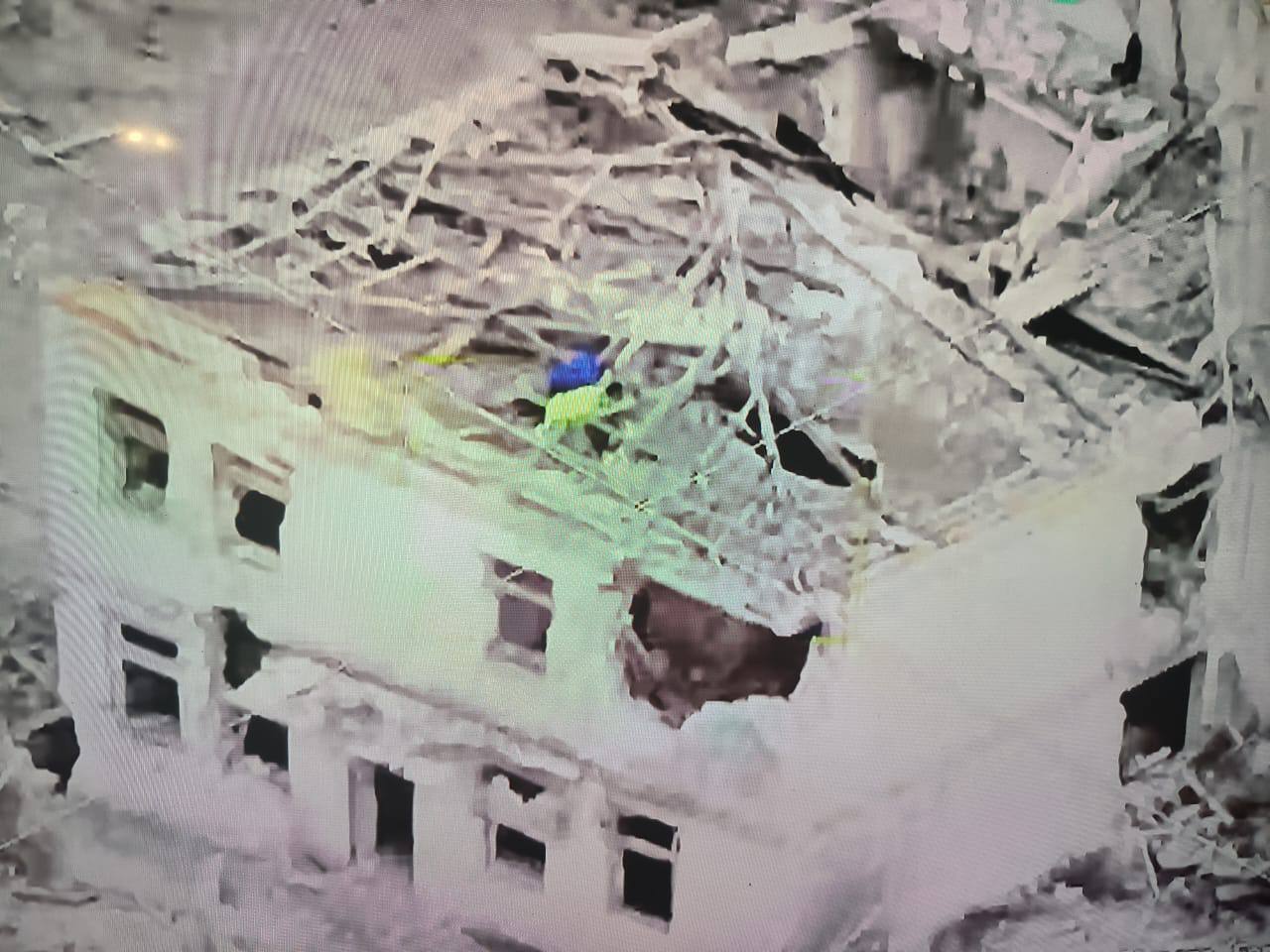 Photo 1. The flag over the ruined school in Robotyne, a frame from the 47th Brigade's drone video published on 23 August 2023 [20] — Photo: 47th Mechanised Brigade (via ArmyInform), CC BY 4.0, via Wikimedia Commons
Strategic and operational context
Twelve brigades were to breach the defences on a 30 km frontage and isolate Tokmak within seven days; at that tempo they would have met only about 30% of the Russian forces available on the axis [1]. The brigades lacked the equipment and readiness, so planners hoped that sustained pressure would break Russian morale, which RUSI calls "very optimistic" [1].
From 3 June the 9th Corps (47th, 65th, 33rd Brigades) made company-level mechanised breaches. Line charges cut lanes that were too shallow, the corps had about ten demining vehicles that overheated after long ploughing, usually only the lead vehicle had a plough, and there were no smoke rounds [1]. When the lead vehicle stopped, those behind could not turn in the lane. By mid-July units were moving "slowly, on foot" behind sappers crawling across the minefields [5].
In July the command committed the Maroon Corps, its exploitation force, rather than stop. The objective was cut to Tokmak and the frontage narrowed from 30 km to 10 km [1]. RUSI judges that Russian attrition peaked in early August, and that a breakthrough to Tokmak was most likely then [1]. Robotyne sits in that window.
Terrain and weather in detail (OAKOC)
 Figure 1. The Robotyne axis in detail (sketch; unit positions estimated; to 30 August 2023 only). Places from OSM [19], elevations from Open-Meteo [18] — Own work, after sources 1, 2, 4, 6–13
Observation. The ground climbs south: Orikhiv about 52 m, Mala Tokmachka 68 m, Robotyne 137 m, Novoprokopivka 139 m [18]. The defender looked down the slope. A 90 m grid shows a low strip of 70–90 m between higher ground on both sides [18], matching RUSI's advance "canalised" between heights about 7 km apart [1].
Avenues of approach. Robotyne is 15 km from the centre of Orikhiv, 2.6 km north of Novoprokopivka and 12.5 km west of Verbove [19]. The T-0408 road runs on to Tokmak, about 24 km south [8]: the obvious axis, and so the best watched.
Key terrain. The flanking heights and their tree lines, from which fire could reach anything moving along the corridor.
Obstacles. Russian minefields grew from a doctrinal 120 m to as much as 500 m deep, with anti-tank mines stacked so that one strike stops a vehicle [2]. One line charge clears about 100 m, so a 500 m field needs about six [3].
Cover and concealment. Windbreak tree lines divide the fields into a grid. They were the attacker's only cover and the defender's hiding place; summer foliage hid positions from drones [14]. ERA5 gives highs of 30.4°C on 26 July and 34.6–36.8°C on 5–7 August, with real rain only on 28 July (12.1 mm) and 11 August (28.7 mm) [17]. Daylight fell from 15 h 12 min to 13 h 29 min by 30 August, lengthening the night from under nine hours to ten and a half [17], giving more time both for clearing lanes and for re-seeding them.
Organisation and command relationships
Company-level dispositions were not published; "est." marks estimates. Russian unit numbers indicate command elements, not order of battle [1].
| Side |
Echelon |
Unit / element |
Role and equipment |
Source |
| Ukraine |
Corps |
9th Corps (47th, 65th, 33rd Bdes) |
Opened the offensive in June |
[1] |
| Ukraine |
Corps |
Maroon Corps (exploitation force) |
Committed from July |
[1] |
| Ukraine |
Brigade |
47th Separate Mechanised Brigade |
Entered Robotyne 22 Aug; Bradley, Leopard 2 |
[8] |
| Ukraine |
Special |
Special operations forces |
Helped clear the way |
[11] |
| Ukraine |
Platoon |
Assault platoons |
At best about two per battalion |
[1][2] |
| Ukraine |
Company |
Representative assault company |
Two assault platoons, one line platoon, engineer section (est.) |
scenario |
| Ukraine |
Engineers |
Sapper teams |
Hand clearing, often at twilight |
[3][5] |
| Ukraine |
Fires |
GMLRS, DPICM |
About 7 GMLRS a day theatre-wide, shifted to counterbattery |
[1] |
| Russia |
Army |
58th Combined Arms Army |
Responsible for the axis |
[1] |
| Russia |
Division |
42nd Motor Rifle Div (70, 71, 291 Regts) |
First line, about one regiment per 10 km |
[1] |
| Russia |
Division |
7th Airborne Div |
A regiment per 10 km of first line; second line |
[1] |
| Russia |
Division |
76th Airborne Div |
Brought up in late August |
[12][13] |
| Russia |
Artillery |
439th Artillery Bde (Tornado-S) |
35 days of ammunition cached |
[1] |
| Russia |
Aviation |
About 60 attack helicopters |
Ka-52 firing Vikhr and Ataka from 8–10 km |
[1][2] |
| Russia |
Teams |
ATGW teams on the flanks |
Better trained troops, well stocked |
[2] |
One company attack could draw support from up to three brigades that had never trained together [1]. Commanders preferred keeping their drone view to laying smoke: only 3% of Ukrainian fire missions were smoke [2].
Day-by-day account
26–27 July: the mechanised attack resumes
ISW assessed that Ukrainian forces broke through prepared positions south of Orikhiv to within 2.5 km east of Robotyne [4]. The defending 58th Army had held since early June without relief, and its commander had been dismissed [4].
28 July – 10 August: tree line by tree line
Russian artillery shelled abandoned trenches once Ukrainians occupied them, infantry with armour counterattacked at night, and positions changed hands several times [1]. Night resupply was too dangerous because of scatterable mines and scarce night sights, so it went by day under FPV drones, tank ATGMs fired from hilltops and helicopter missiles [1].
11–18 August: the edge of the village
The scenario dates fighting inside the village from about 11 August, a day of heavy rain [17]. Russian sources claimed the north-east had been retaken, but footage from 17–18 August showed Ukrainian troops still there [6].
20–23 August: the centre and the flag
Footage from 20–21 August put Ukrainian troops in central Robotyne, perhaps past the densest minefields [7]. On 22 August the 47th Brigade said it had entered; Bradleys carried in troops and took out civilians, though how much was held was unclear [8]. The flag went up on 23 August (Photo 1) [20].
25–30 August: announcement and reinforcement
ISW cited Russian commentators worried that exhausted units had no rotation or reinforcement [9]. On 28 August the deputy defence minister announced the liberation [11], and ISW noted Russia spending relatively elite airborne forces on vulnerable positions [10]. By 1 September fighting had reached the forward defences near Novoprokopivka and Verbove [12].
 Figure 2. Manoeuvre by phase (18-second loop; reduced motion shows only the final situation). Positions sketched and partly estimated — Own work
Decision points in depth
The headings follow the training scenario; x2, x4 and x7 are what-if phases (Figure 3).
 Figure 3. Decision points and weather. Weather: ERA5 reanalysis for the Robotyne grid cell [17]; decision times follow the training scenario — Own work
p1 The mounted breach has stalled (27 July, before dawn)
Knew: yesterday's column had stopped in the minefield; almost no breaching equipment was left. Options: another mounted breach behind the last plough tank, hand-cleared lanes and assaults on foot, waiting for vehicles, or a long preparation and a mounted attack. Decision: hand clearing and assault on foot [1][5]. Otherwise: the last plough meets the same narrow lane; a long preparation signals the hour, and stacked mines still stop vehicles with one strike [2].
p2 First night on the tree line (early August, dusk)
Knew: Russian guns were registered on their own former trenches; ammunition was half gone; night counterattacks were the pattern. Options: hold with fires laid on the approach, leave the trenches for new scrapes, pull back, or bring the line platoon up at dusk. Decision: hold with fires laid in advance [1]. Otherwise: FM 3-90 advises moving beyond enemy positions before consolidating, since they are pre-registered [16], and Russia was rigging trenches with charges [2]. Empty trenches had real merit.
x2 Take it back (what-if, next morning)
Situation: the tree line lost overnight, about one Russian platoon back in it. Recommended: re-check the lane for scatterable mines, then repeat a deliberate assault under mortar cover. In reality assaults often had to be repeated several times [1].
p3 The last kilometre (early August, daytime)
Knew: one lane; mines by night, drones, tank ATGMs and helicopters by day. Options: night resupply, day resupply under counterbattery and counter-drone cover, relief by the line platoon, or pushing on unsupplied. Decision: day resupply under cover [1]. Otherwise: a relief crowds the lane, and FM 3-90 warns that a simultaneous relief is the easiest to detect [16].
p4 The edge of Robotyne (around 10 August)
Knew: ATGW teams in the western tree line covered the road; few fire missions remained. Options: straight down the road, flanks first, bypass toward Verbove, or dig in. Decision: flanks first; securing the flanks of any gain was a precondition [1]. Otherwise: Russian ATGW teams let attackers pass, then ambushed them from the flank [2].
x4 Caught on the narrow axis (what-if, around 11 August)
Situation: lead groups pinned short of the first houses. Recommended: break into the nearest tree line, then send a small group against the ATGW post. In reality the advance was slow and flank-first, not a stall in the open [1][6].
p5 Into northern Robotyne (11–18 August)
Knew: Russians in cellars and garden trenches; their channels claiming the north-east retaken. Options: small groups with engineers checking first, the line platoon down the main street, fire on each position, or waiting for another company. Decision: small groups; the north-eastern positions held [6]. Otherwise: trenches prepared for demolition [2] argue for checking before entering.
p6 After the centre (22–23 August)
Knew: the flag was up; the southern outskirts were Russian; airborne troops were coming. Options: push south tonight, consolidate and clear mines, spend the last fires on the assembly area, or rest the assault platoons. Decision: consolidate while small groups probed south [7][8]. Otherwise: this is FM 3-90's consolidation moment [16].
p7 Beyond Robotyne (28–30 August)
Knew: the second line was filling with airborne troops; the assault platoons had had no relief for weeks. Options: small groups toward Verbove, the road south, rest, or a last fire mission then advance. Decision: small groups toward Novoprokopivka and Verbove [12]. Otherwise: ammunition could sustain offensive fire only until October at the latest [1]; a pause would have spent the time left.
x7 Counterattack from the south (what-if, late August)
Situation: fresh airborne troops hit the southern outskirts before the company is set. Recommended: hold the centre and northern exits, trading southern houses for time. In reality the outskirts stayed contested into September [12], and the village stayed Ukrainian until ISW judged it lost in July 2024 [15].
 Photo 2. The trade rows building in Orikhiv, the rear base of the axis, after shelling on 19 August 2023 [21] — Photo: Zaporizhzhia Regional State Administration, CC BY 4.0, via Wikimedia Commons
Doctrine re-read
Assaulting on foot (FM 3-90, para 5-86). Units usually assault dismounted when the enemy has strong anti-armour capability, obstacles prevent manoeuvre, mounted assaults stall short of the objective and the enemy is in prepared positions [16]. Robotyne met all four.
Breaching (ch. 18, paras 18-22, 18-23, table 18-1). The tenets are intelligence, SOSRA (suppress, obscure, secure, reduce, assault), organisation, mass and synchronisation, with one lane per company and two per battalion [16]. With 3% smoke [2] and one plough per lane [1], "obscure" and "reduce" were missing; hand clearing was the only reduction left.
Consolidation (paras 1-123, 1-124, 5-87, 5-88). Units strengthen a captured position, move beyond the enemy's registered positions before stopping, and make contact with units on their flanks [16]. Russia's shelling of its own lost trenches [1] is exactly what para 5-87 anticipates.
Relief in place (ch. 15, paras 15-1, 15-2). Relief keeps committed forces effective [16]. With two assault platoons per battalion and too few troops to rotate them [1][2], it existed on paper only.
The Russian side. FM 3-90 tells defenders to counterattack locally before the attacker consolidates (para 9-96) [16]; Russian practice matched its disruption-zone doctrine [1]. Russia also dropped its old norm of 720 rounds to suppress a platoon position for precise fires, and replaced fire on lost trenches with reserve demolition [2].
Source criticism
When was Robotyne taken? Entry on 22 August [8], the flag on 23 August, official announcement on 28 August [11]. The flag frame's Commons metadata says 18 August, but its source article is from the 23rd, so the earlier date is probably a file error [20]. Entry, symbol and claim are three different events.
Did Russia rotate its units? ISW, citing Russian commentators, says the defenders fought from June "without rotation or significant reinforcement" [9]; RUSI says Russia kept rotating regiments so that fresh troops held the line [1]. RUSI rests on later staff interviews, ISW on daily open sources. Both can hold: regiments rotated while individual companies did not.
Where did the 76th Airborne come from? Part 1 cited ISW for Kreminna; Estonian intelligence said Lyman [12]. The UK MoD counted at least five regiments of the 7th and 76th near Robotyne, 10,000 men at full strength but "highly likely" well below it [13]. The figure is notional.
How deep were the minefields? 500 m [2], 300–500 m [3], 3–10 miles [5]. The first two describe one field, the third a belt of successive fields; they do not conflict.
Losses. An open-source count of 518 vehicles lost from June to November for about 20 km [3] is a photo-confirmed floor for the whole axis, not a Robotyne figure. The summer loss rates of 20% then 10% rest on unnamed officials [5].
Lessons
- A breach is an equation. Without smoke, ploughs or counterbattery fire, the lane narrows to one vehicle and every attack becomes deliberate.
- Plan the last kilometre with the assault, with its own fires and counter-drone cover.
- On a narrow axis the flanks are the front. Clear the flank tree lines before entering.
- Count assault troops like ammunition. Two capable platoons per battalion set the tempo of a whole offensive.
- Do not reoccupy registered trenches by reflex. Move beyond them or check them.
- Report what you hold, not what was announced.
Unresolved questions
- Which Russian regiments held Robotyne itself, and when the first airborne companies arrived.
- How many fire missions and demining hours each tree line cost.
- Ukrainian personnel losses were not disclosed; Russian figures are claims.
- In July 2024 ISW assessed that Russian forces had likely taken all of Robotyne; a Ukrainian spokesman reported no major changes [15].
Further reading and viewing
▶BBC News report on Russian minefields slowing the Ukrainian counteroffensiveVideo: Russia's minefields holding up Ukraine's counter-offensive · BBC News, 2023
- RUSI, Stormbreak (2023) [2] and Preliminary Lessons from Ukraine's Offensive Operations, 2022–23 (2024) [1]; FM 3-90 Tactics (2023), chapters 5, 15 and 18 [16].
- Command the assault company yourself in the training scenario Robotyne on Foot.
Sources
- Jack Watling, Oleksandr V. Danylyuk and Nick Reynolds, Preliminary Lessons from Ukraine's Offensive Operations, 2022–23, RUSI Special Report, 2024-07-18, pp. 15–24. https://static.rusi.org/lessons-learned-ukraine-offensive-2022-23.pdf (accessed 2026-10-13)
- Jack Watling and Nick Reynolds, Stormbreak: Fighting Through Russian Defences in Ukraine's 2023 Offensive, RUSI Special Report, 2023-09-04, pp. 1–2, 12–19, 21–22. https://static.rusi.org/Stormbreak-Special-Report-web-final_0.pdf (accessed 2026-10-13)
- CPT Austin Bajc, "Blocked and Bloodied: Lessons from the Combined Arms Breach during the 2023 Ukrainian Counter-Offensive", U.S. Army (army.mil), 2025-07-08. https://www.army.mil/article/286857/blocked_and_bloodied_lessons_from_the_combined_arms_breach_during_the_2023_ukranian_counter_offensive (accessed 2026-10-13)
- Maria Tril, summary of ISW's 26 July assessment, Euromaidan Press, 2023-07-27. https://euromaidanpress.com/2023/07/27/ukraines-intense-attack-on-robotyne-zaporizhzhia-oblast-signifies-a-turning-point-in-the-counteroffensive-effort-isw/ (accessed 2026-10-13)
- Novaya Gazeta Europe, summary of a Washington Post report on advancing on foot and hand clearing, 2023-07-16. https://novayagazeta.eu/amp/en/articles/2023/07/16/wp-ukraine-changes-counteroffensive-tactic-to-clear-russian-minefields-en-news (accessed 2026-10-13)
- Olena Mukhina, summary of ISW's 18 August assessment, Euromaidan Press, 2023-08-19. https://euromaidanpress.com/2023/08/19/ukrainian-soldiers-continue-to-advance-in-zaporizhzhia-oblast-isw/ (accessed 2026-10-13)
- Iryna Voichuk, "ISW: Ukrainian forces make tactically significant advances near Robotyne", Euromaidan Press, 2023-08-22. https://euromaidanpress.com/2023/08/22/isw-ukrainian-forces-make-tactically-significant-advances-near-robotyne/ (accessed 2026-10-13)
- Howard Altman, "Ukraine Situation Report: Kyiv's Forces Enter Robotyne", The War Zone, 2023-08-22. https://www.twz.com/ukraine-situation-report-kyivs-forces-enter-robotyne (accessed 2026-10-13)
- Iryna Voichuk, "ISW: Russian troops fight near Robotyne without rotation or reinforcement", Euromaidan Press, 2023-08-26. https://euromaidanpress.com/2023/08/26/isw-russian-troops-fight-near-robotyne-without-rotation-or-reinforcement/ (accessed 2026-10-13)
- Kyiv Post, ISW Russian Offensive Campaign Assessment, 28 August 2023. https://www.kyivpost.com/amp/post/21013 (accessed 2026-10-13)
- Debora Patta, Omar Abdulkader and Tucker Reals, "Ukraine breaches Russia's defenses to retake Robotyne as counteroffensive pushes painstakingly forward", CBS News, 2023-08-28. https://www.cbsnews.com/amp/news/ukraine-war-russia-yevgeny-prigozhin-wagner-group-putin-robotyne-counteroffensive (accessed 2026-10-13)
- Ukrainska Pravda, report of Estonian Defence Forces intelligence on Robotyne and the 76th Airborne Division (claim), 2023-09-01. https://www.pravda.com.ua/eng/news/2023/09/01/7418029/ (accessed 2026-10-13)
- Ukrinform, report of the UK MoD intelligence update on airborne regiments near Robotyne (claim), 2023-09-18. https://ukrinform.net/rubric-ato/3762619-russia-throws-10000-paratroopers-into-grinder-near-zaporizhzhia-as-line-infantry-british-intelligence.html (accessed 2026-10-13)
- Jan Kallberg, "Ukraine's War of the Treelines", Center for European Policy Analysis (CEPA), 2023-10-02. https://cepa.org/article/ukraines-war-of-the-treelines/ (accessed 2026-10-13)
- Kyiv Independent, ISW's July 2024 assessment of Robotyne and the Ukrainian response, 2024-07-29. https://kyivindependent.com/robotyne-isw/ (accessed 2026-10-13)
- Headquarters, Department of the Army, FM 3-90 Tactics, 2023-05-01 (paras 1-123, 1-124, 5-86 to 5-88, 9-96, 15-1, 15-2, 18-22, 18-23 and table 18-1; Internet Archive text). https://archive.org/stream/fm-3-90-tactics-2023/FM%203-90%20Tactics%202023_djvu.txt (accessed 2026-10-13)
- Open-Meteo, Historical Weather API (ERA5 reanalysis), Robotyne grid cell, daily temperature, precipitation, wind, sunrise and sunset, 24 Jul–31 Aug 2023. https://archive-api.open-meteo.com/v1/archive?latitude=47.443&longitude=35.826&start_date=2023-07-24&end_date=2023-08-31&daily=temperature_2m_max,temperature_2m_min,precipitation_sum,sunrise,sunset,wind_speed_10m_max&timezone=Europe%2FKyiv (accessed 2026-10-13)
- Open-Meteo, Elevation API, elevations for Orikhiv, Robotyne, Verbove, Novoprokopivka and Mala Tokmachka (plus a 10 × 10 grid of the area). https://api.open-meteo.com/v1/elevation?latitude=47.5754,47.4431,47.4280,47.4201,47.5327&longitude=35.7855,35.8261,35.9905,35.8319,35.8968 (accessed 2026-10-13)
- OpenStreetMap Nominatim, place search for Robotyne, Orikhiv, Verbove, Novoprokopivka and Mala Tokmachka. https://nominatim.openstreetmap.org/search?q=Robotyne&format=json&limit=2&countrycodes=ua (accessed 2026-10-13)
- Wikimedia Commons, file page for the flag over the school in Robotyne (47th Mechanised Brigade via ArmyInform, CC BY 4.0). https://commons.wikimedia.org/wiki/File:Drapeau_Ukrainien_hiss%C3%A9_par_la_47e_brigade_m%C3%A9canis%C3%A9e_%C2%AB_Magoura_%C2%BB_sur_l%27%C3%A9cole_d%C3%A9truite_de_Robotyne_le_23_aout_2023.jpg (accessed 2026-10-13)
- Wikimedia Commons, File:Building of Trade Rows in Orikhiv after Russian shelling, 2023-08-19 (01).jpg (Zaporizhzhia Regional State Administration, CC BY 4.0). https://commons.wikimedia.org/wiki/File:Building_of_Trade_Rows_in_Orikhiv_after_Russian_shelling,_2023-08-19_(01).jpg (accessed 2026-10-13)