Battle Analysis
In depth | Yeongcheon — how reinforcements arriving one regiment at a time surrounded a division that had broken through
· 1950-09-05 – 1950-09-13
Overview
Part 1: Yeongcheon (September 1950) told the story of a reserve shifted across the front. This piece checks the dates, regiments and distances inside it. The NK 15th Division, about 3,600 men in three regiments, reached the Yeongcheon corridor in four days [1]. The ROK Army answered by moving a division to another corps and feeding in single regiments from distant fronts [1][6]. The town was lost and retaken twice before the ring closed. Below, the ground is read by OAKOC and the scenario's phases p1–p8 (with what-if phases p2x, p4x, p6x) are followed one by one.
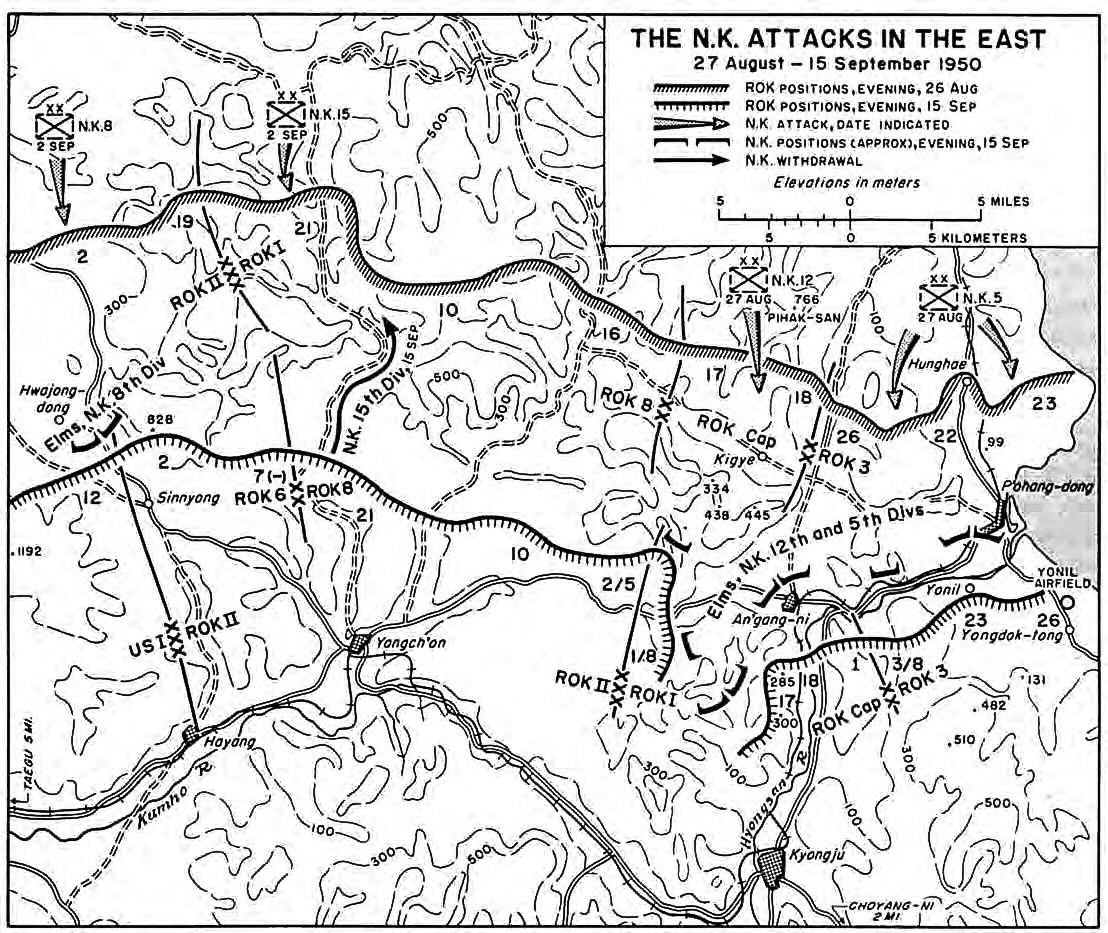 Photo 1. North Korean attacks in the Kyongju corridor (27 Aug–15 Sep 1950). The NK 15th Division's axis is the Yongch'on (Yeongcheon) front at upper left — US Army map from Appleman (1961), public domain (PD-USGov-Military-Army), via Wikimedia Commons
Strategic and operational context
In early September NK II Corps tried to cut the lateral Taegu–P'ohang corridor in two places: its 8th Division toward Hayang, 12 air miles east of Taegu, and its 15th toward Yeongcheon, 20 air miles east. The 15th started 35 air miles north, below Andong, with orders to take Yeongcheon at all costs [1].
The attack came in the week Eighth Army itself wavered. Around 5 September Walker weighed a withdrawal to the Davidson Line; orders were drafted but never issued, and Army headquarters moved to Pusan [1]. A Korean account dates his briefing of the plan to ROK chief of staff Chung Il-kwon to 7 September [5].
The Capital Division had been pushed off Unjusan, leaving a gap of about 14 km beside the 8th Division [6]. At 1030 on 5 September Army headquarters passed the 8th Division to II Corps and attached the 7th Division's new 5th Regiment [1]. II Corps commander Yu Jae-hung took a regiment each from the 1st and 6th Divisions [5][6]. Appleman calls this "perhaps the most critical period" in the east: from Yeongcheon the enemy could turn west on Taegu or south-east on Task Force Jackson, and chose the latter [1].
Terrain and weather (OAKOC)
 Figure 1. Yeongcheon in detail (approximate). Positions from OSM coordinates [14], distances from Appleman ch. 22 [1]. The regrouping area and the gun position are estimates — own work
Observation. Computed elevations are about 1,115 m near the Bohyeonsan summit, 75 m at Yeongcheon station and 89 m at Impo to the south-east [13]. From the northern massif one looked deep into the basin; inside it, low hills along the Gyeongju road overlooked road and railway at close range [1]. Typhoon rain grounded air support around Kigye and Kyongju on 8–9 September [1].
Avenues of approach. The enemy came by the north road from Sinnyeong, the north-east road from Jayang, and mountain tracks over Bohyeonsan [5][6]. ROK reinforcements came along the corridor from the east and from Taegu in the west [1]. Yeongcheon is 34 km from Daegu and 28 km from Gyeongju [5].
Key terrain. The corridor turned on the south-east hills, not the town. On 6 September the enemy passed through the town and climbed onto those hills over the Taegu–Kyongju road [1]. Impo station is about 7.7 km south-east of Yeongcheon station [14]; Appleman's roadblock, 3.5 miles out, lay between.
Obstacles. The Geumho River runs east–west south of town beside the road and railway. The 15th Division's own route was a poor mountain road [1], hard going for guns and shells.
Cover and concealment. The attack of 5 September began around 0100 in torrential rain [6]. ERA5 reanalysis gives highs of 27–28°C, lows of 18–21°C and mostly 1–3 mm of rain a day on 5–9 September; sunset was near 1845 [12]. Last quarter fell late on 4 September and new moon on the 12th [15], so the nights of 5–10 September were dark until a thin crescent rose after midnight. Rain and darkness favoured infiltrating infantry and hampered observed fire.
Organization and command
Appleman and Korean sources name different regiments; "Korean sources" marks those.
| Side |
Unit / person |
Role |
Source |
| UN |
Eighth Army (Walker) |
Shifted 5th and 11th Regts; weighed withdrawal, then held |
[1] |
| ROK |
II Corps (Yu Jae-hung) |
Took regiments from 1st and 6th Divs |
[5][6] |
| ROK |
8th Division |
Bohyeonsan line; broken, then rebuilt |
[1][2] |
| ROK |
21st Regt, 8th Div |
Held north of town while cut off (Korean sources) |
[6] |
| ROK |
5th Regt, 7th Div |
Attached 5 Sep; cleared town 7 Sep |
[1] |
| ROK |
11th Regt, 1st Div |
From Taegu front, counterattacked 8 Sep |
[1][6] |
| ROK |
19th Regt, 6th Div |
3rd Bn retook town 8 Sep (Korean sources) |
[5][6] |
| US |
Tank platoon (c. 5) |
With ROK troops in town (Korean sources only) |
[5][8] |
| US |
KMAG advisers |
Gathered stragglers, rebuilt 8th Div |
[1] |
| NK |
II Corps (Mu Chong) |
8th, 12th, 15th Divs in the east |
[6] |
| NK |
15th Div (Pak Song-chol, replaced by Cho Kwang-ryol) |
Three regiments, c. 3,600 (prisoner reports) |
[1][6] |
| NK |
15th Div artillery regiment |
Outran infantry, ran out of shells; commander died |
[1] |
| NK |
Chief of staff Col. Kim Yon |
Died on the south-east hills |
[1] |
| NK |
8th Div (21 tanks attached) |
Toward Hayang; stopped by ROK 6th Div |
[1] |
Strength figures count different things (Figure 3). A 2020 Kyongbuk Maeil article sets about 12,000 North Koreans in five regiments against 15,000 ROK troops in seven, with 56 NK 76-mm and 122-mm guns against 26 ROK 105-mm howitzers [4]. The ROK side had more men, the enemy more guns.
Timeline
1–4 September — the hills
The 15th Division attacked the ROK 8th Division on 2 September [1]; on the 3rd the ROK division fell back to Giryongsan while the Capital Division to its east gave up Unjusan [6].
5 September — through the gap
At about 0100, in heavy rain, the enemy came through the gap behind a handful of tanks; Korean accounts say three or five [5][6][7]. ROK troops fell back in scattered groups [2]. At 1030 the 8th Division passed to II Corps with the 5th Regiment attached [1].
6 September — the enemy in Yeongcheon
North of town a ROK regiment panicked when an enemy tank got behind it [1]. Korean accounts put the town's fall at dawn, Appleman has enemy troops in and south of it by mid-afternoon; they moved on to the hills [6][1]. The 21st Regiment held on north of town, cut off [6].
7 September — the 5th Regiment and the roadblock
The enemy set a roadblock 3.5 miles south-east and attacked a ROK regiment a mile south of town. The 5th Regiment, attacking from the east, cleared the town and dug in north of it [1].
8 September — lost and retaken
Follow-on troops retook the town. That afternoon the 11th Regiment arrived from Taegu and cleared most of it; some enemy held on at the station [1]. A Korean account credits the 3rd Battalion, 19th Regiment, with retaking it in under an hour [5].
 Photo 2. ROK soldiers march toward the front (August 1950, Pusan Perimeter). Not taken at Yeongcheon — photo: US Army, public domain (PD-USGov-Military-Army), via Wikimedia Commons
8–9 September — the guns run dry
The NK artillery regiment had moved ahead of its infantry and fired off its shells; ROK counter-battery fire destroyed most of it and its commander died [1]. A Korean account has the 5th Regiment destroying the guns in the Impo tunnel on the 9th [7]; infantry clearing positions already silenced by fire would fit both.
9–10 September — the ring and the road
ROK units surrounded the division on the hills along the Kyongju road; Col. Kim Yon and many senior officers died there [1]. Korean sources describe attacks from the south, west and north from dawn on the 10th [2][5]. That day the road was cleared and 2 tanks, 6 howitzers and a self-propelled gun were taken [1].
11–13 September — north
On the 12th the 8th Division and the 5th Regiment were eight miles north against little resistance [1]. On the 13th the division moved its command post forward [7]. The Inchon landing followed two days later.
Decision points in depth
Phase titles and times follow the scenario; p2x, p4x and p6x are what-if branches (Figure 3).
 Figure 3. Decision flow and strength figures. Phases from the training scenario, figures from Appleman [1] and Kyongbuk Maeil [4]. The CIA figure is as quoted in the scenario data; the original was not checked — own work
p1 Attack in the rain (5 Sep 1100)
Known: three enemy axes, main effort down the road; the attached 5th Regiment is raw but at full strength; no air. Options: hold with the 5th in reserve; fall back to a short line; night counterattack; mass the guns. Decision: hold, keep the 5th back [1]. Otherwise: a withdrawal in contact in rain breaks tired troops; a day later one tank broke a regiment [1]. A spent reserve would have left nothing fresh for the breakthrough.
p2 The line breaks (6 Sep 1500)
Known: enemy in and south of town, climbing the south-east hills; advisers gathering stragglers. Options: new line south of town; 5th Regiment in at once; fall back on Gyeongju; wait and attack together. Decision: the 5th attacked while KMAG rebuilt the division [1]. Otherwise: falling back on Gyeongju opens Taegu; waiting gives up the day the enemy used to set its roadblock [1]. Splitting regrouping and counterattack between two owners let both happen at once.
p2x The corridor blocked (7 Sep 1000, what-if)
Recommended: hit the town again on the corridor axis. Attacking the roadblock first bares a flank to the hills; waiting lets follow-on troops in, as they did on the 8th [1].
p3 The town retaken (7 Sep 1800)
Known: town back, enemy on the hills, a column of unknown size on the north road. Options: dig in north; swing south-east onto the roadblock; push up the north road; shell the hills. Decision: dig in north [1]. Otherwise: the position fell next morning [1], but swinging south-east would have handed the empty town to the column, and the north road meant meeting an unknown force at night. The 5th survived to lead the advance on the 12th [1].
p4 The town changes hands again (8 Sep 1300)
Known: town lost; NK 8th Division pressing toward Hayang; the 11th Regiment arriving this afternoon. Options: straight into a counterattack; guard the Daegu road; artillery first; pull the 5th back. Decision: the 11th attacked on arrival and cleared most of the town [1]. Otherwise: guarding the Daegu road would have watched an empty road, since the enemy turned south-east; the NK 8th Division was already being broken by the ROK 6th [1].
p4x At the edge of town (8 Sep 2200, what-if)
Recommended: attack again before dawn. A Korean account has the town retaken in under an hour [5]; an enemy as tired as you gains most from a quiet night.
p5 The station and the enemy guns (8 Sep 2300)
Known: prisoners say the NK guns are ahead of their infantry and nearly out of shells; friendly fire missions are few. Options: counter-battery; night attack on the station; save shells; push down the road. Decision: counter-battery fire destroyed most of the guns [1]. Otherwise: guns without shells or cover are the cheapest target there is; left alone they might have been resupplied and turned on the infantry closing the ring. Appleman puts their loss first in the division's collapse [1].
p6 The enemy on the south-east hills (9 Sep 0600)
Known: enemy main body on the hills; approaches found from three sides; both regiments and the rebuilt division in hand. Options: three-sided ring; frontal push down the road; wait; fire, then one axis. Decision: the ring [1][2]. Otherwise: a frontal push lets the enemy slip off along the ridges; waiting gives him time to resupply. Without guns he could not stop infantry from several sides.
p6x The ring that did not close (10 Sep 0800, what-if)
Recommended: keep tightening. Chasing escapers lets the remnants cut the road again. The ring did close [1], though a Korean account suggests only about half the enemy was lost by the 12th [7].
p7 The Gyeongju road open (10 Sep 1700)
Decision: clear, regroup, prepare to go north [1]. Pursuing at once would have left remnants on the road; returning the attached regiments would have left too little for the advance.
p8 North again (12 Sep 0700)
Decision: the division and the 5th advanced eight miles [1]. Bohyeonsan is about 23 km away [14]; a dash there would hang supply on one mountain road.
Doctrine
Immediate counterattack (ADP 3-90, para 4-55). The defender rapidly counterattacks an enemy success before it can be exploited [10]. Both regimental counterattacks went in before the enemy chose its next direction.
Piecemeal commitment (para 2-71). The manual warns that committing units as they arrive invites defeat in detail, but may pay off to keep momentum [10]. The 5th alone lost the town within a day; the 5th and 11th in succession gave the enemy no pause. Para 3-11 adds that rapid tempo denies the enemy rest [10].
Reconstitution and reserve (paras 2-72, 2-73, 4-11). Reconstitution includes re-establishing command and cohesion; a committed reserve is replaced from other forces [10]. KMAG's rebuilding of the 8th Division and the 11th replacing the 5th fit both.
Culmination (para 3-116). An attack culminates when ammunition cannot keep up or units lose mutual support [10]. The NK artillery met both conditions [1].
Encirclement (para 2-53) and mission command (ADP 6-0). Encirclement means controlling all of the enemy's ground lines of communication [10]; p6x shows the ring may have leaked. ADP 6-0 (2019) rests on trusting subordinates within intent [11]; regiments from three divisions were held together by one intent: keep the corridor.
 Figure 2. Phase by phase (16-second loop; with reduced motion only the final situation shows). Approximate — own work, after Appleman [1] and Korean accounts [5][6][7]
Source criticism
Dates. Appleman starts the attack on 2 September [1]; Korean references give 5–13 September [2][3], others 2–13 September or 25 August–9 September [4][9]. The choice depends on whether one counts the mountain fighting or the push on the town.
Who retook the town on the 8th. Appleman names the 11th Regiment, a Korean account the 19th's 3rd Battalion [1][5]. Korean sources say both regiments were sent [6], which identifies the "regiment from the 6th Division" Part 1 left open. Appleman may record only units Eighth Army moved.
Enemy strength. Appleman's 3,600 counts three regiments from prisoner reports [1]; the 12,000 of Kyongbuk Maeil covers five regiments [4]; a CIA figure of 10,000 quoted in the scenario data could not be checked. They measure different things.
Losses. Captures differ by period: one day in Appleman, the whole battle in Korean accounts [1][3][5]. ROK dead are given as 29, 50, or about 1,800 for a longer period [3][5][9]; none can be settled without the official history.
Rain. Appleman has the rain ending on 10 September [1]; ERA5 makes the 10th the wettest day at 18.4 mm [12]. Reanalysis can misplace daily rain; the operational record is more trustworthy.
Significance. A 2011 article's claim of a plan to move Koreans to Samoa gives no source [8]; Appleman confirms only a considered withdrawal to the Davidson Line [1]. The documented claim is narrower: Yeongcheon held the eastern perimeter for the counteroffensive [2].
 Photo 3. Artillery supporting the ROK 1st Division fires 90-mm guns at ground targets north of Taegu (1950). Not taken at Yeongcheon — photo: US Army (NARA 111-SC-350451), public domain (PD-USGov-Military-Army), via Wikimedia Commons
Lessons
- Give regrouping and counterattack to different owners. Advisers gathered the division while an intact regiment attacked.
- Task reinforcements before they arrive. The 11th attacked the afternoon it came.
- The enemy's ammunition state is decisive intelligence. One interrogation brought the fire that left the enemy gunless.
- Look past the town to the ground over the road. The road opened three days after the town was retaken.
Open questions
- How the 11th Regiment and the 19th's 3rd Battalion shared the 8 September fighting.
- Which regiment attacked from which side on 9–10 September.
- Where the NK guns stood; the "Impo tunnel" is not in Appleman.
- The US tank platoon's unit, and the 8th Division commander's name in September 1950.
- The Korean official history and the CIA report were not checked in the original.
Further viewing and reading
▶YTN report: Yeongcheon victory, bridgehead for the counteroffensiveVideo: 'Yeongcheon victory', bridgehead for the counteroffensive north (Korean, about 2 min) · YTN, 2023
- Appleman, ch. 22 [1], with its Kigye–P'ohang and Taegu sections.
- ADP 3-90, Offense and Defense (2019), chs. 2–4 [10].
- The training scenario "Yeongcheon" starts on the rainy morning of 5 September.
Sources
- Roy E. Appleman, South to the Naktong, North to the Yalu, US Army Center of Military History, 1961, ch. 22 "Perimeter Battle" (Korean War Online transcript). https://www.koreanwaronline.com/history/Appleman/Chapter22.htm (accessed 2026-10-13)
- Lee Sang-ho, "Yeongcheon jeontu" (Battle of Yeongcheon), Encyclopedia of Korean Culture, Academy of Korean Studies, 2013 (rev. 2023). https://encykorea.aks.ac.kr/Article/E0037758 (accessed 2026-10-13)
- Cho Gyu-nam, "Holding the Naktong line and opening the counterattack", Kyongbuk Maeil, 2020-06-16. https://kbmaeil.com/article/202006150280993 (accessed 2026-10-13)
- Cho Gyu-nam, "Ten days of fighting, charging with everything", Kyongbuk Maeil, 2020-06-23. https://kbmaeil.com/article/202006220281549 (accessed 2026-10-13)
- Mo Hyeon-cheol, "Soul of Gyeongbuk 1-3: Yeongcheon, land of national defence", Maeil Shinmun, 2011-01-21. https://www.imaeil.com/page/view/2011012107020176760 (accessed 2026-10-13)
- Lee Young-wook, "70 years since the armistice: the Naktong perimeter battles (2)", Jeonbuk Ilbo (from Maeil Shinmun), 2023-03-27. https://jjan.kr/article/20230327580235 (accessed 2026-10-13)
- Choi Jeong-hwa, "A fierce back-and-forth: the battle of Yeongcheon", Kyongbuk Maeil, 2023-12-12. https://kbmaeil.com/article/202312110379033 (accessed 2026-10-13)
- Kim Ji-hoon, "The decisive moment: the great battle of Yeongcheon", Newdaily, 2011-11-02. https://www.newdaily.co.kr/site/data/html/2011/11/02/2011110200040.html (accessed 2026-10-13)
- Kim Geun-woo, "Report: remains recovery on Hill 518, Yeongcheon", Maeil Shinmun, 2019-06-24. https://www.imaeil.com/page/view/2019062417510963458 (accessed 2026-10-13)
- Headquarters, Department of the Army, ADP 3-90 Offense and Defense, 31 July 2019 (paras 2-53, 2-71, 2-72, 2-73, 3-10 to 3-12, 3-116, 4-11, 4-55). https://armypubs.army.mil/epubs/DR_pubs/DR_a/ARN34828-ADP_3-90-000-WEB-1.pdf (accessed 2026-10-13)
- Randi Stenson and Ted Crisco, "Combined Arms Center launches new mission command doctrine" (ADP 6-0 revision), army.mil, 2019-08-23. https://www.army.mil/article/225414/ (accessed 2026-10-13)
- Open-Meteo, Historical Weather API (ERA5 reanalysis), Yeongcheon grid, 1–13 Sep 1950. https://archive-api.open-meteo.com/v1/archive?latitude=35.97&longitude=128.94&start_date=1950-09-01&end_date=1950-09-13&daily=temperature_2m_max,temperature_2m_min,precipitation_sum,sunrise,sunset&timezone=Asia%2FSeoul (accessed 2026-10-13)
- Open-Meteo, Elevation API, Bohyeonsan, Yeongcheon station, Impo station and town. https://api.open-meteo.com/v1/elevation?latitude=36.1648,35.9590,35.9220,35.9880&longitude=128.9771,128.9389,129.0105,128.9420 (accessed 2026-10-13)
- OpenStreetMap data (Photon geocoder), search for Impo, Yeongcheon station and Bohyeonsan. https://photon.komoot.io/api/?limit=5&lat=35.97&lon=128.94&q=%EC%9E%84%ED%8F%AC (accessed 2026-10-13)
- NASA Goddard Space Flight Center, Phases of the Moon: 1901 to 2000 (September 1950). https://eclipse.gsfc.nasa.gov/phase/phases1901.html (accessed 2026-10-13)
- YTN, "'Yeongcheon victory', bridgehead for the counteroffensive north" (YouTube), 2023-09-13. https://www.youtube.com/watch?v=RR6VRbqLzDI (accessed 2026-10-13)
- Wikimedia Commons, File:Battle of Kyongju.jpg (PD-USGov-Military-Army). https://commons.wikimedia.org/wiki/File:Battle_of_Kyongju.jpg (accessed 2026-10-13)
- Wikimedia Commons, File:South Koreans at Pusan.jpg (PD-USGov-Military-Army). https://commons.wikimedia.org/wiki/File:South_Koreans_at_Pusan.jpg (accessed 2026-10-13)
- Wikimedia Commons, File:ROK Artillery Taegu.jpg (PD-USGov-Military-Army). https://commons.wikimedia.org/wiki/File:ROK_Artillery_Taegu.jpg (accessed 2026-10-13)