
First Battle of the Marne (September 1914): how one gap decided a campaign
· 1914-08-30 – 1914-09-13
This analysis is for education and research. Content on ongoing wars may change as new information emerges. We label claims separately from confirmed facts.
Overview (BLUF)
In September 1914, French armies and the British Expeditionary Force (BEF) stopped the German right wing on the Marne east of Paris. The first clash came on the Ourcq on the 5th and the general offensive began on the 6th. Fighting in the west ended on the 9th and in the east on the 12th (sources 2, 3). The Germans began to retreat on 9 September and were digging in north of the Aisne by about the 13th. No German army had been broken in the field. A gap of 30–40 km had opened between the 1st and 2nd Armies, Allied columns moved into it, and the German command chose to pull back (source 1).
The outcome turned on a handful of commanders' judgements. Kluck swung east of Paris; Joffre chose when to stop retreating; the BEF entered the gap cautiously; and Moltke, unable to see the battle, left the decision to a single staff officer. This column revisits those four decisions in the manner of a tactical decision game (TDG).
Background and Strategic Context
Germany sent its right wing in a wide wheel through Belgium to seek a quick decision in the west. Before the war Moltke had forecast that decision for the 36th to 40th day of mobilization, that is, 6–10 September (source 1). After losing the Battle of the Frontiers, Joffre decided on 25 August to give ground and prepare a new operation. His armies fell back without breaking up. He formed a new 6th Army (Maunoury) on the far left and gave Foch a detachment taken from the left of the 4th Army, which became the 9th Army on 4 September (source 1).
The German right wing was weaker than planned. The 1st Army had left two reserve corps to invest Antwerp; the 2nd Army's Guard Reserve Corps and the 3rd Army's XI Corps had gone to the Russian front; and the 2nd Army had left VII Reserve Corps and part of VII Corps before Maubeuge (source 1). After weeks of marching, the horses were worn out and food and ammunition were short (sources 1, 3).
Terrain and Weather
The front ran about 300 km from Senlis, north of Paris, to Verdun (sources 2, 3), and the decision came in its western third. East of Paris lies a broad plateau of farmland, woods and villages, cut from east to west by the deep valleys of the Grand Morin, Petit Morin, Marne, Ourcq and Aisne. Passable only at the bridges, these valleys made natural delaying lines and also slowed the Allied push into the gap. The Saint-Gond marshes, source of the Petit Morin, lay in front of the 9th Army, and the Crécy and Malvoisine forests south of Coulommiers (source 1).
On the night of 4/5 September the BEF's II Corps set off at 10 p.m. to avoid the heat of the day. On the evening of the 8th a violent thunderstorm broke, and from the 10th to the 12th rain turned the roads to mud and all but stopped air reconnaissance (source 1).
Forces and Dispositions
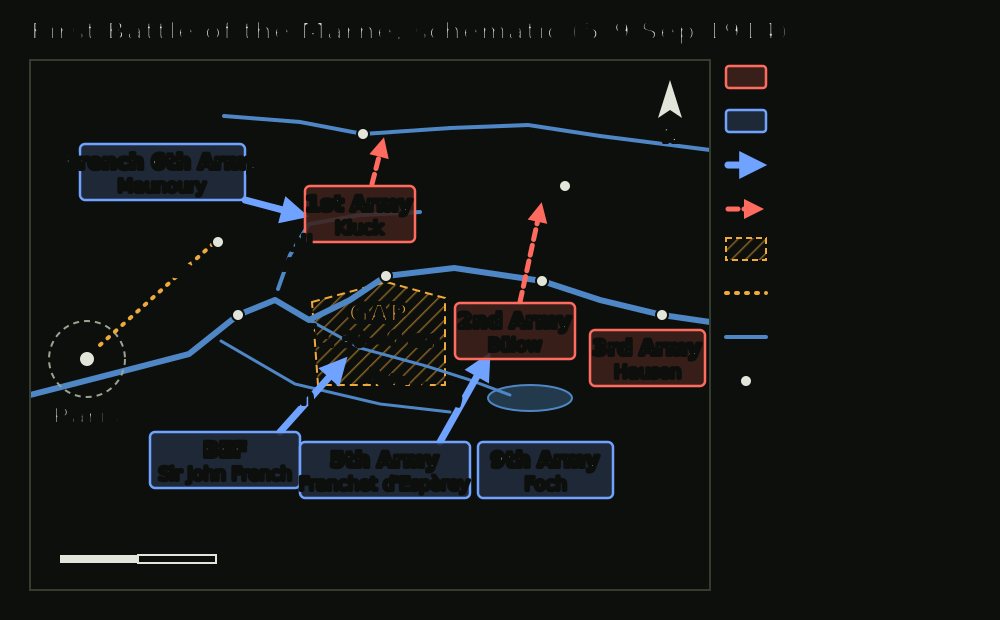
- German (west to east): 1st Army (Kluck), 2nd (Bülow), 3rd (Hausen), 4th (Duke Albrecht of Württemberg) and 5th (Crown Prince Wilhelm). The 1st Army covered its Paris flank with IV Reserve Corps, a brigade short, and one cavalry division, with II Corps echeloned behind its right (source 1).
- Allied (west to east): French 6th Army (Maunoury), the BEF (Sir John French), French 5th Army (Franchet d'Espèrey, who replaced Lanrezac on 3 September), 9th (Foch), 4th (de Langle de Cary) and 3rd (Sarrail). The 6th Army numbered about 70,000 on 5 September; Gallieni counted about 150,000 in his "Army of Paris" including the garrison. The BEF had three corps and a cavalry division, and the French II Cavalry Corps linked it to the 5th Army (source 1).
- Further east, the 3rd, 4th and 5th Armies of both sides mostly fought to pin each other (Figure 1).
Course of the Action
- The turn and the approach (30 Aug–4 Sep): On 30 August Bülow, reporting a decisive victory over the French 5th Army at Guise, asked Kluck to wheel inwards. Kluck turned south-east towards the Oise on the 31st and crossed the Marne on 3–4 September. On the 4th British air reconnaissance reported the 1st Army's south-eastward march in detail (source 1).
- The Ourcq (5–8 Sep): On the afternoon of the 5th the 6th Army ran into Gronau's IV Reserve Corps north-west of Meaux. From that night to the 7th Kluck turned his corps one after another back to the Ourcq (source 1). The price was a wider gap to the 2nd Army. From the night of the 6th, 630 Paris taxis carried men of the 103rd and 104th Infantry Regiments, 7th Infantry Division, to near Nanteuil-le-Haudouin and Silly-le-Long (source 4); the French Ministry of the Armed Forces puts the lift at five battalions, about 5,500 men (source 2).
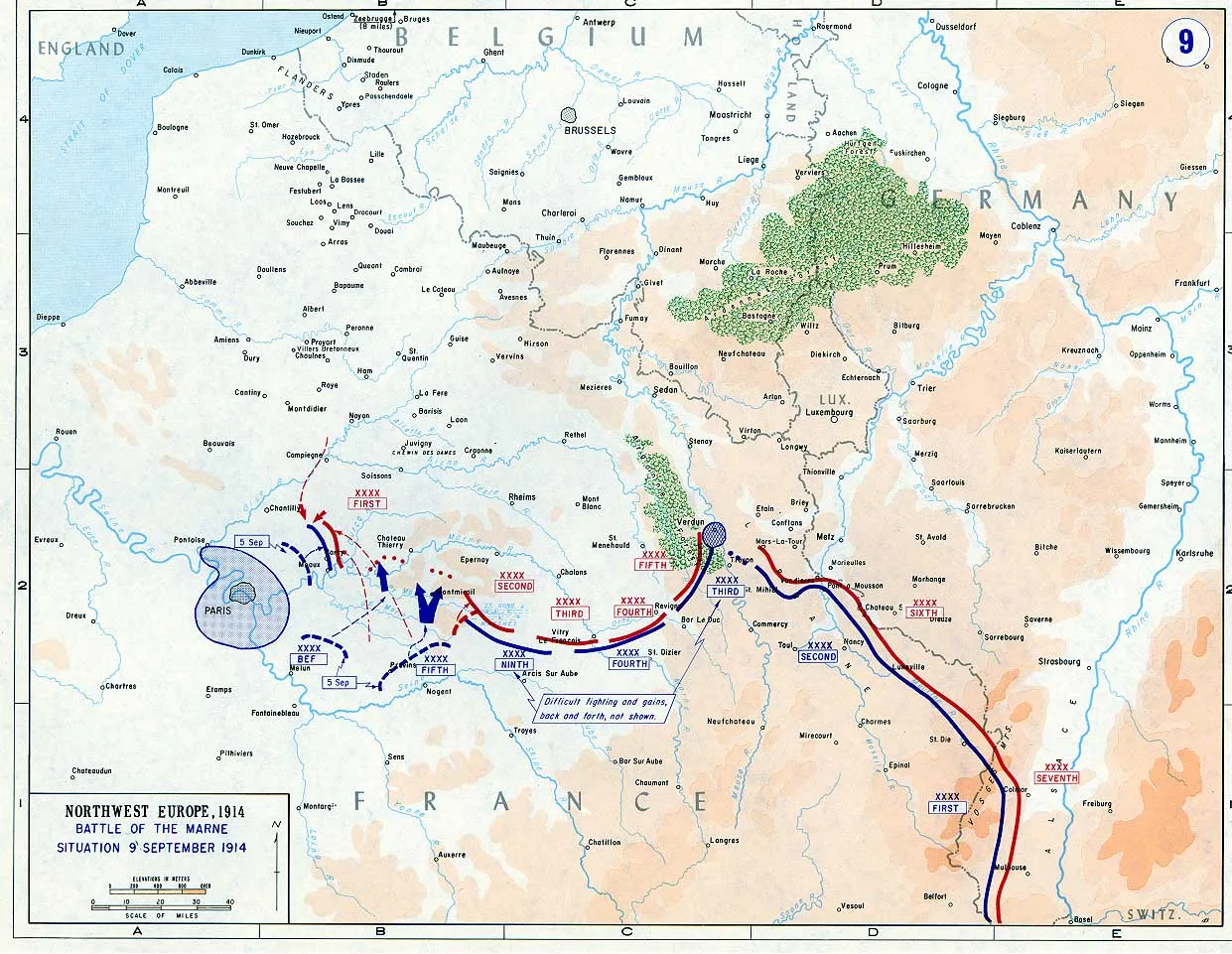
- Into the gap; Saint-Gond (6–9 Sep): From the 6th to the 9th the BEF averaged 11, 9, 10 and 7 miles a day, crossing the Grand Morin, Petit Morin and Marne in turn (source 1). Further east, the left of the German 2nd Army and the right of the 3rd drove back the right of Foch's 9th Army, while the 9th Army's left and the 5th Army threw back Bülow's right (source 1). On the evening of the 9th, zouaves and Breton soldiers of the 77th Infantry Regiment retook the château of Mondement (source 2).
- The retreat (9–14 Sep): The 2nd Army began to withdraw at about 1 p.m. (German time) on the 9th, and the 1st Army issued its retreat order at 2 p.m. On the 10th the Supreme Command (OHL) put the 1st Army under Bülow and pulled the 2nd to 4th Armies back to entrench. By about the 13th the German 1st and 2nd Armies stood north of the Aisne. On the evening of the 14th Falkenhayn took over Moltke's duties, though the change was not announced at once (source 1).
Decision Point Analysis
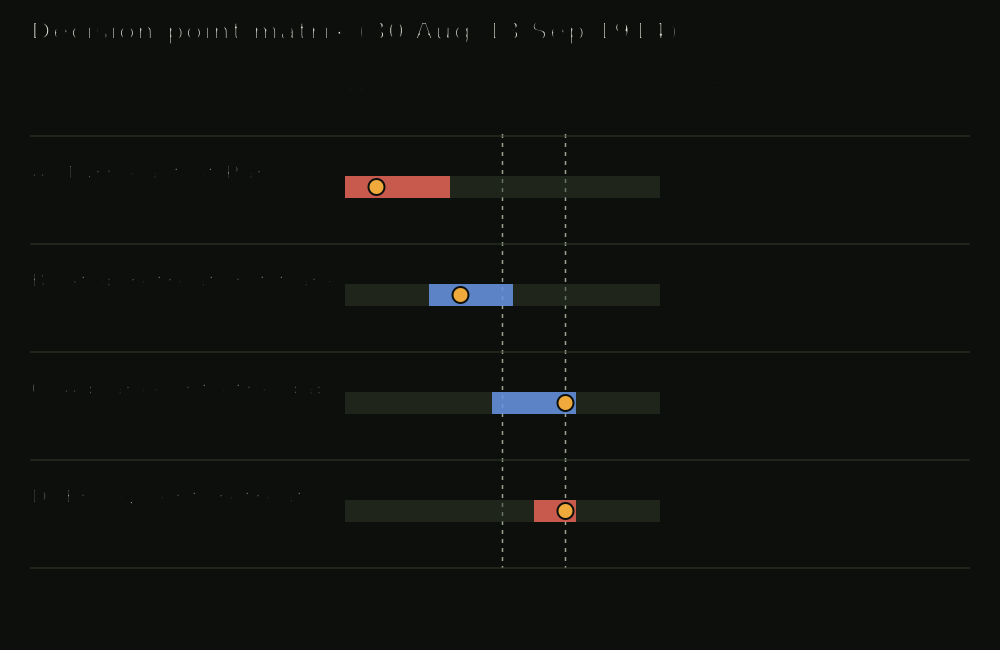
Decision A: turning east of Paris (German 1st Army commander, 30 Aug–4 Sep)
- Situation: on 28 August OHL had directed the 1st Army towards the lower Seine. On the 30th Bülow asked by wireless for the 1st Army to wheel inwards and exploit the victory at Guise (source 1).
- Options: (a) the planned wide wheel west of Paris; (b) turn south-east and pursue the retreating 5th Army; (c) leave a strong flank guard facing Paris and follow in echelon behind the 2nd Army.
- Decision and result: Kluck chose (b), and OHL approved it late on the 30th. On the night of 2/3 September OHL ordered the 1st Army to follow in echelon behind the 2nd and take over flank protection. With the 2nd Army a day's march behind, Kluck left only IV Reserve Corps and II Corps facing Paris and crossed the Marne with the rest. When a fresh order on the evening of the 4th told the 1st and 2nd Armies to face Paris, Kluck replied that the forces there were still assembling and proposed continuing the pursuit (source 1).
- What could have been done differently: pursuing a retreating enemy was locally sensible. But Kluck's chief of staff, Kuhl, later admitted that no one had the slightest sign of an imminent French general offensive (source 1). Kluck staked his flank on an unverified assumption. In TDG terms, he never asked "what if there is an enemy reserve I cannot see?"
Decision B: stop the retreat and strike the flank (French C-in-C and military governor of Paris, 3–6 Sep)
- Situation: the 6th Army had been under Gallieni's orders since 31 August. On the 4th he moved it east and proposed to British headquarters a joint offensive the next day. The same day Joffre wrote to the British that he was still keeping to the plan of retreat (source 1).
- Options: (a) keep retreating behind the Seine to gather more strength; (b) a local flank attack by the 6th Army alone; (c) a general offensive along the whole front.
- Decision and result: Joffre chose (c) in a general order dated 4 September. The 6th Army, the BEF and the 5th Army on the left, and the 3rd Army on the right, were to strike the German flanks while the 9th and 4th Armies held in the centre. On the 5th Joffre visited Sir John French in person to secure British participation (sources 1, 3). Some accounts credit Gallieni with spotting Kluck's turn first and pushing Joffre to act; the British Official History concludes that the decision to resume the offensive rested with Joffre (source 1).
- What could have been done differently: (a) would have given the Germans time to recover. (b) could be parried by Kluck turning to face it, which is exactly what he did. Joffre combined timing, forces gathered by rail, and coalition coordination.
Decision C: advancing into the gap (BEF and French 5th Army, 6–9 Sep)
- Situation: because the attack order reached it only at 3 a.m. on the 5th, the BEF ended that day 12–15 miles behind where Joffre expected it. On the 6th Haig's I Corps, uneasy that the Crécy and Malvoisine forests might hide an enemy on its left, halted and stopped for the night at 6.30 p.m. 8 miles short of its objective (source 1).
- Options: (a) drive deep and fast into the gap regardless of the flanks; (b) advance by bounds, checking the flanks; (c) merely fix the enemy in front.
- Decision and result: (b). French writers criticized the pace; the British Official History answers with the ground and the troops' exhaustion. On the evening of the 8th Joffre judged that the German right had split into two groups linked only by cavalry (Special Instruction No. 19). On the morning of the 9th Bülow passed to the 1st Army an air report of four long enemy columns marching on the Marne, and began his retreat; the columns were the British 1st, 2nd, 3rd and 5th Divisions. A German General Staff officer's account speaks of five columns (source 1).
- What could have been done differently: an exploitation need not be fast to be decisive if the enemy command feels the threat. Pushing the cavalry corps ahead to reconnoitre and screen the gap, with infantry following, seems likely to have gone deeper for the same risk.
Decision D: sending a liaison officer, and retreat (German OHL and 2nd Army, 8–9 Sep)
- Situation: OHL sat in Luxembourg, more than 130 miles away, relying on a single wireless receiving station and on liaison officers. No orders went to the 1st and 2nd Armies from the 5th to the 8th (source 1).
- Options: (a) Moltke goes forward himself; (b) pull the 1st Army east to close the gap; (c) leave the judgement to a liaison officer.
- Decision and result: (c). On the morning of the 8th Moltke sent Lieutenant-Colonel Hentsch round the armies with full powers but no written instructions. Hentsch met Bülow at 2nd Army headquarters that evening and by early on the 9th had concluded there was no option but to fall back behind the Marne. Shortly after 12.30 p.m. (German time) he reached 1st Army headquarters at Mareuil, conferred with the chief of staff, Kuhl, rather than Kluck, and at 2 p.m. the 1st Army ordered its retreat (source 1). The accounts of that meeting differ. Kuhl wrote that he protested strongly because his attack was in full swing; Hentsch stated that the 1st Army's left wing had already been ordered back across the Ourcq before he arrived (source 1).
- What could have been done differently: a commander who cannot see the battle should either put the delegated authority in writing, go forward, or set up a forward command post. Instead a junior staff officer, under oral delegation only, effectively decided the campaign.
Lessons
- Mission command and control: German army commanders had wide latitude, but OHL had no overall picture, and Kluck reshaped OHL's orders to suit his own judgement (source 1). Latitude works when shared commander's intent and communications back it up.
- Information and liaison: the Allies tracked Kluck's march through aerial reconnaissance; the Germans decided the campaign on the judgement of one liaison officer.
- Culmination: long marches, detached corps and shortages of food and ammunition brought the German right wing to its culminating point on the Marne (sources 1, 3). An attacker has to plan for that point in advance.
- Gaps: the gap between adjacent formations is the defender's most dangerous point, but an attacker entering it exposes his own flanks. The BEF's caution and Bülow's retreat were two different calculations of the same gap's risk.
- Railways and interior lines: Joffre moved troops west by rail to build up the 6th Army. The taxis became a symbol of fighting spirit, but most of the troops came by train (sources 1, 4).
- Thinking in TDG terms: at each decision, ask three questions. What if there is an enemy I cannot see on my flank? When do I stop, and when do I strike? When I cannot see, whom do I trust with what?
Sources
- British Official History, Military Operations, France and Belgium, 1914, vol. 1 (Mons to the Aisne), Historical Section of the Committee of Imperial Defence, Macmillan (1922), full text on the Internet Archive (public domain). https://archive.org/details/militaryoperatio01edmouoft (accessed 2026-10-21)
- French Ministry of the Armed Forces, Les Chemins de la Mémoire no. 143, "September 1914: the First Battle of the Marne" (by a professor at the University of Metz) (October 2004). https://www.defense.gouv.fr/chemins-memoire/histoire-memoires/ressources-historiques/premiere-guerre-mondiale/combattre-combats/fronts-0 (accessed 2026-10-21)
- 1914-1918-online, International Encyclopedia of the First World War (Freie Universität Berlin), "Marne, Battles of the", version 1.1 (2023-06-01). https://doi.org/10.15463/ie1418.11423/1.1 (accessed 2026-10-21)
- Musée de l'Armée (Invalides), teachers' object sheet "The Marne taxi" (2025). https://www.musee-armee.fr/fileadmin/user_upload/Ressources_pedagogiques/2025/FicheObjet_TaxiVF.pdf (accessed 2026-10-21)
- US Military Academy Department of History, situation map of the Marne (5–9 Sep 1914), Wikimedia Commons file page (public domain confirmed). https://commons.wikimedia.org/wiki/File:Battle_of_the_Marne_-_Map.jpg (accessed 2026-10-21)
