
Is the Strait of Hormuz closed? Why a few mines can stop a sea lane
· Updated · 2026-02 – 2027-01
This analysis is for education and research. Content on ongoing wars may change as new information emerges. We label claims separately from confirmed facts.
How the decision points in this analysis are adjudicated → · Glossary
Key judgements
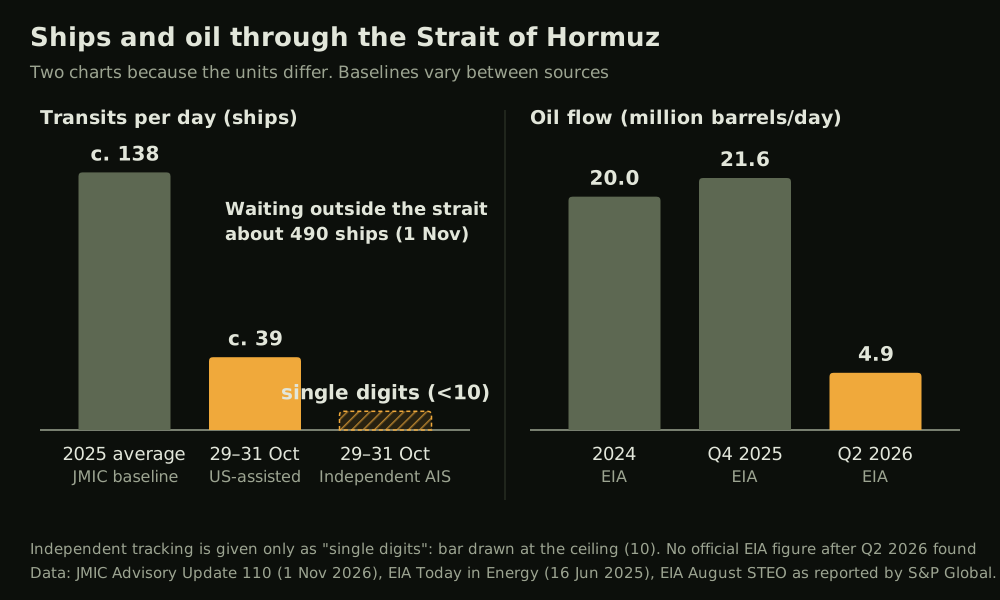
As of 5 November 2026 the Strait of Hormuz cannot honestly be called either closed or open. Iran has declared it shut and hails passing ships towards a northern route under its own control. The United States says the southern route on the Omani side is open and that it has cleared the mines. Actual traffic sits somewhere in between. According to the 1 November update from the Joint Maritime Information Center (JMIC), US-assisted transits on 29–31 October averaged about 39 a day, under 30 per cent of the 2025 average of about 138. Independent ship tracking, which does not rely on US data, saw single-digit daily transits, and about 490 ships were waiting outside the strait (source 1).
Neither Iran nor the United States has published how many mines were laid. The only figure in circulation is an end-of-August report that US Navy underwater drones had found more than 100 suspected mine-like objects (source 13). On 4 November the Islamic Revolutionary Guard Corps (IRGC) claimed that four tankers had struck mines on a "prohibited" route south of the strait and were burning, but gave no ship names or flags, and there has been no independent confirmation (sources 3, 4). The strikes JMIC confirmed in late October were unidentified projectiles and explosives that a small boat fixed to a hull. Its confirmed list contains no sea-mine strike (source 1).
We reach three judgements. First, the strait was stopped by the risk that mines might be there; how many were actually laid matters much less. Merchant ships move on insurance prices, not on naval statements, and underwriters price in threats that nobody can confirm. Second, even if Washington and Tehran reach a deal, mine clearance and insurance procedures mean traffic will take weeks to months to return to pre-war levels. At Wonsan in 1950, in the Tanker War of 1987–88 and in the 1991 Gulf War, the time needed to clear mines set the pace of operations. Third, South Korea has not decided on a Hormuz "deployment". What cleared the vice-ministers' meeting on 5 November is an amended motion to extend the Cheonghae Unit's dispatch, widening its area to the open sea south of Oman and adding a maritime patrol aircraft, an explosive ordnance disposal (EOD) team and unmanned mine-countermeasure equipment. A cabinet meeting (scheduled for 10 November) and National Assembly consent are still to come, and mine clearance inside the strait is not part of the motion (sources 28, 29).
The figures here are those public as of 5 November. A statement by one party alone is marked claim, and anything resting on one outlet is marked single source.
Is the Strait of Hormuz closed right now?
The war began on 28 February with US and Israeli strikes on Iran. Iran declared the strait closed in early March, and on 3 March marine insurers withdrew war-risk cover in the Gulf (sources 41, 42). Since then the strait has closed and reopened repeatedly. A temporary ceasefire came on 8 April, but on 13 April the US Navy began a blockade of Iranian ports, which is still in force (sources 1, 42). In May Iran set up a "Persian Gulf Strait Authority" to issue transit permits and collect tolls; the US Treasury sanctioned it on 27 May (source 22). Iran declared the strait closed again on 12 July. JMIC replied the same day that the southern route remained open and that "there is no controlling authority regulating passage or fee required for any route" (source 2). On 27 September the IRGC proclaimed a ban on unauthorised transit (source 42).
November has brought no change in the basic picture. Iran says the strait stays closed until the United States lifts oil sanctions, ends its naval blockade and releases frozen funds (source 4). A senior Iranian official added that the strait could reopen within two days if Washington met those demands (source 7). On 3 November the United States carried out "limited, defensive" strikes on Iranian surface-to-air missiles on Qeshm Island, which the US president called a "minor attack". The next day he said "we have to do something large", hinting at a much bigger strike (sources 4, 6). Indirect talks continue through Qatari, Pakistani and Saudi mediators, with mixed reports of progress (sources 5, 6). The market is betting on a deal. On 4 November Brent crude fell below $100 a barrel for the first time since September (sources 5, 6).
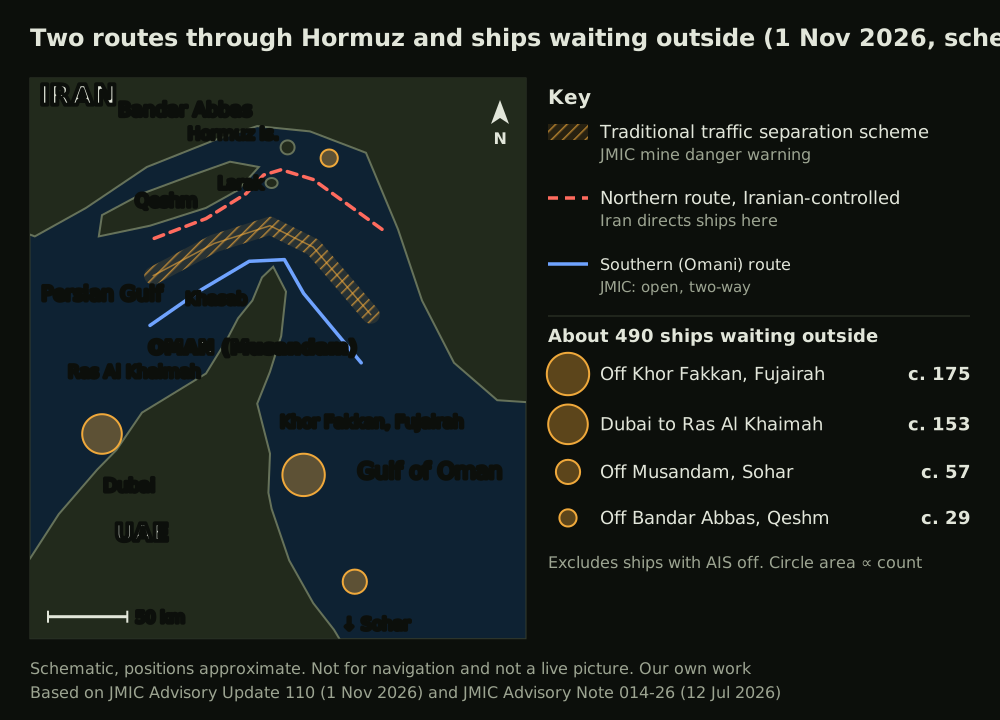
| Item | Figure | Date and source |
|---|---|---|
| Normal traffic | about 138 transits a day | 2025 average, JMIC (source 1) |
| US-assisted transits | about 39 a day (119 in 72 hours) | 29–31 October, US Navy shipping-control data cited by JMIC (source 1) |
| Transits seen by independent tracking | single digits a day | same period, JMIC (source 1) |
| Ships waiting outside the strait | about 490 | 1 November, JMIC; excludes ships with the Automatic Identification System (AIS) switched off (source 1) |
| Seafarers unable to leave the Gulf | about 6,000 (up to 400 ships) | 28 August, International Maritime Organization (IMO) (source 17); on 8 July the IMO Secretary-General said "nearly 6,000" (source 16) |
| Attacks on merchant ships | 28 in October, the most in any month since tracking began in 2017 | Washington Institute for Near East Policy (WINEP) count, Reuters 23 October (source 15) |
| Attacks in a week | about 12 ships in the week of 5–11 October | maritime risk consultancy count, Reuters 23 October (source 15) |
| Confirmed attacks inside the strait | 18 since 6 October | JMIC, 1 November (source 1) |
The figure of 39 US-assisted transits and the single digits seen by independent tracking do not contradict each other. The first is counted by the US Navy itself; the second comes from commercial data that pick up AIS signals via satellites and shore stations. Many ships switch off AIS to avoid attack, which opens the gap (source 1). Pre-war baselines also differ: JMIC uses 138 a day, while the International Monetary Fund's ship-tracking service uses a median of about 73 (sources 1, 21). Any percentage needs its baseline stated.
Why does the Strait of Hormuz matter?
According to the US Energy Information Administration (EIA), oil moving through the Strait of Hormuz averaged 20 million barrels a day in 2024. That is about 20 per cent of world petroleum consumption and more than a quarter of seaborne oil trade, and about a fifth of world trade in liquefied natural gas (LNG) also passed through the strait. Asia took 84 per cent of the crude and 83 per cent of the LNG, and South Korea was one of the four main destinations for the strait's crude, alongside China, India and Japan. Spare capacity on Saudi and Emirati bypass pipelines comes to only about 2.6 million barrels a day (source 18).
The war broke that flow. The EIA put oil flows through the strait at 4.9 million barrels a day in the second quarter of 2026, against 21.6 million in the fourth quarter of 2025 (source 19). Some has returned since. The shipping analytics firm Kpler estimated oil flows through the strait in mid-October at about 14 million barrels a day, 82 per cent of the pre-war level. The figure was reported by the Wall Street Journal; the original is paywalled and we could check it only in a secondary summary, so it is single source (source 42). US Central Command (CENTCOM) claims that 1.5 billion barrels of crude have been exported with US help since the summer and that it has assisted more than 3,000 transits over six months (source 20). With ship counts under 30 per cent of normal, a recovery in oil on that scale would suggest that large tankers are crossing with AIS off or joining US-assisted transits.
South Korea was heavily exposed. In 2025 the Middle East supplied 69.1 per cent of its crude imports. As the government and refiners turned to the Americas and Africa, the Middle Eastern share of crude arriving in May–July 2026 fell to a provisional 48.5 per cent. The International Energy Agency (IEA) agreed a joint release of 400 million barrels of member stocks soon after the war began, and South Korea's share was 22.46 million barrels. Rather than release government stocks directly, the government chose to meet it through product swaps and an adjustment to private-sector stockholding obligations (source 40).
How many mines has Iran laid?
A naval mine is an explosive charge left floating, tethered or on the seabed to go off when a ship passes. Some explode on contact with a hull; others sense a ship's magnetic field or noise and need no contact, and mines can also be set off remotely or on a timer. They work best in shallow water (source 14).
Before the war a private risk consultancy put Iran's mine stockpile at 5,000–6,000. The US Defense Intelligence Agency (DIA) assessed in 2019 that it exceeded 5,000 (source 14; the DIA document itself could not be opened, so this rests on a secondary citation). A report that CENTCOM put the stockpile at more than 8,000 is single source (source 12). Known types include the Maham 3, a moored mine with magnetic and acoustic sensors, and the Maham 7, which sits on the seabed. An IRGC fast boat can carry two or three mines, and small fishing boats, dhows and divers can also lay them. The US military said on 10 March that it had destroyed 16 Iranian minelaying craft (source 14).
There is still no official figure for how many mines were actually laid in 2026. In April a British naval specialist site wrote that no confirmed count existed (source 13). On 25 August came the report that US Navy underwater drones had found more than 100 suspected objects (see source 13; the original report was by Axios). In a video message on 27–28 August the CENTCOM commander said that mines the IRGC had laid months earlier had been cleared from the recognised traffic separation scheme (TSS), without giving a number (source 11). That was about four and a half months after clearance began on 11 April (source 12). Shortly before, Iran's deputy foreign minister had said that only Iran knew where the mines were (source 12). On 31 August CENTCOM said it had struck two Iranian launchers on Larak Island before they could launch mines (source 10), which means mines were also being scattered from the shore by rocket (source 12).
The table sets out the issues on which claims diverge most.
| Issue | Iran (IRGC) claim | US (CENTCOM) claim | Independent data |
|---|---|---|---|
| Is the strait open? (1–5 November) | Closed until the US meets its conditions; ships should take the northern Iranian route (source 4) | The southern route is open and thousands of merchant ships have passed safely (source 8) | Threat level "severe"; about 39 US-assisted transits a day, single digits on independent tracking, about 490 waiting (JMIC, source 1) |
| Transit permits and tolls | Permits from the Strait Authority; more than 3,000 ships have paid fees and used Iran's designated route (Iranian media, source 10) | The Authority is sanctioned (source 22); ships that pay tolls will be intercepted | "There is no controlling authority regulating passage or fee required for any route" (JMIC, 12 July, source 2) |
| Mines laid | Not disclosed; "only Iran knows where they are" (source 12) | Not disclosed; more than 100 suspected objects detected (reported, source 13); TSS cleared (late August, source 11); main routes cleared (28 October, source 8) | No official or independent count. On 1 November JMIC still advised vigilance for attempted mining in and near the TSS (source 1) |
| Mine strikes | A very large crude carrier on 31 August, three or four tankers on 29–30 October, two on 1 November, four "destroyed" on 4 November; all on a "prohibited" route, no ship names (sources 3, 9, 10) | "No ships have hit mines" (31 August, source 9); no specific rebuttal of the 4 November claim found | Confirmed late-October cases are three projectile strikes (RITI, ARZANAH, AL MAYEDA) and one explosive fixed by a small boat (LOUISE 1); no confirmed sea-mine strike (JMIC, source 1) |
| Ships hit, cumulative | Also claims hits the US calls false | More than 95 per cent of assisted transits safe (source 20, claim) | Since March: 113 by WINEP (23 October), 120 by the IMO, 135 by UK Maritime Trade Operations (UKMTO) (16 October) (source 15); 167 incidents of all types by JMIC (1 November) (source 1) |
Cumulative attack counts differ between bodies because they draw the line between "attack" and "incident" differently and cover different stretches of sea.
The IRGC's mine claims always concern the southern route that Iran calls "prohibited", outside the TSS the US says it has cleared. Even unconfirmed, such a claim forces owners and insurers to reprice the southern route, which makes Iran's designated northern route relatively more attractive. Whether or not the mines exist, the claim alone achieves part of its aim. Conversely, CENTCOM's line that "no ships have hit mines" can be true for sea mines specifically; the US has acknowledged that ships were hit (source 10). Readers following the news will get a more accurate picture by separating sea mines, explosives fixed to hulls, and projectiles such as drones and missiles.
Why a few mines can stop a strait
Above all, merchant shipping runs on insurance. Before the war the additional war-risk premium for the Gulf was about 0.25 per cent of hull value. After the war began it rose as high as 10 per cent and was still 3–8 per cent at the end of August. For a $150 million tanker, a 10 per cent rate adds $15 million to a single transit, against about $375,000 before the war. Removing an area from the high-risk list of the London market's Joint War Committee (JWC) requires formal evidence that clearance is complete and a sustained record of incident-free passages (source 21). On 16 August the IMF's ship tracking recorded a single commercial transit. The US president announced nine days later that the mines had been cleared, and the insurance market did not cut its rates on his word alone (source 21).
Clearing mines is far slower than laying them. A few fast boats can lay mines in days, but it took US forces four and a half months to clear the two TSS lanes (source 12). Before the war the US Navy had moved its last four Avenger-class minesweepers in Bahrain out of the Middle East; sources differ on whether they were retired or temporarily withdrawn (sources 12, 13, 25). Clearance relied on divers, special forces, unmanned underwater vehicles (UUVs) and sonar towed by unmanned surface vessels (sources 11, 13).
Unverifiable threats also go into the risk calculation. The side that declares clearance complete cannot prove that no mine remains. So long as the side that laid them keeps their positions secret, the possibility of one last mine turns into higher premiums and crews refusing to sail.
Mines did the same thing to a sea lane in the Korean War.
| Case | Mines laid (estimate) | Immediate result | Lesson |
|---|---|---|---|
| Wonsan, 1950 | "thousands" supplied by the Soviet Union | Two US minesweepers (Pirate, Pledge) sunk on 12 October; ROK Navy minesweeper YMS-516 lost on 18 October; landing put back from the 20th to the 26th (source 23) | A side with no navy can still take control of a landing timetable with mines |
| Tanker War, 1987–88 | Iranian M-08 contact mines and others | Bridgeton, in the first escorted convoy, struck on 24 July 1987; US frigate Samuel B. Roberts struck on 14 April 1988 (sources 24, 25) | A mine costing $1,000–1,500 caused about $90 million in repairs |
| Gulf War, 1991 | more than 1,000 (about 1,290 estimated) | Amphibious assault ship Tripoli and cruiser Princeton struck less than three hours apart on 18 February (sources 26, 27) | Mines did not prevent the war, but they removed the option of a landing |
| Hormuz, 2026 | no official count; more than 100 suspected objects (reported) | about four and a half months to clear the TSS; early-November traffic under 30 per cent of normal (sources 1, 12) | Even unconfirmed mine claims hold traffic down |
Wonsan, 1950. After Inchon, UN forces planned to land the US X Corps at Wonsan. Sweeping began on 10 October. On the 12th the US minesweepers Pirate and Pledge struck mines and sank, and on the 18th the ROK Navy's YMS-516 was lost to a magnetic mine during a check sweep off the beaches. The landing, planned for 20 October, slipped to the 26th. The US Naval Historical Center recorded that a major disaster could easily have resulted (source 23). The admiral in charge of the sweep is said to have remarked, in substance, that a nation without a navy had taken control of the sea from the United States using pre-First World War weapons laid by vessels of the kind used at the time of Christ. We could not find the primary record of the remark. The Republic of Korea Navy lost a minesweeper in its first mine war.
The Tanker War, 1987–88. With Kuwaiti tankers under repeated attack during the Iran–Iraq War, the United States agreed on 7 March 1987 to put Kuwaiti tankers under the US flag and escort them (Operation Earnest Will). The first convoy left the Gulf of Oman on 22 July. Two days later, at 06:55 on the 24th, the supertanker Bridgeton struck an M-08 contact mine, which tore a hole of about 50 square metres in its hull. Nobody was hurt and the ship stayed afloat (source 24). On the night of 21 September the United States caught the Iranian landing ship Iran Ajr laying mines. Mines found aboard matched the design of those swept off Kuwait and carried consecutive serial numbers (source 24). On 14 April 1988 the US frigate Samuel B. Roberts, on escort duty, struck an M-08 mine that broke its keel and flooded its engine room. The mine is estimated to have cost $1,000–1,500; repairs cost about $90 million and took 18 months (source 25; the amounts and duration vary between sources). Four days later, on the 18th, the United States mounted a one-day retaliatory operation (Praying Mantis), striking Iranian maritime bases and sinking two Iranian warships (source 25).
The Gulf War, 1991. Iraq laid more than 1,000 mines off Kuwait (about 1,290 in ten danger areas by a US Naval Institute estimate) (source 27). At 04:36 on 18 February the amphibious assault ship Tripoli, flagship of the coalition mine-countermeasures force, struck a moored mine; at about 07:15 the Aegis cruiser Princeton struck an influence mine on the seabed. Allied ships had sighted more than 150 suspected mines in the preceding weeks (source 26). The coalition never landed on the Kuwaiti coast. The Marine landing force afloat served instead as a demonstration that held Iraqi forces on the shore (source 27).
In all four cases the side that used mines was the side that did not control the sea. What it was after was less a particular ship than its opponent's time and options. Iran has gained the same thing at Hormuz in 2026. The United States can blockade Iranian ports from outside the strait, but proving to insurers and seafarers that the lanes inside it are safe takes months.
How far do Korean ships and the 'deployment' go?
Korean ships and seafarers. When the war began, 26 Korean ships were counted in the Gulf inside the strait (source 43). They began to leave during the June ceasefire. By the Ministry of Oceans and Fisheries' count, 22 ships and 135 Korean seafarers remained on 22 June (source 38), and by 7 July only two Korean ships and 17 Koreans were left. Ten of the 17 were aboard five foreign ships that operate only within the Gulf and had no plans to leave (source 39). On 12 July the government advised Korean shipping companies to keep out of the strait (source 43). We found no newer ministry count after July.
The Korean ship directly hit was HMM's Namu. At about 15:30 local time on 4 May, while the ship lay at anchor inside the strait, an explosion and fire broke out on the port side of its engine room. On 10 May the Ministry of Foreign Affairs announced the result of a joint government investigation: two unidentified flying objects had struck the outer plating of the port-side ballast tank at the stern twice, about a minute apart, leaving damage about 5 metres wide and about 7 metres deep into the hull. The investigators judged a mine or torpedo unlikely and did not name an attacker (source 37).
The amended Cheonghae Unit motion. Behind the "Hormuz deployment" debate that fills Korean search results is the following, as reported on 5 November.
| Item | Content | Status |
|---|---|---|
| Area of operations | Gulf of Aden off Somalia (about 600 nm, about 1,100 km) → open sea south of Oman, to the southern edge of Duqm port (about 1,200 nm, about 2,222 km) | Cleared by vice-ministers on 5 November; awaits National Assembly consent (sources 28, 29) |
| Added assets | One P-8 maritime patrol aircraft (45 personnel), an EOD team of 30, unmanned underwater vehicles, unmanned surface vessels and remotely operated vehicles | Proposed (sources 28, 29, 30) |
| Personnel cap | 320 → 395 | Proposed (source 28) |
| Mission | Existing tasks (safe passage for Korean ships, protection of nationals in emergencies) plus "supporting the restoration of freedom of navigation on international sea lanes" | Proposed (source 28) |
| Command and coalitions | Under the Chairman of the Joint Chiefs of Staff, operating independently, joining no coalition for now | Proposed (source 28) |
| Mine clearance inside the strait | Not in this motion; would need safe conditions such as the end of the war or a bilateral agreement, plus separate National Assembly consent | Undecided (source 29) |
| Timetable | Cabinet meeting and presidential approval on 10 November → Assembly committee and plenary. If passed this year, the added assets join in the first half of 2027. The dispatch runs from the date of consent to 31 December 2027 | Scheduled (sources 28, 29) |
The "650 km" in headlines is not the size of the new area. It is the reported straight-line distance from Duqm to the Strait of Hormuz (about 350 nm) (source 28). Our own great-circle measurement from Duqm to the narrowest part of the strait gives about 780 km. Either way, the new area stops several hundred kilometres short of the strait. Reports differ on whether the Gulf of Oman is included. The motion's title says "open sea south of Oman", and one outlet reported that the Gulf of Oman is excluded (source 29). The Ministry of National Defense cites four principles: no involvement in the war, protection of Korean nationals and ships, no detection inside Iranian territory or territorial waters or inside the Strait of Hormuz, and independent command (source 29). The official rationale is piracy, which the ministry says rose from 11 incidents in the Gulf of Aden area last year to 36 this year (source 29).
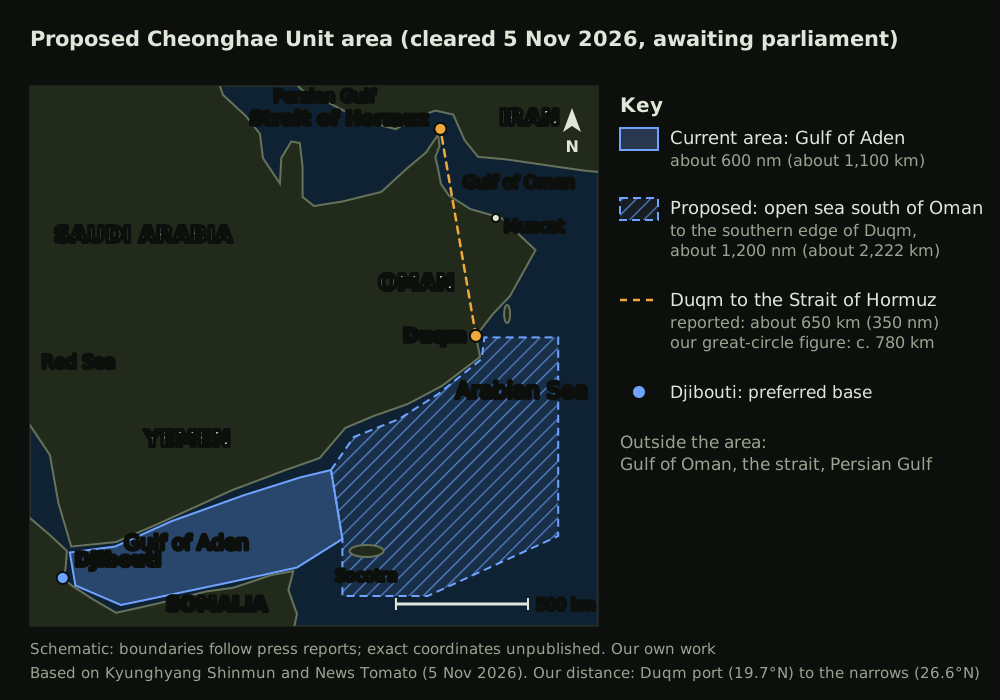
How it differs from 2020. On 21 January 2020 the government "temporarily" extended the Cheonghae Unit's area into the Gulf of Oman and the Persian Gulf without joining the US-led maritime security coalition (source 32). That expansion was criticised for going ahead without National Assembly consent. The new motion goes through the Assembly and stops outside the strait. It comes less close to the strait than 2020 did, and its procedure is heavier.
US pressure and public opinion. On 5 May the presidential office said it was reviewing the US request for a Hormuz dispatch with the Korean Peninsula's readiness and domestic legal procedures in mind (source 33). On 4 September the US administration said it was "still waiting" for South Korea to deploy assets to the region, and a senior presidential official said that "nothing has been decided", with options including non-combat tasks outside the strait such as surveillance, reconnaissance and mine clearance (source 44). September polls showed more opposition than support. The National Barometer Survey (NBS) asked 1,002 people on 7–9 September about sending patrol aircraft and a support ship to Hormuz and found 45 per cent against and 36 per cent in favour (source 34); a Gallup Korea poll found 55 per cent against and 32 per cent in favour (source 35). Both asked about a Hormuz deployment in general, before the November motion existed. Civic groups argue that widening an existing unit's mission amounts to a "back-door deployment", with a risk of being drawn into the war through the Combined Maritime Forces (CMF), which sits under US Central Command (source 36).
In short, the government's proposal amounts to watching from outside the strait and getting ready to help with clearance once the war is over. A defence official explained that Korea has very little experience of unmanned mine countermeasures and needs to prepare in advance (source 30). The navy that lost a minesweeper at Wonsan is facing mines again 76 years later. Given how expensive time is in mine warfare, sending the equipment early so crews can learn it is sensible in itself. But no decision has been taken to put that equipment inside the strait. That would require the war to end and separate National Assembly consent.
Scenarios to January 2027
| Scenario | Description | Likelihood | Early indicators |
|---|---|---|---|
| 1. Contested, partly open strait continues | Indirect talks stall; local strikes and attacks on ships recur. US-assisted transits stay at a few dozen a day and hundreds of ships keep waiting | Even chance (most likely) | JMIC weekly data showing 30–50 assisted transits a day; repeated IRGC claims of strikes on the "prohibited" route |
| 2. Phased reopening after a deal | US easing of sanctions and the blockade meets Iran's sequenced plan to reopen on the second day. Clearance inside the strait and the return of normal insurance take weeks to months | Low | Mediators' announcements; UK- and French-led mine countermeasures forces entering the strait; JWC narrowing its high-risk area; the 490-ship queue shrinking |
| 3. Escalation and a tighter blockade | A large US strike, further Iranian minelaying and attacks on ships drive transits back to single digits a day | Low | A large US strike; signs of minelaying inside the strait (announced strikes on minelayers or shore launchers); war-risk rates rising again |
Our confidence in these judgements is low. The negotiations shift day by day, and many of the key figures come from the parties themselves. In every scenario, though, traffic is likely to return to pre-war levels more slowly than any deal is reached, because insurance, the pace of clearance and unverifiable threats do not disappear with a signed text.
Dated indicators to watch:
- 10 November: cabinet approval of the amended Cheonghae Unit motion and its submission to the National Assembly, followed by the date it goes to the Assembly's National Defence Committee and the debate over whether the Gulf of Oman is included (sources 28, 29).
- Mid-November: US and Iranian replies to Qatar's new mediation proposal. Qatar said on 3 November that it expected both sides' replies within 36 hours (source 5).
- Late November: the Chinese special envoy for the Middle East's visits to Iran, Oman and Saudi Arabia (source 5).
- Weekly: which way JMIC's figures for US-assisted transits (39 a day) and waiting ships (490) move. If assisted transits pass 60 a day and the queue shrinks markedly, the picture is tilting towards scenario 2 (our own threshold).
- If a deal comes: deployment of the mine countermeasures forces the UK and France have prepared, and changes to the JWC high-risk area. On 6 October a French naval commander said the minehunters were "ready to go now" (source 45). Only when additional war-risk premiums fall below 1 per cent of hull value (about 0.25 per cent before the war; the 1 per cent threshold is our own) can the strait be said to be truly open (source 21).
Sources
- JMIC (published by UKMTO), Advisory Update 110, 1 March to 1 November 2026 (2026-11-01). https://www.ukmto.org/-/media/ukmto/products/jmic_advisory_update_110_01-nov-1.pdf (accessed 2026-11-05)
- JMIC, Advisory Note 014-26: the Strait of Hormuz is not closed (2026-07-12). https://www.ukmto.org/-/media/ukmto/products/jmic-advisory-note-01426-soh-not-closed.pdf (accessed 2026-11-05)
- Dawn (Reuters), IRGC claims four tankers hit mines (2026-11-04). https://www.dawn.com/news/2042031 (accessed 2026-11-05)
- investingLive, IRGC four-tanker claim, Iran's conditions for reopening, Qeshm strikes (2026-11-04). https://investinglive.com/commodities/iran-s-irgc-says-four-tankers-destroyed-by-mines-south-of-hormuz-two-vessels-detained/ (accessed 2026-11-05)
- CBS News, Iran war live updates (2026-11-03 to 04). https://www.cbsnews.com/live-updates/iran-war-us-trump-midterms-strait-of-hormuz/ (accessed 2026-11-05)
- Gulf News, US warns of a large strike as Brent falls (2026-11-04). https://gulfnews.com/world/mena/middle-east-conflict-trump-warns-of-heavy-hit-as-iran-says-americans-voted-no-to-war-1.500735100 (accessed 2026-11-05)
- OilPrice.com, Brent at $100 on hopes of a US–Iran deal (2026-11-04). https://oilprice.com/Latest-Energy-News/World-News/Brent-Falls-to-100-as-Traders-Bet-on-a-US-Iran-Deal.html (accessed 2026-11-05)
- Gulf News, CENTCOM says main transit routes cleared of mines (2026-10-29). https://gulfnews.com/world/mena/us-military-rejects-iranian-mine-strike-claims-says-hormuz-transit-lanes-remain-clear-1.500727648 (accessed 2026-11-05)
- Dawn, CENTCOM dismisses Iranian claims of a tanker hitting mines (2026-08-31). https://www.dawn.com/news/2026407/centcom-dismisses-iranian-claims-of-tanker-hitting-mines-in-strait-of-hormuz (accessed 2026-11-05)
- The Maritime Executive, CENTCOM says Iran is trying to intimidate shipping with false reports (2026-08-31). https://maritime-executive.com/article/centcom-says-iran-attempts-to-intimidate-shipping-with-false-reports (accessed 2026-11-05)
- Deseret News, US military says the Hormuz traffic separation scheme is cleared of mines (2026-08-28). https://www.deseret.com/politics/2026/08/28/us-military-says-strait-of-hormuz-has-been-cleared-of-mines-as-war-negotiations-stall/ (accessed 2026-11-05)
- 19FortyFive, four and a half months to clear the Hormuz mine routes (2026-08-30). https://www.19fortyfive.com/2026/08/the-us-navy-says-the-hormuz-mine-routes-are-now-clear-it-took-4-5-months-and-china-holds-100000-more/ (accessed 2026-11-05)
- Navy Lookout, US Navy autonomous minehunting in the Strait of Hormuz (2026-04-20). https://www.navylookout.com/us-navy-conducts-autonomous-minehunting-operations-in-the-strait-of-hormuz/ (accessed 2026-11-05). The figure of more than 100 suspected objects is from Axios (2026-08-25, https://www.axios.com/2026/08/25/hormuz-mines-remove-oil-iran-trump); the original could not be opened and was checked from search summaries only
- Arab News, Iran's mine types and stockpile (2026-04-04). https://www.arabnews.pk/node/2638702 (accessed 2026-11-05)
- Reuters (published by Internazionale), ship attacks in the Strait of Hormuz hit a record in October (2026-10-23). https://www.internazionale.it/ultime-notizie-reuters/2026/10/23/ship-attacks-in-strait-of-hormuz-hit-record-high-in-october (accessed 2026-11-05)
- IMO Secretary-General statement on attacks on ships in the Strait of Hormuz (2026-07-08). https://www.imo.org/en/mediacentre/secretarygeneral/pages/new-attacks-on-ships-in-the-strait-of-hormuz.aspx (accessed 2026-11-05)
- The Maritime Executive, IMO: 400 ships and 6,000 seafarers still unable to leave (2026-08-28). https://maritime-executive.com/article/imo-400-ships-and-6-000-seafarers-are-still-unable-to-depart-persian-gulf (accessed 2026-11-05, checked from search summaries)
- EIA, Today in Energy: oil flows through the Strait of Hormuz (2025-06-16). https://www.eia.gov/todayinenergy/detail.php?id=65504 (accessed 2026-11-05)
- S&P Global, EIA August Short-Term Energy Outlook (2026-08-11). https://www.spglobal.com/energy/en/news-research/latest-news/crude-oil/081126-us-eia-raises-brent-outlook-to-87b-on-hormuz-shipping-constraints (accessed 2026-11-05, checked from search summaries)
- Marine Insight, CENTCOM commander visits Hormuz as exports top 1.5 billion barrels (2026-10-26). https://www.marineinsight.com/us-centcom-commander-visits-strait-of-hormuz-as-oil-exports-top-1-5-billion-barrels-since-summer/ (accessed 2026-11-05)
- Insurance Business, the declaration that Hormuz is clear and the insurance market's view (2026-08). https://www.insurancebusinessmag.com/us/news/marine/trump-says-hormuz-is-clear--the-insurance-market-disagrees-587552.aspx (accessed 2026-11-05)
- US Treasury Office of Foreign Assets Control (OFAC), recent actions: designation of the Persian Gulf Strait Authority (2026-05-27). https://ofac.treasury.gov/recent-actions/20260527_33 (accessed 2026-11-05)
- US Naval Historical Center, photographic record of the Wonsan minesweeping operation (HyperWar). https://ibiblio.org/hyperwar/OnlineLibrary/photos/events/kowar/50-unof/wonsn-2.htm (accessed 2026-11-05)
- War on the Rocks, revisiting the Tanker War (2024-03-20). https://warontherocks.com/revisiting-the-tanker-war/ (accessed 2026-11-05)
- Defense One, lessons from a US warship hit by an Iranian mine (2026-04-14). https://www.defenseone.com/ideas/2026/04/lessons-navy-warship-iran-mine/412852/ (accessed 2026-11-05)
- UPI, US warships hit mines (1991-02-18). https://www.upi.com/Archives/1991/02/18/US-warships-hit-mines/9760666853200/ (accessed 2026-11-05)
- USNI Proceedings, lessons from responding to sea-mine strikes in Operation Desert Storm (2025-08). https://www.usni.org/magazines/proceedings/2025/august/responding-sea-mine-strikes-during-operation-desert-storm-lessons (accessed 2026-11-05; the original could not be opened, checked from search summaries)
- Kyunghyang Shinmun, motion to extend the Cheonghae Unit's area south of Oman (2026-11-05). https://www.khan.co.kr/article/202611050942021/ (accessed 2026-11-05)
- News Tomato, amended Cheonghae Unit extension motion clears the vice-ministers' meeting (2026-11-05). https://www.newstomato.com/ReadNews.aspx?no=1319361 (accessed 2026-11-05)
- Seoul Shinmun, wider Cheonghae Unit mission and added assets (2026-11-05). https://www.seoul.co.kr/news/politics/2026/11/05/20261105500033 (accessed 2026-11-05)
- Kyunghyang Shinmun, review of a wider Cheonghae Unit area (2026-10-15). https://khan.co.kr/article/202610152223015 (accessed 2026-11-05)
- YTN, independent dispatch of the Cheonghae Unit to Hormuz decided (2020-01-21). https://www.ytn.co.kr/_ln/0101_202001211705371743 (accessed 2026-11-05)
- Financial News, presidential office says US request under review (2026-05-05). https://www.fnnews.com/news/202605051854061009 (accessed 2026-11-05)
- Supple, NBS poll on a Hormuz dispatch (2026-09-10). https://supple.kr/news/cmtuxnzd0004acdvv3tikf1w4 (accessed 2026-11-05)
- Yonhap News TV (via Nate News), Gallup Korea poll on a Hormuz deployment (2026-09-12). https://m.news.nate.com/view/20260912n05363 (accessed 2026-11-05)
- People's Solidarity for Participatory Democracy, notice of a National Assembly forum on the Cheonghae Unit's wider mission (2026-10-14). https://peoplepower21.org/peace/2054637 (accessed 2026-11-05)
- Newsis, Ministry of Foreign Affairs: two unidentified flying objects struck the Namu's stern twice (2026-05-10). https://www.newsis.com/view/NISX20260510_0003623465 (accessed 2026-11-05)
- Herald Business, 22 Korean ships and 135 seafarers inside the strait (2026-06-21). https://www.heraldk.com/article/2026062116000078144 (accessed 2026-11-05)
- YTN, two Korean ships and 17 Koreans inside the strait (2026-07-07). https://www.ytn.co.kr/_ln/0102_202607071148368189 (accessed 2026-11-05)
- Aju Business Daily, Middle East crude share at a provisional 48.5 per cent and the IEA joint release (2026-05-26). https://www.ajunews.com/view/20260526155000702 (accessed 2026-11-05)
- Al Jazeera, marine insurers cancel war-risk cover in the Gulf (2026-03-03). https://www.aljazeera.com/economy/2026/3/3/maritime-insurers-cancel-war-risk-cover-in-gulf-will-it-spike-energy-cost (accessed 2026-11-05)
- Wikipedia (English), 2026 Strait of Hormuz crisis; used to cross-check dates of the outbreak, closure declarations and ceasefires, and the mid-October Kpler estimate (citing the Wall Street Journal, 2026-10-21). https://en.wikipedia.org/wiki/2026_Strait_of_Hormuz_crisis (accessed 2026-11-05)
- Newsis, Korean ships inside the strait and the advice to stay out (2026-07-12). https://www.newsis.com/view/NISX20260712_0003705770 (accessed 2026-11-05, checked from search summaries)
- Kyunghyang Shinmun, US "still waiting" for Korea to deploy assets (2026-09-06). https://www.khan.co.kr/article/202609062119005/ (accessed 2026-11-05)
- The National, French navy "ready to go now" for a Gulf deployment (2026-10-06). https://www.thenationalnews.com/news/europe/2026/10/06/french-warships-ready-to-go-now-for-gulf-deployment-says-admiral/ (accessed 2026-11-05, checked from search summaries)