
Pavlov's House (1942): how a battalion made a strongpoint of the building four men took
· 1942-09-27 – 1942-11-25
This analysis is for education and research. Content on ongoing wars may change as new information emerges. We label claims separately from confirmed facts.
Command this battle yourselfIn-depth part 2 →Pavlov's House in depth: where the combat record ends and the story beginsHow the decision points in this analysis are adjudicated → · Glossary
Overview (BLUF)
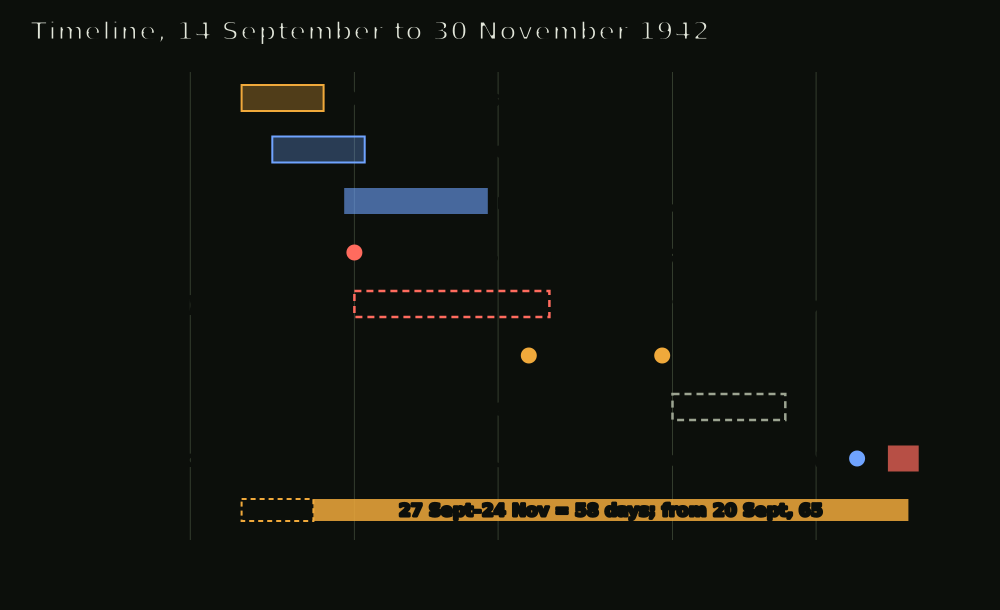
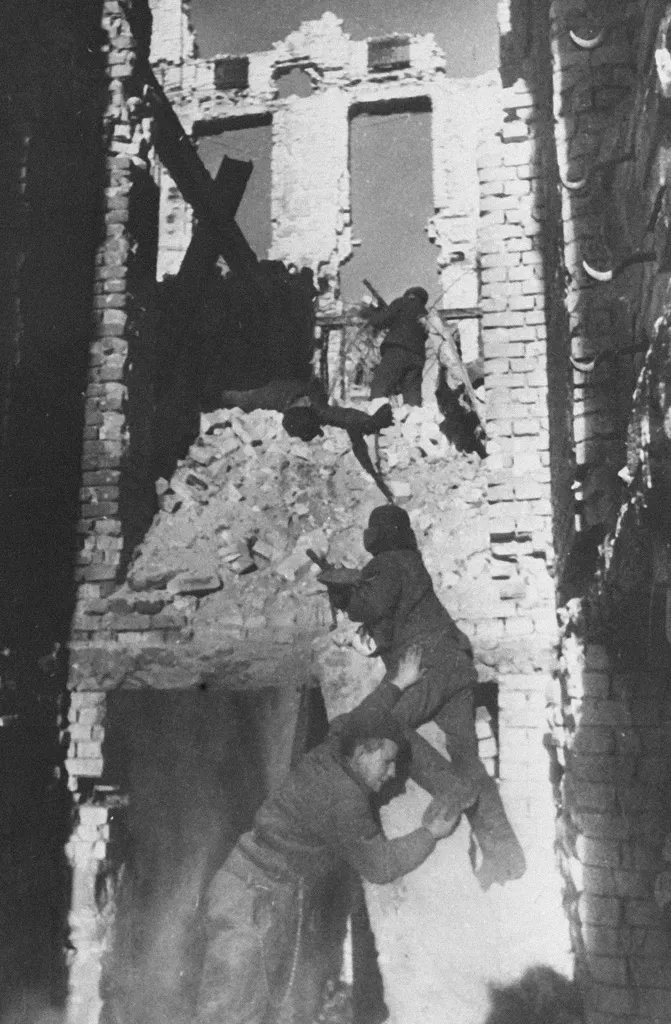
In late September 1942 Sergeant Yakov Pavlov, a section leader in the 42nd Guards Rifle Regiment of 13th Guards Rifle Division, entered a four-storey block on the east side of 9 January Square with three men. Days later Lieutenant Ivan Afanasyev arrived with a machine-gun platoon and an anti-tank rifle team and took charge of the defence, while 3rd Battalion's sappers and signallers added mines, wire, a communication trench and telephone lines. The garrison left the building on 24–25 November to attack the 'Milk House' across the square.
The Soviet Union presented all this as a fortress held by 'Pavlov and his 24' for 58 days. Later research sees it differently. One man led the entry and another ran the defence, the garrison changed as men came and went by night, and a trench tied the building to the regimental command post in the mill. German divisional logs show no long siege, though that silence does not rule out hard fighting: the corps files are gone and company actions seldom reached divisional logs (source 1).
This article keeps the two stories apart. What rests on memoirs alone is marked as memoir, and where dates and strengths differ between sources, they are left differing.
Background and Strategic Context
13th Guards Rifle Division crossed the Volga into the city centre on the night of 14–15 September, about 10,000 strong. Its task was to retake the central landing stage and stop the German 71st Infantry Division, which had broken through to the river, from settling in. By early October its casualties had passed 4,000 (source 1). When the line hardened around 20 September, 9 January Square became empty ground between the two sides. The Germans made strongpoints of the 'Milk House' to the west of the square, the 'L-shaped house' to the north, and the State Bank and NKVD buildings to the south. The one supply route was the salt pier on the riverfront, usable only at night (source 5).
From 27 September the weight of the German offensive moved north to the factory district. The 71st Division was spread over a wide front, with several battalions rated exhausted, and the Soviets had too little infantry for a continuous line. Both sides held solid buildings and covered the ground between with fire (source 1). The block earned its value in those conditions. It would not decide the fate of the city, but it filled a weak spot in the regimental line and looked into the German front. Later judgements that place its value at regimental and divisional level are more convincing than either the Soviet 'strategic' claim or the sceptics' 'no value at all'.
Terrain and Weather
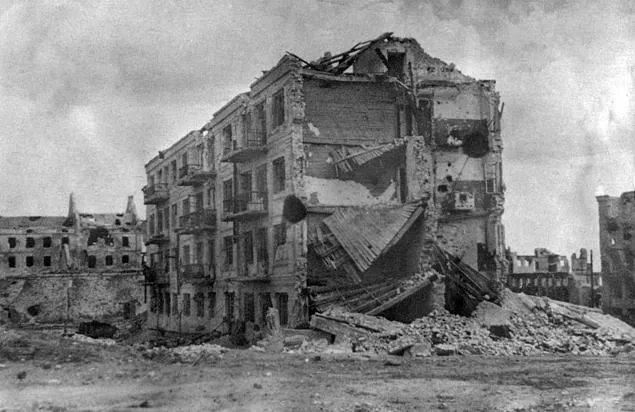
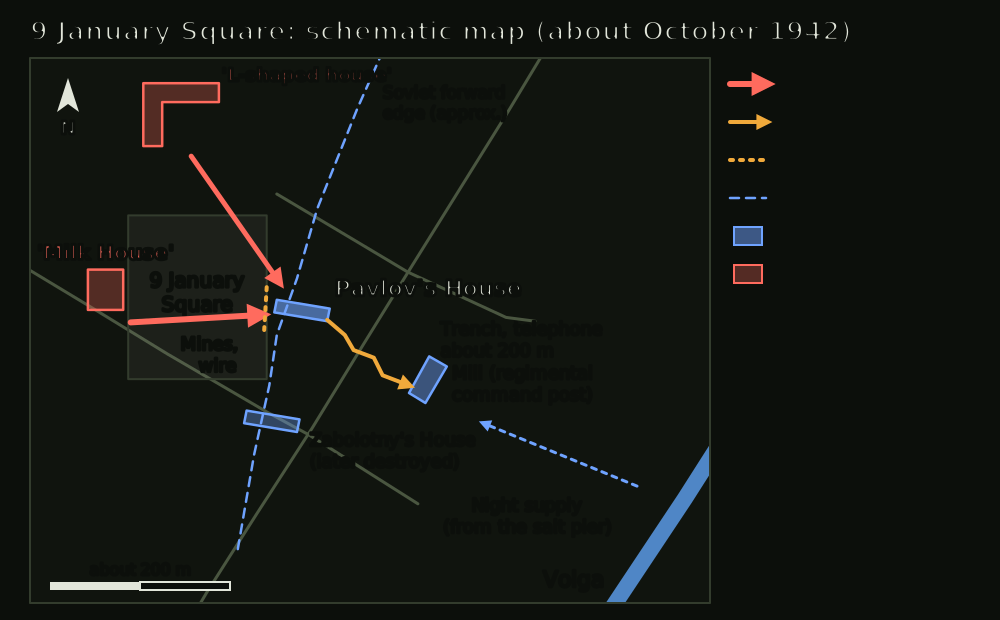
The building, put up in the mid-1930s, was a four-storey brick block with four entrances; its western gable and north wall faced the square. Its pre-war address was 61 Penza Street, and today it is 39 Sovetskaya Street. The top of the Volga bank was about 250 to 300 metres away (sources 1, 6). By our own calculation from OSM coordinates, it stood about 160 metres from the mill, about 90 metres from the neighbouring building to the south, and about 220 metres from the site of the 'Milk House', where the Officers' House now stands (Figure 1).
From the upper floors one could reportedly see and fire about 1 km to the west (source 2). The cost was just as plain. The building jutted forward, which opened its view of the approaches over the square, but the 150 to 200 metres behind it was also exposed, and until the trench was dug just moving to and fro was dangerous. Water was always short; memoir has the garrison straining rusty water from the heating pipes to drink (source 1).
Forces and Dispositions
- Soviet: 62nd Army; 13th Guards Rifle Division (Major General Aleksandr Rodimtsev); 42nd Guards Rifle Regiment (Colonel Ivan Yelin); 3rd Battalion (Captain Aleksei Zhukov); 7th Company (Senior Lieutenant Ivan Naumov). The company command post was at the main position, outside the building (sources 5, 6).
- Scouts and reinforcements: at first the sergeant and three men. The 2014 article lists the reinforcements as one Maxim heavy machine gun and seven men, three anti-tank rifles and six men, two mortars and four men, and three submachine gunners. A Russian account gives 17 men in the first group and has the mortars arriving days later (sources 2, 6).
- Garrison strength: officially 24. Sources also give 25 to 31, or about 30 in practice. One operational history gives a peak establishment of 48, which is not a daily strength (sources 1, 2).
- German: 71st Infantry Division of LI Corps, with 194th Infantry Regiment (Friedrich Roske) on this front. We found no record of the units or numbers opposite this one building (source 1).
Course of the Action
- Entry (late September): Pavlov's memoir has the four crawling 150 to 200 metres on the evening of 27 September and driving Germans out of one entrance. The date varies from the 20th to the night of 27–28 September. Afanasyev wrote that the building was empty (sources 1, 2, 6, 7).
- Report (about the same time): according to the memoir, a medical orderly took the report back and the regimental commander approved holding the building. Another account says the first runner was stopped and the news arrived only on 29 September, but it rests on one weak book (sources 1, 7).
- Reinforcement and fortification (days later to early October): Afanasyev ran the defence. Windows were bricked up and loopholes cut, cellar and ground-floor walls were holed, mines and wire went down, and a trench and buried telephone line were put in (sources 1, 6).
- October fighting: memoirs describe frequent infantry attacks, attacks with tanks, and a day when only 16 men could fight. Divisional logs have no such entries. The pioneer battle group of the night of 1 October was aimed at the divisional boundary north of the building and had nothing to do with it (source 1).
- Loss of the neighbour (date unknown): Zabolotny's House to the south was reportedly burned and blown up by the Germans and fell with its garrison (source 6).
- A symbol is made (October): Izvestia covered the building on 18 October and the 62nd Army newspaper on 31 October. The second article put 'Pavlov's House' in its headline and set the frame of a multinational garrison. Chuikov's memoir later added 'more than 50 days' and the comparison with the taking of Paris, which has no count behind it (sources 1, 4).
- Attack on the 'Milk House' (22–25 November): after Operation Uranus opened, the regiment attacked across the square and failed to take the building. Naumov fell, and Afanasyev and Pavlov are said to have been wounded, though the timing of Pavlov's wound is disputed (sources 1, 5).
Decision Point Analysis
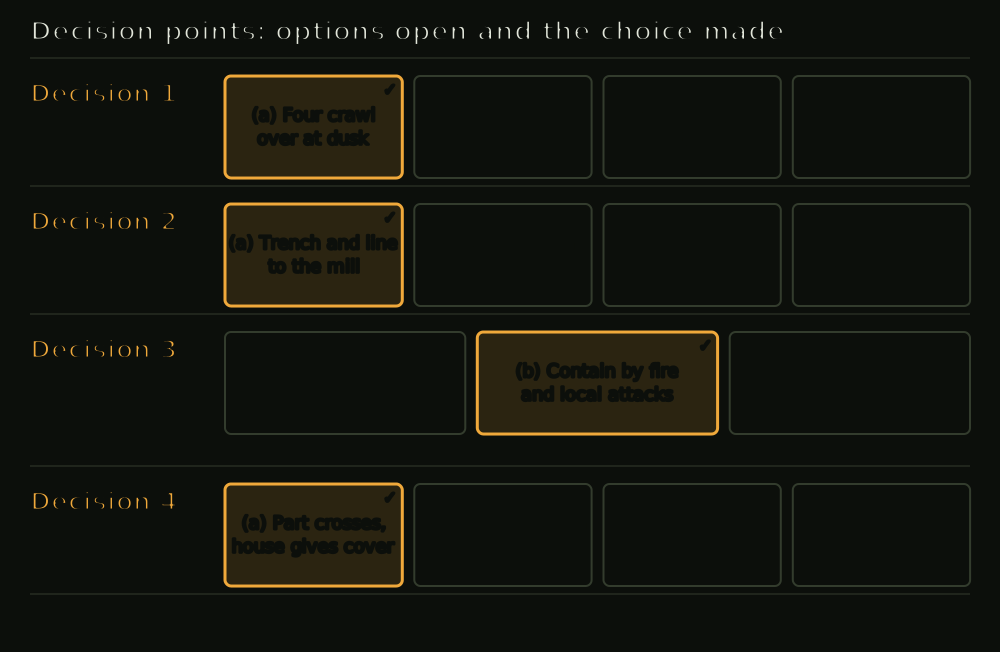
Decision 1: send four men to the building (battalion commander and sergeant, late September; scenario phase 1) The regimental commander wanted the two buildings on the square made into strongpoints, and the battalion commander picked this one (sources 2, 6). The options were (a) four men crawling over at dusk, (b) waiting for night and going with a platoon, (c) staying out and covering it by fire from the mill, or (d) mortar fire followed by a rush. They took (a). With nobody sure whether the enemy was inside, a small party risked little, and a bombardment would have given away surprise. A reconnaissance turned into an occupation. It lasted because the sergeant at once sent back a report.
Decision 2: tie the building to the regiment (regimental and battalion commanders, lieutenant, early October; scenario phase 6) The options were (a) a trench and buried telephone line to the mill, (b) a short trench only as far as the south house, (c) no trench and crawling at night, or (d) two branches, one running to the Volga. They dug about 200 metres of trench (sources 1, 6), with sappers, signallers and even civilians helping. This is the decision that most contradicts the 'isolated fortress'. Supply, casualties, reliefs and telephone all used this route, and observation from the upper floors became artillery fire across the Volga only through that line. The weapons inside the walls were the front end of this system.
Decision 3: what to do about the building (German 71st Division, October) We have not seen German orders, so this is inferred from events. The options were (a) gathering reserves to storm it, (b) containing it by fire and local attacks, or (c) ignoring it and committing elsewhere. Their conduct looks closest to (b). The division was worn down, the corps was looking at the factory district, and the pioneer group it formed on 1 October went elsewhere (source 1). The Germans did not sit idle, however. Wilhelm Adam, Paulus's adjutant, recalled Roske saying that assault groups took the ground floor but could not take the whole building (source 6, second-hand). No log confirms the scale of any tank attack.
Decision 4: come out and attack (regiment, late November; last scenario phase) The options were (a) part of the garrison crossing with the building's machine guns in support, (b) a night approach by a sappers' lane, (c) staying put and supporting by fire, or (d) sapping up to the wall before attacking. What happened was closest to (a). The attack did not take the building and the company commander fell (sources 1, 5). In a January 1943 interview the divisional commander said that a building taken but not held soon drew a German counter-attack (source 10); he was not speaking of this building. The '58 days' remembered as a defence ended in an attack.
Lessons
- A building becomes a strongpoint inside a system. Observation from above, the telephone, the trench and fields of fire matched with the neighbours made one block into a strongpoint. Current doctrine likewise assumes perimeter defence and engineer support for a strong point (FM 3-90, source 3).
- Mutual support outlasts walls. If the Soviet account of fire over the approaches from three directions is right, the local defence could go on as walls came down. When the end wall nearly collapsed, the regimental commander had some weapons moved outside (source 2).
- Mission command and reporting. The sergeant's decision on the spot fed the battalion's plan because the report went straight back, and the same goes for the division of labour once the lieutenant arrived. Higher command can use an opportunity seized on the ground only if it knows about it.
- Sustainment. Without supply, relief and evacuation by night a position lasts a few days. A fixed '24' cannot explain how this one lasted.
- Reading the sources. Memoirs hold experience and divisional logs hold the larger operations. Silence in either one is not proof of absence. However inflated a story becomes, the military facts inside it can still be recovered.
Sources
- Wargame Design Studio, "Pavlov's House" (2026-09-04). Commentary with page-level footnotes to memoirs and studies; the books themselves were not checked. https://wargameds.com/blogs/news/pavlovs-house (accessed 2026-10-31)
- Nezavisimoye Voyennoye Obozreniye, "Дом Павлова без легенд и мифов" (2014-02-14). https://nvo.ng.ru/history/2014-02-14/15_pavlov.html (accessed 2026-10-31)
- US Army, FM 3-90 Tactics (2023), paras 8-66, 9-59 to 9-70, A-68 to A-69. https://armypubs.army.mil/epubs/DR_pubs/DR_a/ARN38160-FM_3-90-000-WEB-1.pdf (accessed 2026-10-31)
- Chuikov, Сражение века, Militera text. http://militera.lib.ru/memo/russian/chuykov/07.html (accessed 2026-10-31)
- Mill area and dates of death: Pavlov, Фронтовые записки; Panchenko, 163 дня на улицах Сталинграда, seen through footnotes of the Russian Wikipedia article on Gerhardt's mill; books not checked. https://ru.wikipedia.org/wiki/%D0%9C%D0%B5%D0%BB%D1%8C%D0%BD%D0%B8%D1%86%D0%B0_%D0%93%D0%B5%D1%80%D0%B3%D0%B0%D1%80%D0%B4%D1%82%D0%B0 (accessed 2026-10-31)
- Fortification and the south house: Gurkin (1963); Adam's recollection: V. Adam, Катастрофа на Волге (2001), seen through footnotes of the Russian Wikipedia article on Pavlov's House; books not checked. https://ru.wikipedia.org/wiki/%D0%94%D0%BE%D0%BC_%D0%9F%D0%B0%D0%B2%D0%BB%D0%BE%D0%B2%D0%B0 (accessed 2026-10-31)
- Delayed runner: Erwin Bekier, Als die Wolga brannte (Der Kinderbuchverlag, 1977), p. 25; gist of Afanasyev's memoir, seen through footnotes of the German Wikipedia article 'Pawlow-Haus'; books not checked. https://de.wikipedia.org/wiki/Pawlow-Haus (accessed 2026-10-31)
- Wikimedia Commons, File:Pavlov's House.jpg (unknown author, public domain). https://commons.wikimedia.org/wiki/File:Pavlov%27s_House.jpg (accessed 2026-10-31)
- Wikimedia Commons, File:RIAN archive 602770 Battle of Stalingrad.jpg (Georgy Zelma, CC BY-SA 3.0). https://commons.wikimedia.org/wiki/File:RIAN_archive_602770_Battle_of_Stalingrad.jpg (accessed 2026-10-31)
- Jochen Hellbeck, Stalingrad: The City That Defeated the Third Reich (PublicAffairs, 2015), around pp. 292–93. Bibliographic record only. https://openlibrary.org/search?q=Hellbeck+Stalingrad (accessed 2026-10-31)

