
Pavlov's House in depth: where the combat record ends and the story begins
· 1942-09-27 – 1942-11-25
In-depth part 2 · preview; full text with Individual Plus
This analysis is for education and research. Content on ongoing wars may change as new information emerges. We label claims separately from confirmed facts.
Command this battle yourself← Part 1 overviewPavlov's House (1942): how a battalion made a strongpoint of the building four men tookHow the decision points in this analysis are adjudicated → · Glossary
Overview
Part 1: Pavlov's House (1942) covered the course of events and four decisions. This article also asks where the story comes from. The evidence lies in three layers: wartime press from 1942 at the bottom, then the memoirs of Pavlov (1951), Chuikov (1960s), Rodimtsev (1969) and Afanasyev (1970), and on top the studies and log comparisons published since 2009 [1]. Each layer asks a different question, so the numbers differ. All three broadly share the outline of a four-man entry, a garrison and a regimental system; they part over dates, strengths, the intensity of attacks and who commanded. Below we go through the terrain item by item, follow the training scenario's phases and set the disagreements side by side. We could not check most of the main studies and memoirs in the original and cite them through footnotes, which the text says where it matters.
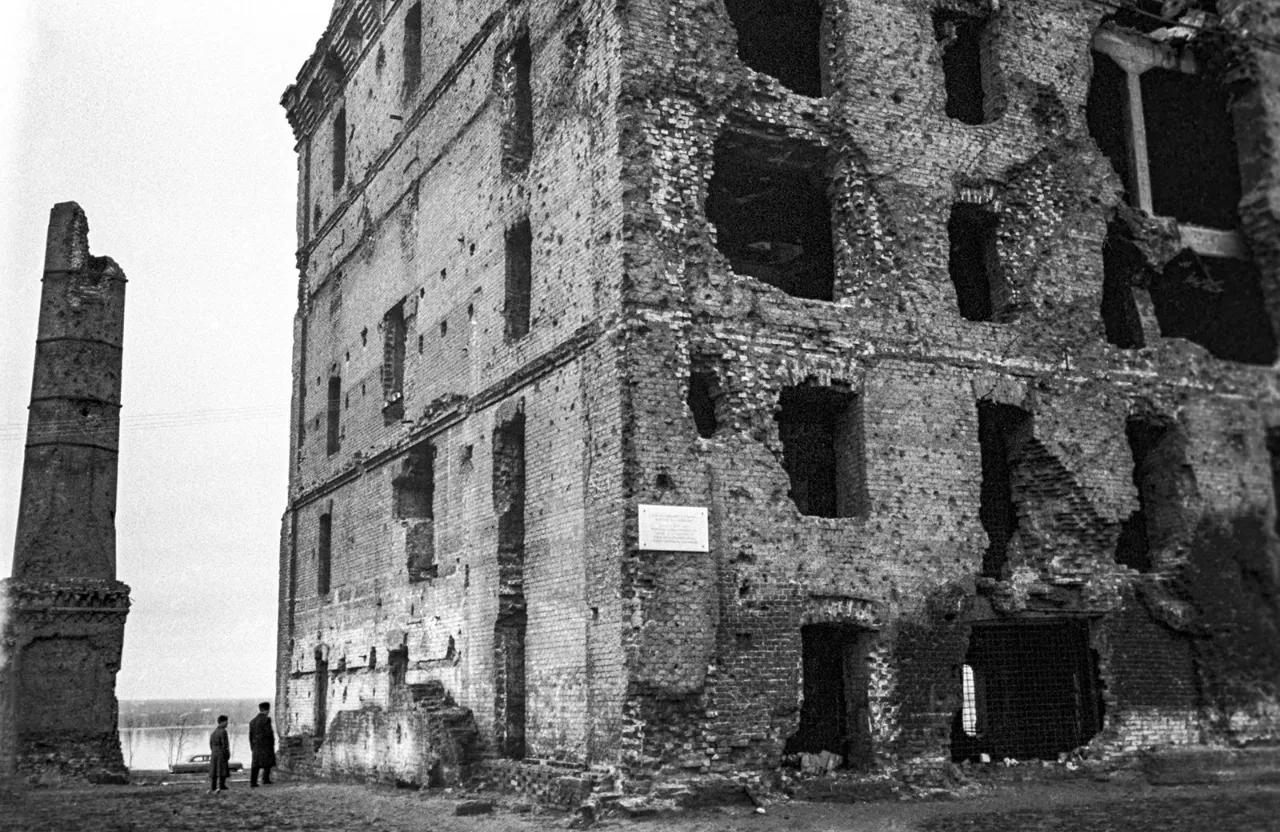
Strategic and operational context
By mid-September 62nd Army had been pushed back to a few stretches of riverbank in the centre. 13th Guards Rifle Division, which crossed on the night of 14–15 September, retook the central landing stage but shrank fast in the fighting that followed, and the line became a chain of separate fragments [1]. Chuikov writes of placing small garrisons in solid buildings, able to fight all round if surrounded [2]. Later commentary calls the method 'active defence': small assault groups, local counter-attacks, forward artillery observers and underground or covered communications [1]. Taking one building makes sense only as part of this.
On 27 September the German main effort lay towards the factory district. As the 24th Panzer, 389th Infantry and 100th Jäger Divisions pressed from the north, the 71st Infantry Division made supporting attacks in the centre [1]. Pavlov's patrol was one small part of that crisis. 13th Guards and the neighbouring 284th Rifle Division were among the few links between the northern and southern parts of 62nd Army, so the regiment had every reason to close the gap in its front [1]. Short of men, both sides held only solid buildings and covered the rest with fire. In those conditions this block let a few men influence a wide front.
Terrain and weather (OAKOC)
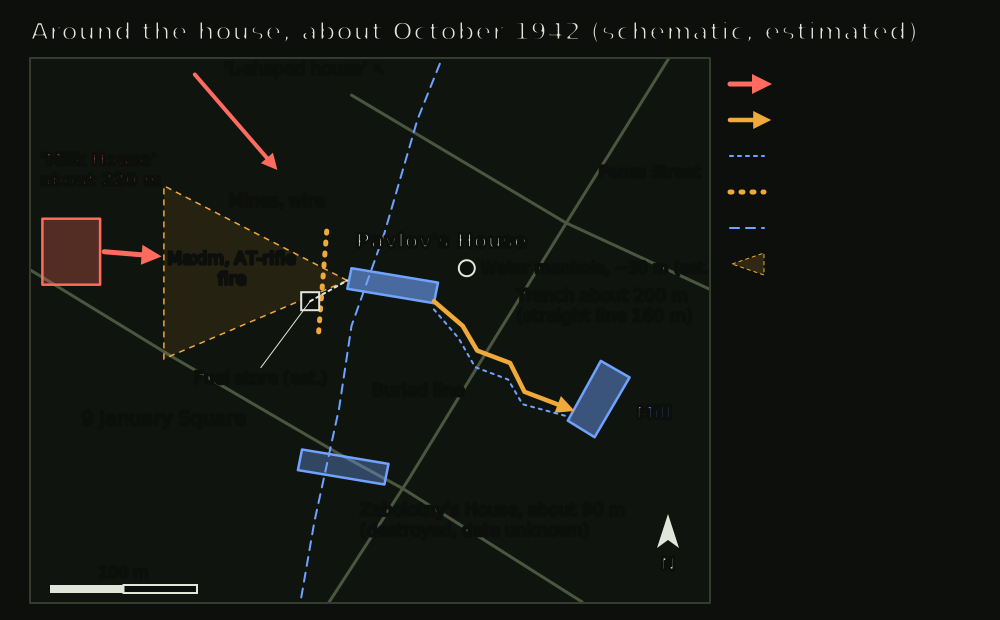
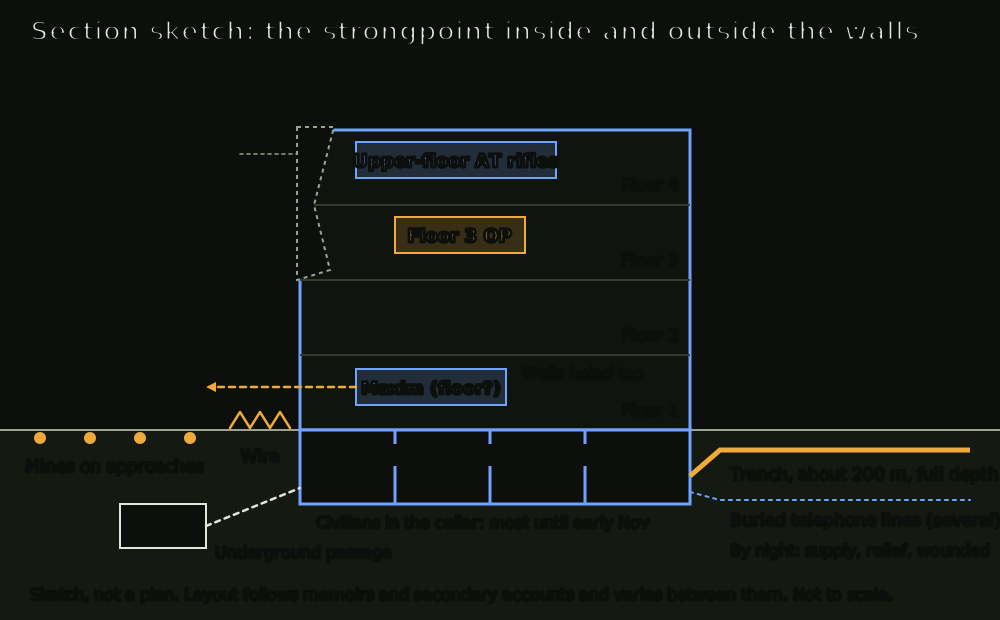
Observation and fields of fire (O). From the upper floors one could see and fire about 1 km west and further north and south, over the German routes to the river [2]. There are statements that the third-floor observation post was never suppressed [2] and that artillery observers came up to the top floor daily [11]. Both are Soviet sources.
Avenues of approach (A). The Germans had the western route straight over the square, the north-western route down from the 'L-shaped house', and the street to the south. The four entrances opened on to Solnechnaya Street [1]. For the Soviets the only way in was the 150 to 200 metres of exposed ground from the mill, made safe only once the trench was through [1]. The Volga bank lay about 250 to 300 metres behind [1][10], so a German break on this axis would soon reach the river.
Key terrain (K). The regiment's whole cluster mattered more than the one building. A Russian account groups the mill, Pavlov's House and Zabolotny's House as the 'Penza' strongpoint, with the mill at its centre [12]. One commentary limits the block's value to regimental and divisional level and says flatly that it did not command a decisive crossing by itself [1]. That fits the map better than the wartime article's 'strategically important building' [1].
Obstacles (O). The Soviets mined the approaches from the German side and put wire round the building [11]. The 'four layers of wire' common in English accounts has no traceable source, so we leave it out. Ruins and shell holes gave cover to attacker and defender alike.
Cover and concealment (C). Load-bearing walls divided the cellar into defensible compartments [1], and during shelling everyone except observers and sentries went below [2]. Outside there were covered firing points and an underground passage to a fuel store, and another reportedly led to a water manhole about 30 metres off [2][11]. When the end wall had nearly collapsed the regimental commander had some weapons moved outside [2].
Weather. The accounts of the building say little about weather. ERA5 reanalysis gives average daytime highs of about 20°C and almost no rain in late September. In late October average highs fall to about 11°C, with about 30 mm of rain. In early November average lows are about -4°C, and the coldest night about -11°C [18]. Reanalysis for the 1940s is only a guide, but it does suggest that by the time the civilians left in early November the garrison in its trench and cellar was living below freezing at night.
The full in-depth analysis is part of Individual Plus.
Terrain in detail, the hour-by-hour course, every decision point, doctrine and source criticism follow. Part 1 columns stay free.
See plans