
A Taiwan blockade drill without a name? China's unannounced sea deployment and the Bashi Channel, Taiwan's southern gate
· 2026-10 – 2027-05
This analysis is for education and research. Content on ongoing wars may change as new information emerges. We label claims separately from confirmed facts.
How the decision points in this analysis are adjudicated → · Glossary
Key judgements
As of 10 November 2026 China had not announced any named blockade exercise around Taiwan. The regular briefings held in late October and early November by China's Ministry of National Defense and the State Council Taiwan Affairs Office (TAO) gave no exercise name, dates or areas (sources 11, 12, 13). The talk of a "Taiwan blockade drill" came instead from what happened in the open sea beyond Taiwan. On 3 November the Secretary-General of Taiwan's National Security Council said more than 100 Chinese navy and coast guard vessels were deployed in the Western Pacific (source 6). On 6 November the American Enterprise Institute (AEI) and the Institute for the Study of War (ISW) assessed that China might be holding "a major, unannounced military exercise that simulates surrounding and isolating Taiwan" (source 9).
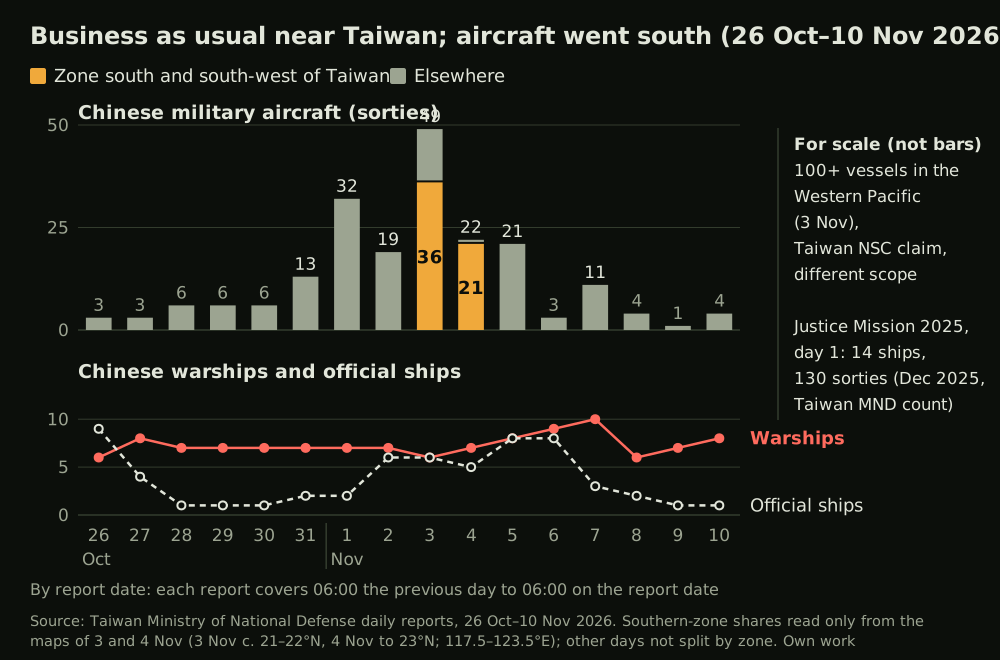
Over the same period the daily count of activity near Taiwan published by Taiwan's Ministry of National Defense (MND) looked ordinary. In the reports for 1–10 November there were 6–10 Chinese warships around Taiwan each day, no different from mid-October (sources 1, 5). What changed was where the military aircraft went. In the 3 November report (covering 06:00 on 2 November to 06:00 on 3 November), 36 of 49 sorties were concentrated in a single zone in the sea south and south-west of Taiwan, running from south-west of the island past its southern tip to east of the Bashi Channel (source 2).
We reach three judgements. First, in legal terms this activity was neither a blockade nor a quarantine. There was no declaration or notification, and no report of merchant ships being stopped and inspected. It is closer to an unannounced force deployment exercise (sources 9, 26, 27, 28). Second, the weight appears to have fallen not on Taiwan's coastline but towards its southern gate, the Bashi Channel, and the Philippine Sea beyond (assessment). That is why a figure of "more than 100 vessels" could appear alongside a near-shore count of around ten. Unannounced deployments of around 100 ships into the open sea are not new: since December 2024 there were others in December 2025 and in May and July 2026 (sources 22, 30, 47, 48). What ISW singles out this time is that major surface forces from three theatre commands appeared together beyond the First Island Chain (source 9). Third, for South Korea the detour matters before the Taiwan Strait itself. The route merchant ships would take if the strait were shut, east of Taiwan and through the Bashi Channel, is exactly where this pressure appears to have fallen (sources 37, 38).
The figures here are those public as of 10 November 2026. A statement by one party alone is marked claim, and anything resting on one source is marked single source. Strait widths and distances, which we measured ourselves from public coordinates and depth data, are marked "our own calculation" (sources 33, 34).
Did China officially announce a Taiwan blockade drill in November 2026?
As of 10 November 2026 China had officially announced no blockade exercise against Taiwan. It published no exercise name or area, and up to its 10 November report Taiwan's MND issued only its usual daily counts (sources 1, 11, 12).
Chinese statements stayed with "routine" and "lawful". At a regular briefing on 29 October the Ministry of National Defense spokesperson called the Liaoning carrier group's activity in the Western Pacific "annual routine training" and said it was not aimed at any country. Asked about more coast guard and survey ships in the open sea east and south of Taiwan, he described their activity as normal, in "China's jurisdictional waters east of Taiwan island" (source 11, claim). On 4 November the TAO spokesperson said that the China Coast Guard conducts "regular law-enforcement patrols and inspections" (巡查) in the waters east of Taiwan island in accordance with the law and is "continuing to strengthen control of the relevant waters" (管控) (source 12, claim). The published excerpts of the TAO briefing of 28 October contain no exercise announcement either (source 13).
That breaks with the practice of recent years. Since August 2022 every named major exercise around Taiwan has opened with a Xinhua notice or an Eastern Theatre Command spokesperson's statement giving its name or areas (sources 23, 24, 43–46). Strait Thunder-2025A began without a name on its first day and was named the next (source 46). Justice Mission-2025, which began on 29 December 2025, listed among its training subjects the "blockade and control of key ports and key areas" (要港要域封控) and "multi-dimensional deterrence on the exterior lines" (外线立体慑阻) (source 24). ISW also noted that China "normally announces and names major military exercises targeted against Taiwan", and had done so for the previous four large-scale exercises (source 9).
Large unannounced deployments are not new either. According to the US Department of Defense's 2025 report on China's military power, in December 2024 China surged navy and coast guard ships around Taiwan and beyond the First Island Chain without announcing an exercise. The report assessed that forces from the Eastern, Northern and Southern Theatre Commands were probably practising a blockade east of Taiwan and strikes on foreign ships (source 22, PDF p. 52). In early December 2025 Chinese navy and coast guard ships at one point numbered more than 100 across the sea from the southern Yellow Sea through the East and South China Seas into the Pacific. Citing intelligence reports and sources, Reuters called it the largest maritime show of force to date and reported that no officially named drills had been announced (source 30). In May 2026 the National Security Council Secretary-General reported more than 100 vessels from the Yellow Sea to the South China Sea and the Western Pacific, and in July a "record" of more than 110 along the First Island Chain (sources 47, 48, claim). Some argued that many of the July vessels had simply left port to avoid a typhoon (source 48). November 2026 is more accurately read as a continuation of this pattern, and its "more than 100" is in fact lower than the July claim. Describing it as "the first time three theatre commands have moved together" is also wrong.
| Status | What | Basis |
|---|---|---|
| Confirmed | 6–10 Chinese warships near Taiwan a day (reports of 1–10 November), the same level as mid-October | Taiwan MND (sources 1, 5) |
| Confirmed | 36 of 49 sorties in the 3 November report were in a zone south and south-west of Taiwan; 21 of 22 in the 4 November report (including helicopters) were in a similar zone extending further west | Taiwan MND maps (sources 2, 3) |
| Confirmed | No exercise name, dates or areas announced at Chinese Ministry of National Defense or TAO briefings | Ministry of National Defense transcript; published TAO excerpts (sources 11, 12, 13) |
| Confirmed | Japan reported only one aircraft, presumed to be a Chinese drone, passing between Yonaguni and Taiwan, and no ship transits there | Japan Joint Staff Office (source 18) |
| Claim | More than 100 Chinese navy and coast guard vessels in the Western Pacific (3 November) | Secretary-General of Taiwan's National Security Council (source 6) |
| Claim | Liaoning's activity is annual routine training; activity east of Taiwan is normal and lawful | Chinese Ministry of National Defense and TAO (sources 11, 12) |
| Assessment | Possibly an unannounced encirclement and isolation exercise involving Eastern, Northern and Southern Theatre forces, larger in ship numbers and extent than Justice Mission-2025 | AEI/ISW (source 9) |
| ISW claim, cited basis does not match | Satellite imagery on 2 November showed the aircraft carrier Fujian leaving its base at Sanya, Hainan, heading east | ISW (source 9). The X post ISW cites concerns a Type 075 amphibious assault ship leaving Yulin base on 3 November |
Around ten ships near Taiwan, so where did 'more than 100' come from?
On the evidence available up to 10 November 2026, the two numbers come from the same government counting different areas. The MND daily count is the number of ships detected in the sea and airspace around Taiwan. "More than 100" is the total on a map covering the whole Western Pacific, from the Yellow Sea to the South China Sea and the Philippine Sea (sources 1, 6).
The figure of "more than 100" comes from a post on X by the Secretary-General of the National Security Council at 21:19 Korean time on 3 November, saying that more than 100 Chinese navy and coast guard vessels were deployed in the Western Pacific. The attached map is labelled "NOV 03 2026" and "Total: 100+ Vessels". Its dots are scattered across the Yellow Sea and East China Sea, the waters north-east and east of Taiwan, the sea from off Guangdong to west of the Bashi Channel, the South China Sea and the Philippine Sea. In the Philippine Sea there are labels that read as the navies of the Northern, Eastern and Southern Theatre Commands (NTCN, ETCN, STCN) and a label for the Liaoning carrier group. The map shows each cluster only by size band, fewer than 10 or fewer than 5, so the total of 100 cannot be checked exactly from outside (source 6, claim).
The figure of "more than 50", which appears in some reports, is a different statement. On 29 October Reuters quoted a senior Taiwanese official as saying there were more than 50 Chinese navy and government ships between the waters south of Japan and the Philippines. The map the Secretary-General released at the time showed 53 ships, 34 of them warships (source 7). The two numbers differ in date and in scope, and should not be read as one count that grew. As early as 30 October ISW assessed that the Chinese navy appeared to be rehearsing, on a large scale, a scenario in which it holds major forces east of Taiwan to block outside intervention (source 10).
Some errors crept in as the numbers were passed on. One English-language outlet wrote that 31 sorties in the 3 November report had crossed the median line of the Taiwan Strait (source 8). The MND text says only that 31 sorties entered the airspace of central, south-western and eastern Taiwan, and on the attached map just one sortie crossed the median line (sources 1, 2).
The same thing happened in December 2024. The MND daily count then was 12 navy ships and nine official ships, but an anonymous security source put the total at about 90. The MND explained that the Chinese navy was building two layers of "walls", at the eastern edge of Taiwan's air defence identification zone (ADIZ) and in the Pacific beyond it (source 21). The near-shore count captures ships that come close to the coast; the big numbers count everything inside and outside the First Island Chain (assessment). In July 2026 the Director-General of Taiwan's National Security Bureau himself said that Chinese navy and coast guard deployments in the East China Sea, the Taiwan Strait and the South China Sea had always numbered around 100 (source 49, single source).
AEI and ISW read two groups in the material the Secretary-General released. One is four task forces operating between Taiwan and Guam, drawn from three theatre commands and including the Liaoning carrier group. The other is at least six coast guard ships closely surrounding Taiwan, plus an unstated number of navy ships (source 9). The outer group barely registers in the MND near-shore count. Figure 1 shows, day by day, how the number of ships near Taiwan held steady while the aircraft shifted south.
Blockade, quarantine or exercise: what is the difference, and where does this fit?
A blockade is a wartime act that a belligerent declares and notifies, and that applies equally to the ships of every nation. A quarantine is a peacetime measure in which a law-enforcement body such as a coast guard takes the lead and selects the targets it inspects. An exercise carries no such legal requirements. As of 10 November 2026, of the three, this activity is closest to an unannounced exercise or deployment.
| Blockade | Quarantine | Exercise or deployment | |
|---|---|---|---|
| Legal character | An act of war. Requires declaration and notification, effectiveness and impartial application to the ships of all states (sources 26, 27) | A peacetime measure, applied selectively and in proportion to the threat (Cuba, 1962) (source 27) | No legal requirements |
| Who takes the lead | The armed forces (sources 28, 29) | The coast guard or other law-enforcement bodies, with the military supporting through deterrence and surveillance (source 28) | The armed forces and the coast guard |
| First visible signs | A declaration of blockade; notice of the start date, area and grace period for neutral ships to leave (sources 26, 27) | Announcement of customs or inspection rules; boarding and searches (source 28) | Exercise notices or navigational warnings, sometimes no notice at all |
| November 2026 | Not applicable | Not applicable. Only the claim of regular coast guard law-enforcement patrols and inspections and of stronger control of the waters (source 12) | Unannounced deployment (assessment, source 9) |
The San Remo Manual (1994) sets out the international law applicable to war at sea. Under it, a blockade must be declared and notified to all belligerents and neutral states (paragraph 93), and the declaration must specify its commencement, duration, location and extent (paragraph 94). Effectiveness (paragraph 95) and impartial application (paragraph 100) are also required. The blockading force "may be stationed at a distance determined by military requirements" (paragraph 96). In other words, an outer cordon far from the coast is formally possible (source 26). The US Navy handbook (2007 edition) treats quarantine as a peacetime military action that bears little resemblance to a true blockade, describing it as a measured response matched to the threat and applied selectively (source 27, pp. 4-9 to 4-10). The Center for Strategic and International Studies (CSIS) separates a quarantine of Taiwan, "a law enforcement–led operation", from a blockade, "a military-led campaign", and judges that a quarantine might not be seen as an act of war (source 28).
This time there was no declaration or notification, no announcement of inspection rules and no report of merchant ships being stopped (sources 9, 11, 12). The reading that China "likely aims to demonstrate that it can cut Taiwan off from air and sea during a conflict" is ISW's assessment (source 9). The same logic seems to explain why official Chinese wording prefers "blockade and control" (封控) to "blockade" (封锁). Declaring a blockade would make it a wartime act and oblige China to stop third-country ships on equal terms (assessment).
The China Coast Guard and the grey zone. The first organisation to watch for a move towards quarantine is the coast guard. US Department of Defense records show that the China Coast Guard stayed out of the 2023 exercises around Taiwan but took part in both exercises in 2024, and in Joint Sword-2024B in October 2024 it encircled Taiwan for the first time. Citing another report, it also noted that coordination between the coast guard and the PLA would likely become the norm around Taiwan (source 22, PDF pp. 25, 44, 52). Speaking to reporters before reporting to the Legislative Yuan on 22 October, the Director-General of Taiwan's National Security Bureau said China Coast Guard activity east of Taiwan and in the Western Pacific was becoming increasingly routine, and that maritime militia fishing boats had begun to operate alongside it in the waters east and south-west of Taiwan (source 31). This points the same way as the TAO's reference on 4 November to "regular law-enforcement patrols and inspections" and stronger control of the waters (source 12). The threshold of quarantine is the moment a coast guard ship, not a warship, steps forward and stops a merchant vessel.
Will China blockade or invade Taiwan? The options the US Department of Defense sets out for China go beyond an amphibious invasion. Its report lists amphibious invasion, strike campaigns and a maritime blockade together, and judges that a joint blockade campaign, combined with missile strikes and the seizure of outlying islands, could last from weeks to months (source 22, PDF pp. 8, 46). CSIS argues that China could achieve its aims without sealing Taiwan off completely (source 29). There is no basis for treating this activity as evidence of preparation for invasion. We read it as a repeated, unnamed rehearsal of the outer deployment that a blockade option would need (assessment).
Why did the Bashi Channel and the PLA Southern Theatre Command stand out this time?
Two things point to the south. On the MND maps for 3 and 4 November, aircraft were concentrated in a zone south and south-west of Taiwan. The map posted by the National Security Council Secretary-General showed a Southern Theatre navy label in the Philippine Sea (sources 2, 3, 6). ISW also wrote that satellite imagery showed the Fujian sailing east from its base at Sanya, Hainan, but the post ISW cites for this concerns a different ship, so we do not rely on it here (source 9). Nor, up to 10 November 2026, did we find any official confirmation from Taiwan, the Philippines or Japan that Chinese ships had passed through the Bashi Channel.
The aircraft went south. The map attached to the 3 November report shows 36 sorties by fighters, support aircraft and drones operating between 07:00 and 17:30 in a single zone of roughly 21–22°N and 117.5–123.5°E (approximated from the attached map). The zone runs from the north-eastern South China Sea south-west of Taiwan, past the island's southern tip, to east of the Bashi Channel and south-east of Lanyu. The map's legend says 28 of the 36 sorties entered Taiwan's south-western airspace (source 2). In the next day's report, 21 of 22 sorties, including helicopters, operated in a similar southern zone that extended further west, up to 23°N, and 13 of them entered the south-western airspace (source 3). Most of the zone lies west of the Bashi Channel, so these flights cannot be said to have targeted the channel alone. ISW judged that the 36 sorties "south of Taiwan" may have supported the four task forces in the Western Pacific (source 9). From the 5 November report onwards, flights towards the Taiwan Strait median line became the focus and the southern share fell (source 4). The 9 November report recorded one sortie and the 10 November report four (source 1).
The Bashi Channel is not a new direction. In August 2022, of the six exercise zones in the Xinhua notice, zone 5 lay below Taiwan's southern tip towards the Bashi Channel and zone 6 south-west of Taiwan, at the southern mouth of the Taiwan Strait (source 23). Firing zone 4 of Justice Mission-2025 also lay south to south-west of Taiwan's southern tip (21°05′–21°49′N, 119°16′–121°00′E) (source 25). All of these zones, however, lay within about 190 km of Taiwan's southern tip (our own calculation). The difference this time is that forces spread beyond the First Island Chain into the Philippine Sea (assessment, sources 6, 9).
The Fujian aircraft carrier and Sanya. The Fujian was commissioned on 5 November 2025 at a naval port in Sanya, Hainan. With hull number 18, it is China's first aircraft carrier with electromagnetic catapults and its third carrier (source 32). The US Department of Defense describes it as China's first indigenously designed carrier and its first flat-deck carrier, larger than the two before it (source 22, PDF p. 24). ISW wrote that satellite imagery on 2 November showed the Fujian "leaving its base in Sanya, Hainan, due east, possibly toward southern Taiwan", that at least three other major surface combatants had left the same base between 26 October and 2 November, and that these deployments included "two of its three carriers and at least four of its ten guided-missile cruisers" (source 9). The X post ISW cites for the Fujian (account d_viekass), however, reports a Type 075 amphibious assault ship leaving Yulin base on 3 November and does not mention the Fujian. The ISW update of 30 October that it cites for the other Sanya departures contains no Sanya satellite imagery. We therefore record this only as an ISW claim whose basis we could not verify, and do not use it in our judgements. The Liaoning group went out by the southern route. On 26 October the Armed Forces of the Philippines' Western Mindanao Command said it had tracked the Liaoning group on 22 October passing through waters west of Mindanao towards the Celebes Sea (source 14). ISW dates the transit to 23–26 October, so the dates do not match (source 9).
The Southern Theatre is one pillar of any Taiwan operation. According to the US Department of Defense, two of the PLA Army's six amphibious combined-arms brigades and two of the four marine brigades that would be committed to an invasion of Taiwan belong to the Southern Theatre Command (source 22, PDF p. 47). ISW noted that it is rare for surface forces from three theatre commands to move together, since the Eastern Theatre Command has run most exercises aimed at Taiwan since 2022 (source 9). The prominence of Southern Theatre forces reads less as an anomaly than as a rehearsal, on the open sea, of a division of roles that is already settled (assessment).
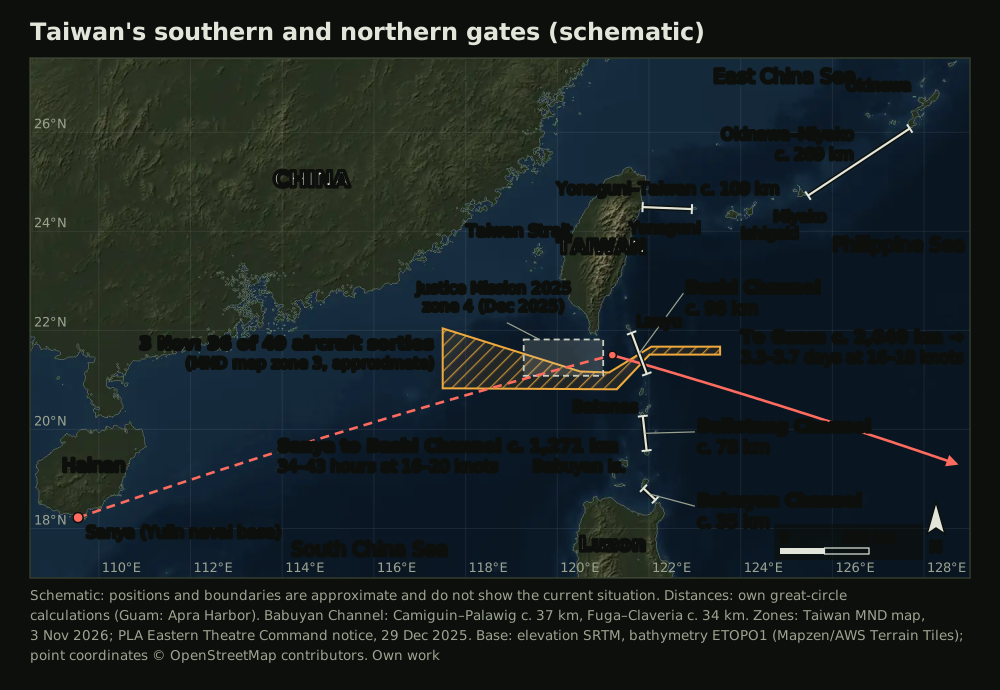
The Luzon Strait is three channels. The Luzon Strait between Taiwan and the Philippine island of Luzon is not a single waterway. The Batanes and Babuyan islands split it into three. The northern Bashi Channel is about 98 km wide from Mavulis, the northernmost Philippine island, to Taiwan's Xiaolanyu, and its deepest point on a straight cross-section is about 2,380 metres. The Balintang Channel in the middle is about 78 km wide, and the Babuyan Channel in the south about 35 km (our own calculation, sources 33, 34). Simply subtracting 12 nautical miles of territorial sea on each side leaves a corridor of about 29–33 nautical miles outside territorial waters in the Bashi Channel, but practically none in the Babuyan Channel (our own calculation). Deep, wide channels like these are harder to close with mines than the shallow Taiwan Strait. Surveillance sensors and anti-ship missiles on the islands either side are the better tool (assessment).
The distances work out as follows. From the Yulin naval base at Sanya to the middle of the Bashi Channel is about 1,271 km, or about 34–43 hours at 16–20 knots. From the Bashi Channel to Guam is about 2,640 km, about 3.3–3.7 days at 16–18 knots (our own calculation, source 33). A ship leaving Sanya can reach the southern gate within two days without appearing in the count of ships near Taiwan. The CSIS blockade scenario places seven surface action groups and about 20 coast guard and other law-enforcement vessels in the Taiwan Strait and around the main island. It does not address an outer ring such as the Bashi Channel or the Miyako Strait (source 29). For an outer cordon covering gates around 100 km wide and the sea east of Taiwan between them, endurance on station and resupply matter more than the number of ships (assessment). Figure 2 sets out the widths of the northern and southern gates and the distances between them.
How does Japan's south-western island chain (Yonaguni and Miyako) fit in?
In Japanese announcements up to 10 November 2026, the northern gate linked to this activity is the Miyako Strait. If the Bashi Channel is the southern gate into the sea east of Taiwan, the Yonaguni–Taiwan gap (about 109 km) and the Okinawa–Miyako gap (about 269 km) are the northern gates (our own calculation, source 33). The Chinese ship transits Japan announced this time were concentrated in the Miyako Strait and the Osumi Strait, and the only thing that passed between Yonaguni and Taiwan was one drone (sources 15–20).
In date order, Japan's Joint Staff Office reported the following. On 27 October the Renhai-class 102 and replenishment ship 903, and the Luyang III-class 117 and Jiangkai II-class 546, passed between Okinawa and Miyako into the Pacific (sources 15, 16). On the same day the Renhai-class 109, the Luyang III-class 133, the Jiangkai II-class 530 and China Coast Guard ship 2307 headed into the Pacific through the Osumi Strait (source 17). On 31 October one aircraft presumed to be a Chinese drone flew between Yonaguni and Taiwan into the Pacific (source 18). The Luyang III-class 121 returned to the East China Sea with fast combat support ship 901 on 1 November, came back out into the Pacific with replenishment ship 890 on 2 November, and went back in on 4 November (sources 19, 20). This suggests that the groups deployed to the open sea were rotating and staying on station with replenishment ships in tow (assessment).
Japan is preparing for these northern gates. The Ministry of Defense's Defense Buildup Program includes reorganising the 15th Brigade into a division, strengthening island electronic warfare units and keeping units of the upgraded Type 12 surface-to-ship missile. It also plans a joint maritime transport unit to move forces to the south-west and new supply support stations (source 35, printed pp. 19–20). The regional paper Ryukyu Shimpo reported that the 2026 Defense White Paper again lists the division reorganisation as a plan for this year and also covers the new air-defence electronic warfare unit at the Yonaguni garrison. We could not open the white paper itself, so this is stated as reported (source 36). Japan's Minister of Defense said at a press conference in September 2025 that the Yonaguni unit would be deployed in fiscal 2026, which ends in March 2027 (source 51).
Japan's surveillance on Yonaguni gives it an early look at the sea north-east of Taiwan. The Bashi Channel, however, lies beyond the reach of Japanese sensors, so Japan has to rely on northern Philippine and US assets there (assessment, based on our own calculation). This activity was weighted to the south, and according to Japanese announcements no ship passed through the Yonaguni–Taiwan gap. The northern gates should not be read as the centre of this pressure.
If China blockades Taiwan, what happens to South Korea's sea lanes and trade?
Of the material public up to 10 November 2026, the most specific figures are CSIS estimates based on 2024 trade data. South Korea relies on the Taiwan Strait route for 24 per cent of its imports and 20 per cent of its exports, worth about $300 billion (source 37). If the Taiwan Strait were shut, the first detour would run east of Taiwan and through the Bashi Channel, and that is exactly where this pressure was applied. For South Korea, the detour being shaken first is a heavier burden than a closure of the strait itself (assessment).
CSIS judged that about 71 per cent of South Korea's crude oil comes from Persian Gulf producers, and that much of it passes through the Taiwan Strait because many ships take the shortest route. The figure predates the 2026 Iran conflict, so current sourcing may differ. A ship from Singapore to Busan that goes through the Luzon Strait and round the east of Taiwan adds little distance. Going south of the Philippines and up through the Miyako Strait adds roughly 1,000 miles (source 37). During the Chinese exercises of August 2022, some cargo ships and tankers did go east of Taiwan rather than through the strait, taking about half a day longer (source 38). If the Bashi Channel and the open sea east of Taiwan come under pressure, as they did this time, what remains is the longer route south of the Philippines (assessment). We could not find the share of traffic passing through the Taiwan Strait and the Bashi Channel in public data from the Ministry of Oceans and Fisheries or the Korea Maritime Institute (KMI).
The shipping market has not moved yet. The latest listed-areas circular from the London insurance market's Joint War Committee (JWC) that we found is the Black Sea circular of 16 September 2026 (JWLA-035). Its full list of listed areas includes neither Taiwan nor the South China Sea (source 39). The Persian Gulf and Gulf of Oman were already listed, and the circular of March 2026 (JWLA-033) added Bahrain, Djibouti, Kuwait, Oman and Qatar (source 52). With Middle East routes already listed as war-risk areas, a listing for the waters around Taiwan would leave South Korea carrying risk at both gateways its crude oil passes through (assessment).
We found no separate South Korean government comment on this activity up to 10 November 2026. The last position we could confirm is the Ministry of Foreign Affairs spokesperson's briefing of 30 December 2025, just after Justice Mission-2025, which expressed the hope that peace and stability in the Taiwan Strait would be maintained (source 40).
Over the next one to six months, what signs would point to real blockade preparations?
None of the signs below had appeared as of 10 November 2026. Rather than ship numbers, we look in turn at whether forces stay on station, whether replenishment ships follow them, whether the coast guard stops merchant ships, and whether navigational warnings and area closures are issued. This order is an assessment based on the facts set out above and our own calculations.
- Sailings from Sanya. If satellite imagery or Taiwanese or Japanese announcements confirm carriers and large surface ships leaving the base at Sanya, Hainan, there are about two days before they can reach the Bashi Channel (our own calculation, sources 9, 33).
- The southern share and the ship count near Taiwan. Watch whether sorties in the southern zone cluster again in MND daily reports, and whether any day sees more than 14 ships or more than 100 sorties near Taiwan. On the first day of Justice Mission-2025 the MND counted 14 ships and 130 sorties (sources 1, 50).
- Northern and southern gates moving together. If Japan Joint Staff Office announcements of transits at Miyako and Yonaguni fall on the same dates as activity in the south, we read it as practice in holding both gates at once (sources 15–20).
- Resupply and endurance. If replenishment ships accompany forces on the open sea and they stay for more than a week, this is no demonstration lasting a few days. This time, too, the groups moving through Miyako were accompanied by replenishment ships (sources 15, 19).
- Coast guard inspections. If the coast guard stops, boards and inspects merchant ships bound for Taiwan, or announces customs or inspection rules, we judge that the quarantine stage has begun (source 28).
- Legal and commercial signals. Navigational warnings or area closures, a declaration of blockade or a change in the JWC listed areas would mean the line between exercise and blockade had been crossed (sources 26, 27, 39).
Where is the situation around Taiwan heading to May 2027?
| Scenario | Description | Likelihood | Early indicators |
|---|---|---|---|
| 1. Unnamed outer pressure recurs | No announced exercises; the near-shore count stays around ten ships, and forces on the open sea come to light only through Taiwan's National Security Council or Japanese announcements | Likely | No official Chinese announcement; around ten ships near Taiwan in MND counts; repeated Japanese announcements of Miyako transits; no change in JWC circulars |
| 2. A named large-scale exercise is announced | After Taiwan's elections the Eastern Theatre Command holds an exercise around Taiwan with a published name and areas | Even chance | Eastern Theatre Command announcement of a name and areas; navigational warning zones; MND counts of more than 14 ships or more than 100 sorties; reports of merchant ships detouring east of Taiwan |
| 3. A coast guard-led quarantine is tested | The coast guard, citing law enforcement, inspects shipping bound for Kinmen, Matsu, Penghu or Taiwan | Low | Coast guard announcement of ship inspections; reports of boarding and searches; coast guard rather than navy ships in front; higher insurance premiums and detour notices from Korean shipping lines |
The three scenarios are not mutually exclusive.
We rate scenario 1 likely because unannounced large deployments have recurred since December 2024. From 2023 to 2025 China named and announced one or two exercises around Taiwan each year (April 2023; May and October 2024; April and December 2025) (sources 24, 43–46). That is why the likelihood of scenario 2 within the next six months cannot be rated low. In early December 2025 the Director-General of Taiwan's National Security Bureau also said China was then in what is generally the most active season for its military drills (source 30). Given how routine coast guard activity has become, scenario 3 may be put to the test at some point. With no case yet of merchant ships being stopped and inspected, however, we rate it low. Our confidence in these judgements is moderate to low, because as long as China announces nothing, many of the key figures rest on Taiwanese counts and claims.
Dated indicators to watch:
- 18–19 November: the Asia-Pacific Economic Cooperation (APEC) leaders' meeting takes place in Shenzhen, China (source 41). As host, China has little reason to announce a named exercise during this period (assessment).
- 28 November: polling day for Taiwan's local elections (source 42). The period from just after the vote to the end of the year is the first window to watch for scenario 2 (assessment).
- Around 29 December: the first anniversary of Justice Mission-2025 (source 24). Watch whether any day in the MND daily count exceeds 14 ships or 100 sorties (source 50).
- Late December: when the US Department of Defense publishes its 2026 report on China's military power, check how it assesses this unannounced deployment. The 2025 edition came out on 23 December (source 22).
- By the end of March 2027: whether the reorganisation of Japan's 15th Brigade into a division and the deployment of the air-defence electronic warfare unit at Yonaguni proceed as planned (sources 35, 36, 51).
- Daily and weekly: the southern share of sorties in MND daily reports, Japan Joint Staff Office announcements of transits at Miyako and Yonaguni, and JWC listed-areas circulars (sources 1, 15–20, 39).
Sources
- Taiwan Ministry of National Defense, 「中共解放軍臺海周邊海、空域動態」 daily report list and reports of 26 October–10 November 2026 (3 November report plaact/88120, 4 November 88140, 5 November 88145, 9 November 88170, 10 November 88189, among others) (2026-10-26 to 11-10). https://www.mnd.gov.tw/news/plaactlist , https://www.mnd.gov.tw/news/plaact/88120 , https://www.mnd.gov.tw/news/plaact/88189 (accessed 2026-11-10)
- Taiwan Ministry of National Defense, map attached to the 3 November report (臺海周邊海、空域活動示意圖, 06:00 2 November to 06:00 3 November) (2026-11-03). https://www.mnd.gov.tw/NewUpload/202611/1151103_臺海周邊海、空域活動示意圖_124673.jpg (accessed 2026-11-10)
- Taiwan Ministry of National Defense, map attached to the 4 November report (2026-11-04). https://www.mnd.gov.tw/NewUpload/202611/1151104_臺海周邊海、空域活動示意圖_051650.jpg (accessed 2026-11-10)
- Taiwan Ministry of National Defense, map attached to the 5 November report (2026-11-05). https://www.mnd.gov.tw/NewUpload/202611/1151105_臺海周邊海、空域活動示意圖_043072.jpg (accessed 2026-11-10)
- Taiwan Ministry of National Defense, daily report of 15 October (mid-October comparison) (2026-10-15). https://www.mnd.gov.tw/news/plaact/87995 (accessed 2026-11-10)
- Official X account of the Secretary-General of Taiwan's National Security Council, post and attached map on more than 100 Chinese navy and coast guard vessels in the Western Pacific (2026-11-03). https://x.com/i/status/2117592613905895766 , map https://pbs.twimg.com/media/HWMzQXPaYAAg1yb.jpg?name=orig (accessed 2026-11-10)
- Reuters report (republished by gCaptain), Taiwan flags an "obvious threat" from more than 50 Chinese vessels across Taiwan, Japan and the Philippines (2026-10-29). https://gcaptain.com/taiwan-flags-obvious-threat-from-50-chinese-vessels-in-wide-sweep-of-waters/ (accessed 2026-11-10)
- Taiwan News, report on Chinese military aircraft and ships around Taiwan on 3 November (2026-11-04). https://www.taiwannews.com.tw/news/6471672 (accessed 2026-11-10)
- AEI and ISW, China & Taiwan Update, November 6, 2026 (data cut-off 5 November) (2026-11-06). https://www.aei.org/commentary/china-taiwan-update-november-6-2026/ (accessed 2026-11-10)
- AEI and ISW, China & Taiwan Update, October 30, 2026 (2026-10-30). https://www.aei.org/commentary/china-taiwan-update-october-30-2026/ (accessed 2026-11-10)
- Chinese Ministry of National Defense, transcript of the October regular press conference (2026-10-29). http://www.mod.gov.cn/gfbw/xwfyr/lxjzhzt/2026lxjzh/2026n10y/16497153.html (accessed 2026-11-10)
- State Council Taiwan Affairs Office of China, regular press conference excerpts (辑录) (2026-11-04). https://www.gwytb.gov.cn/xwdt/xwfb/xwfbh/202611/t20261104_12821443.htm (accessed 2026-11-10)
- State Council Taiwan Affairs Office of China, regular press conference excerpts (辑录) (2026-10-28). https://www.gwytb.gov.cn/xwdt/xwfb/xwfbh/202610/t20261028_12820309.htm (accessed 2026-11-10)
- Inquirer, Philippine Western Mindanao Command tracks a Chinese carrier fleet traversing Mindanao waters (2026-10-26). https://www.inquirer.net/493907/westmincom-chinese-carrier-fleet-seen-traversing-mindanao-waters/ (accessed 2026-11-10)
- Japan Joint Staff Office, Chinese navy ship movements (Renhai-class 102 and replenishment ship 903 heading south-east between Okinawa and Miyako) (2026-10-27). https://www.mod.go.jp/js/pdf/2026/p20261027_02.pdf (accessed 2026-11-10)
- Japan Joint Staff Office, Chinese navy ship movements (Luyang III-class 117 and Jiangkai II-class 546 heading south-east between Okinawa and Miyako) (2026-10-27). https://www.mod.go.jp/js/pdf/2026/p20261027_03.pdf (accessed 2026-11-10)
- Japan Joint Staff Office, Chinese navy ship and coast guard ship movements (heading east through the Osumi Strait) (2026-10-28). https://www.mod.go.jp/js/pdf/2026/p20261028_01.pdf (accessed 2026-11-10)
- Japan Joint Staff Office, flight of an aircraft presumed to be a Chinese drone between Yonaguni and Taiwan (2026-11-02). https://www.mod.go.jp/js/pdf/2026/p20261102_01.pdf (accessed 2026-11-10)
- Japan Joint Staff Office, Chinese navy ship movements (Luyang III-class 121, fast combat support ship 901, replenishment ship 890) (2026-11-02). https://www.mod.go.jp/js/pdf/2026/p20261102_04.pdf (accessed 2026-11-10)
- Japan Joint Staff Office, Chinese navy ship movements (Luyang III-class 121 heading north-west between Okinawa and Miyako) (2026-11-05). https://www.mod.go.jp/js/pdf/2026/p20261105_01.pdf (accessed 2026-11-10)
- Taipei Times, large-scale Chinese navy and coast guard deployment around Taiwan in December 2024 (2024-12-10). https://www.taipeitimes.com/News/front/archives/2024/12/10/2003828269 (accessed 2026-11-10)
- US Department of Defense, Military and Security Developments Involving the People's Republic of China 2025 (annual report to Congress), PDF pp. 8, 24, 25, 44, 46, 47, 52 (2025-12-23). https://media.defense.gov/2025/Dec/23/2003849070/-1/-1/1/ANNUAL-REPORT-TO-CONGRESS-MILITARY-AND-SECURITY-DEVELOPMENTS-INVOLVING-THE-PEOPLES-REPUBLIC-OF-CHINA-2025.PDF (accessed 2026-11-10)
- Xinhua authorised notice (republished by Sina), coordinates of six zones for major military exercises around Taiwan island (2022-08-02). https://news.sina.cn/2022-08-02/detail-imizirav6491920.d.html (accessed 2026-11-10)
- China Daily (Chinese edition), Eastern Theatre Command announces the Justice Mission-2025 exercise (2025-12-29). https://cn.chinadaily.com.cn/a/202512/29/WS6951c63ca310942cc4998fd7.html (accessed 2026-11-10)
- Eastern Theatre Command live-fire notice (republished by Sina), coordinates of five Justice Mission-2025 zones (2025-12-29). https://news.sina.cn/gn/2025-12-29/detail-inhemcnz0530144.d.html (accessed 2026-11-10)
- International Committee of the Red Cross (ICRC) IHL Databases, San Remo Manual on International Law Applicable to Armed Conflicts at Sea (1994), paragraphs 93–108 (1994). https://ihl-databases.icrc.org/en/ihl-treaties/san-remo-manual-1994/article-93-108 (accessed 2026-11-10)
- US Navy, NWP 1-14M The Commander's Handbook on the Law of Naval Operations (July 2007 edition), section 4.4.8 (pp. 4-9 to 4-10) and section 7.7 (pp. 7-9 to 7-10) (2007-07). https://www.govinfo.gov/content/pkg/GOVPUB-D201-PURL-gpo56195/pdf/GOVPUB-D201-PURL-gpo56195.pdf (accessed 2026-11-10)
- CSIS ChinaPower, How China Could Quarantine Taiwan (2024). https://features.csis.org/chinapower/china-quarantine-taiwan/ (accessed 2026-11-10)
- CSIS ChinaPower, How China Could Blockade Taiwan (2024-08-22). https://features.csis.org/chinapower/china-blockade-taiwan/ (accessed 2026-11-10)
- Taipei Times (Reuters report), China deploys navy vessels across Asia: more than 100 ships at one point; National Security Bureau Director-General on 'the most active season' for drills (2025-12-05; Reuters original 2025-12-04). https://www.taipeitimes.com/News/taiwan/archives/2025/12/05/2003848363 (accessed 2026-11-10)
- Central News Agency (CNA), National Security Bureau report to the Legislative Yuan: China Coast Guard activity east of Taiwan and in the Western Pacific becoming routine (2026-10-22). https://cna.com.tw/news/aipl/202610220082.aspx (accessed 2026-11-10)
- Xinhua, aircraft carrier Fujian commissioned (Sanya, Hainan) (2025-11-07). https://www.news.cn/photo/20251107/4016b587a1b6489f80f9907e0f23af5f/c.html (accessed 2026-11-10)
- OpenStreetMap Nominatim, coordinates of points on either side of the straits (basis of our own calculations, © OpenStreetMap contributors). https://nominatim.openstreetmap.org/ (accessed 2026-11-10)
- GEBCO 2020 bathymetric grid (OpenTopoData public API), depth samples along strait cross-sections (basis of our own calculations). https://api.opentopodata.org/v1/gebco2020 (accessed 2026-11-10)
- Japan Ministry of Defense, Defense Buildup Program (provisional English translation), printed pp. 19–20 (2023-03-14). https://www.mod.go.jp/j/policy/agenda/guideline/plan/pdf/program_en.pdf (accessed 2026-11-10)
- Ryukyu Shimpo, 2026 Defense White Paper reported to the Cabinet: 15th Division reorganisation and Yonaguni electronic warfare unit (2026-08-04). https://ryukyushimpo.jp/politics/entry-5429012.html (accessed 2026-11-10)
- CSIS ChinaPower, How Much Trade Transits the Taiwan Strait? (published 2024-08-22, updated with 2024 trade data and methodology). https://features.csis.org/chinapower/china-taiwan-strait-trade (accessed 2026-11-10)
- Reuters report (republished by MarineLink), China's Military Drills Near Taiwan Disrupt Key Shipping Lanes, quoting BIMCO's chief analyst (2022-08-05). https://www.marinelink.com/amp/news/chinas-military-drills-near-taiwan-498539 (accessed 2026-11-10)
- Joint War Committee (JWC, a joint LMA/IUA committee), circular JWLA-035 with the full list of listed areas (2026-09-16). https://maritimecyprus.com/wp-content/uploads/2026/11/JWLA-035-Black-Sea-1.pdf (copy hosted by Maritime Cyprus, accessed 2026-11-10)
- Kuki News, South Korean Ministry of Foreign Affairs spokesperson's regular briefing on the Taiwan Strait (2025-12-30). https://www.kukinews.com/article/view/kuk202512300165 (accessed 2026-11-10)
- Longgang District Government, Shenzhen, Shenzhen to host the 2026 APEC leaders' meeting (18–19 November) (2026-01-06). https://www.lg.gov.cn/english/news/latestnews/content/post_12588327.html (accessed 2026-11-10)
- Central News Agency (CNA), notice of polling on 28 November for Taiwan's local elections (2026-08-20). https://cna.com.tw/news/aipl/202608200078.aspx (accessed 2026-11-10)
- China Daily (Chinese edition), Eastern Theatre Command announces the Joint Sword exercise (2023-04-08). https://cn.chinadaily.com.cn/a/202304/08/WS6430b81aa3102ada8b23757c.html (accessed 2026-11-10)
- China Daily (Chinese edition), Eastern Theatre Command announces the Joint Sword-2024A exercise (2024-05-23). https://cn.chinadaily.com.cn/a/202405/23/WS664e907ea3109f7860ddf08d.html (accessed 2026-11-10)
- China Daily (Chinese edition), Eastern Theatre Command announces the Joint Sword-2024B exercise (2024-10-14). https://cn.chinadaily.com.cn/a/202410/14/WS670cb583a310b59111d9ddad.html (accessed 2026-11-10)
- Radio Free Asia (RFA) Mandarin, Eastern Theatre Command's Strait Thunder-2025A exercise (2025-04-02). https://rfa.org/mandarin/guoji/yatai/gangtai/2025/04/02/china-pla-exercise-taiwan-strait-thunder-2025a/ (accessed 2026-11-10)
- AFP (republished by Arab News), Taiwan security chief says China deployed 'over 100 vessels' in regional waters (2026-05-23). https://www.arabnews.com/node/2644664/amp ; Taipei Times on the same statement (2026-05-24). https://www.taipeitimes.com/News/front/archives/2026/05/24/2003857863 (accessed 2026-11-10)
- Focus Taiwan (CNA English), National Security Bureau Director-General on four PLA Navy formations in the Western Pacific; National Security Council Secretary-General on a 'record' of more than 110 vessels (2026-07-06). https://focustaiwan.tw/politics/202607060009 (accessed 2026-11-10)
- United Daily News (聯合報), National Security Bureau Director-General: Chinese navy and coast guard deployments have always numbered around 100 (2026-07-06). https://udn.com/news/story/10930/9609388 (accessed 2026-11-10)
- Taiwan Ministry of National Defense, daily report of 30 December 2025 (first day of Justice Mission-2025: 130 aircraft sorties, 14 warships, 8 official ships) (2025-12-30). https://www.mnd.gov.tw/news/plaact/85592 (accessed 2026-11-10)
- Japan Ministry of Defense, Minister of Defense press conference transcript (air-defence electronic warfare units to be deployed at Kengun and Yonaguni in fiscal 2026) (2025-09-16). https://www.mod.go.jp/j/press/kisha/2025/0916a.html (accessed 2026-11-10)
- Joint War Committee (JWC), circular JWLA-033 (adding Bahrain, Djibouti, Kuwait, Oman and Qatar) (2026-03-03). https://maritimecyprus.com/wp-content/uploads/2026/03/JWLA-033_Iran.pdf ; Reuters report (republished by Insurance Journal) https://insurancejournal.com/news/international/2026/03/03/860272.htm (accessed 2026-11-10)


