
North Korea's grey-zone pressure: is it weaponising the border instead of going to war?
· 2024-01 – 2027-04
This analysis is for education and research. Content on ongoing wars may change as new information emerges. We label claims separately from confirmed facts.
How the decision points in this analysis are adjudicated → · Glossary
The bottom line
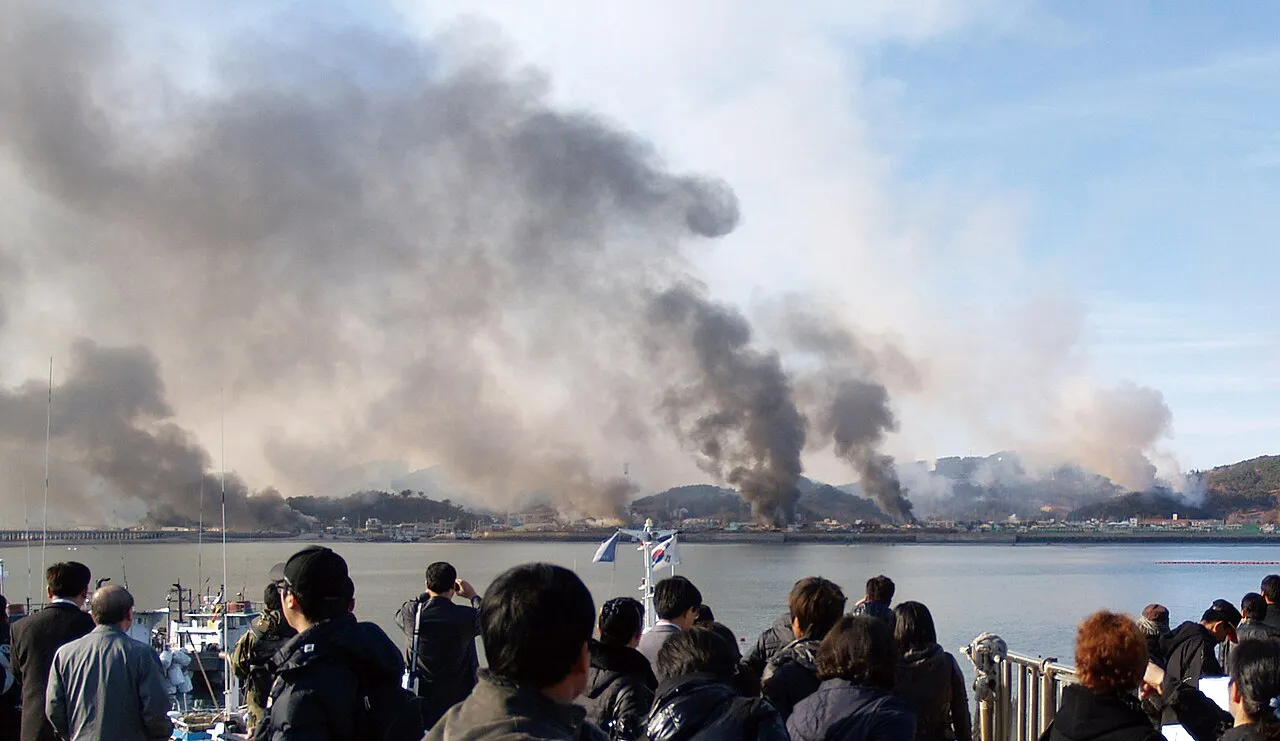
The western front has been loud this autumn. On 21 September two mines went off in quick succession in the 25th Division's sector of the western Demilitarised Zone (DMZ); three South Korean soldiers were admitted to hospital, two of them seriously hurt. South Korea and the UN Command concluded that North Korean troops had laid the mines about ten metres south of the Military Demarcation Line (MDL); North Korea wrote to the UN Security Council calling the charge a "fabrication". North Korean soldiers crossed the MDL about 20 times in August and about 30 times in September. In late October self-propelled guns with barrels turned south appeared on the Kaepung coast opposite the Aegibong observatory in Gimpo. On 29 October about ten short-range ballistic missiles (SRBMs) flew from the Wonsan area into the East Sea; Pyongyang presented the launch as a demonstration of its 600 mm super-large rocket launchers, drones and cruise missiles (sources 1, 2, 7–12, 68, 69).
The loudspeakers are back in the argument too. On 21 October the director of the Workers' Party General Affairs Department said the North's psychological-warfare loudspeakers would be running along the whole border "within October". On 29 October residents of Paju near the border said they had heard music and eerie noises from the north for four or five hours from dawn, and Yonhap described it as an apparent test broadcast. The same day, however, the National Intelligence Service (NIS) told parliament the report was a false alarm, and by 30 October the Joint Chiefs of Staff (JCS) said no loudspeaker operation had been confirmed, only continuing maintenance. As of 30 October the North's loudspeakers have not been officially confirmed as switched back on (sources 17, 64–66).
This column asks two questions. Is North Korea preparing for war? If not, what is it doing on the border?
We reach three judgements. First, on public evidence none of the decisive indicators of full-scale war preparation is lit. We found no source reporting mobilisation or a reserve call-up, special stockpiles of food or fuel, or dispersal of the leadership, and as of early 2026 about 11,000 troops were in Russia's Kursk region. Second, North Korea is using construction to turn the MDL into a "border" and exploiting the friction that work creates as a means of pressure. Of Russia's methods in Europe, the one that travels most easily to Korea is blurring where the line runs and turning that ambiguity into a weapon; proxy government and referendums have almost no room to take hold. Third, the most likely course to April 2027 is continued border friction. The most dangerous path is a 2015-style local stand-off in which a single round of warning shots turns into a real artillery exchange; we judge that path unlikely.
The evidence has clear limits. We could not obtain any South Korean intelligence or JCS document stating "no signs of mobilisation". The first judgement therefore rests on an absence of reporting and cannot prove that the indicators are actually unlit. Below, one side's announcement is marked claim and a single report without independent confirmation is marked reported. Living people are referred to by their titles.
What is happening on the border
In late 2023 North Korea's President of State Affairs defined inter-Korean relations as those between "two hostile states". In January 2024 he told the Supreme People's Assembly that the Northern Limit Line (NLL) in the West Sea was "illegal" and that an intrusion of even "0.001 mm" would be treated as a provocation to war (reported, source 34). That October North Korea blew up the northern sections of the Gyeongui and Donghae roads, saying its constitution now defined South Korea as a "hostile state" (sources 16, 47). At the Ninth Party Congress in February 2026 the leader spoke of a "pre-emptive strike mission of deterrence" and of investing further in a system for rapid nuclear use (source 14). A revised constitution, apparently introduced in March, deleted every clause on unification and defined the territory as bordering, to the south, "the Republic of Korea" (source 15). In May he ordered that the southern border be made an "impregnable fortress" (reported, source 61). There are reports that the congress wrote "two states" into the party rules, but we could not confirm this from a primary source and do not rely on it.
South Korea moved the other way. In June 2024 it suspended the whole of the 19 September 2018 military agreement and, in answer to the trash balloons, restarted its loudspeaker broadcasts; the North replied with noise broadcasts from July (sources 45, 65). In June 2025 the new government switched its loudspeakers off and the North followed suit. In August Seoul removed all its fixed loudspeakers, but Pyongyang said it had never taken its own down and never would. On 15 August the South Korean President pledged to restore the 2018 agreement (sources 46, 49, 65, 71), and in November 2025 the defence ministry first proposed military talks to fix the MDL baseline (source 70). North Korea took up neither offer. The party congress branded even Seoul's engagement policy an attempt at regime subversion (source 14).
| Date | Event | Nature of the evidence |
|---|---|---|
| 5–6 Jan 2024 | Coastal guns fire from around Capes Jangsan and Deungsan: more than 200 rounds on the 5th, about 60 on the 6th, all landing in the buffer zone north of the NLL. Residents of Yeonpyeong and Baengnyeong take shelter | JCS statements, several reports (sources 35, 36) |
| From Apr 2024 | Mines, fences, anti-tank obstacles and tactical roads begin along the whole MDL | South Korean military assessment (source 2) |
| May–Oct 2024 | 28 rounds of trash balloons. GPS jamming from the Haeju and Kaesong areas (late May to early June, early November) | JCS statements (sources 29, 44) |
| Jun–Jul 2024 | South Korea restarts loudspeaker broadcasts (June); North Korea begins noise broadcasts (July) | Press summary (source 65) |
| 15 Oct 2024 | Northern sections of the Gyeongui and Donghae roads and railways blown up; South Korean troops return fire | JCS statement (source 47) |
| 2025 | 17 MDL crossings in the year | Yonhap, reported, seen only in a search summary (source 4) |
| Jun 2025 | South Korea halts its loudspeakers; the North follows | Several reports (sources 46, 65) |
| Aug 2025 | South Korea removes all its fixed loudspeakers; the North denies removing its own | Defence ministry; North Korean claim (sources 65, 71) |
| 26 Sep 2025 | North Korean freighter crosses the NLL, turns back after warning shots | reported (source 48) |
| 17 Nov 2025 | Defence ministry first proposes military talks on the MDL baseline; no reply | Government statement (source 70) |
| Aug–Sep 2026 | About 20 MDL crossings in August, about 30 in September | Figures supplied to a lawmaker's office; attributed variously to the JCS and to the Defence Intelligence Agency (sources 1, 3) |
| 21 Sep 2026 | Two mines explode in the 25th Division's sector of the western DMZ. Of the 18 soldiers on the operation, three are admitted to hospital (two seriously hurt) and 15 are treated and discharged. Another North Korean anti-personnel mine is found south of the MDL on 29 September | Joint JCS–UN Command investigation; UN Command finds an armistice violation (sources 2, 7, 69) |
| 5 Oct 2026 | JCS final finding: mines laid by North Korean troops about ten metres south of the MDL, unlikely to have drifted, at least four in all. Seoul demands an apology and removal | JCS statement (sources 6, 69) |
| 19 Oct 2026 | Statement by the director of the party's General Affairs Department. She claims South Korea made 2,870 warning broadcasts and fired warning shots 201 times between 1 August and 17 October, and says the North is "considering" resuming loudspeakers and adding tactical strike weapons along the border | North Korean claim (source 67) |
| 21–22 Oct 2026 | The same official says loudspeakers will run along the whole border "within October" and warns that if South Korean warning shots do real harm beyond a warning, the North "will show no mercy". On the 22nd she says the loudspeakers will be on standby "within days" | North Korean claim (sources 17, 18, 72) |
| 23 Oct 2026 | Defence ministry makes a second proposal for talks on the MDL baseline, possibly three-way with the UN Command. The same day a military report that the North has laid about 960,000 mines since 2024 becomes public | Government statement, report to parliament (sources 5, 7) |
| 25 Oct 2026 | North Korea's UN mission writes to the Security Council calling the mine incident a "fabrication" | North Korean claim (source 8) |
| 25–26 Oct 2026 | Armoured vehicles with barrels pointed south on the Kaepung coast. A Reuters reporter saw three; Yonhap identified them as 122 mm self-propelled guns | Press observation, no official military confirmation (sources 9, 10) |
| 29 Oct 2026 | About ten SRBMs fired from the Wonsan area into the East Sea, flying about 250 km: the year's 17th ballistic launch by the JCS count. North Korean media describe a demonstration, watched by the leader, of a 600 mm rocket-launcher battalion firing in salvo, cruise missiles and suicide drones | JCS statement; North Korean claim (sources 11, 12, 68) |
| 29 Oct 2026 | Residents of Daeseong-dong and Tongil-chon in Paju say they heard loudspeakers for four to five hours from dawn. The NIS calls it a false report; the JCS says it has confirmed no operation | Resident accounts and reported; government denial (sources 64, 65) |
| 30 Oct 2026 | JCS says there is continuing maintenance activity and nothing further to report. No North Korean reply to the 23 October proposal | JCS briefing (source 66) |
The launch count for the year now tallies. The 29 October salvo came 17 days after a launch on 12 October and was the year's 17th by the JCS count (sources 11, 68).
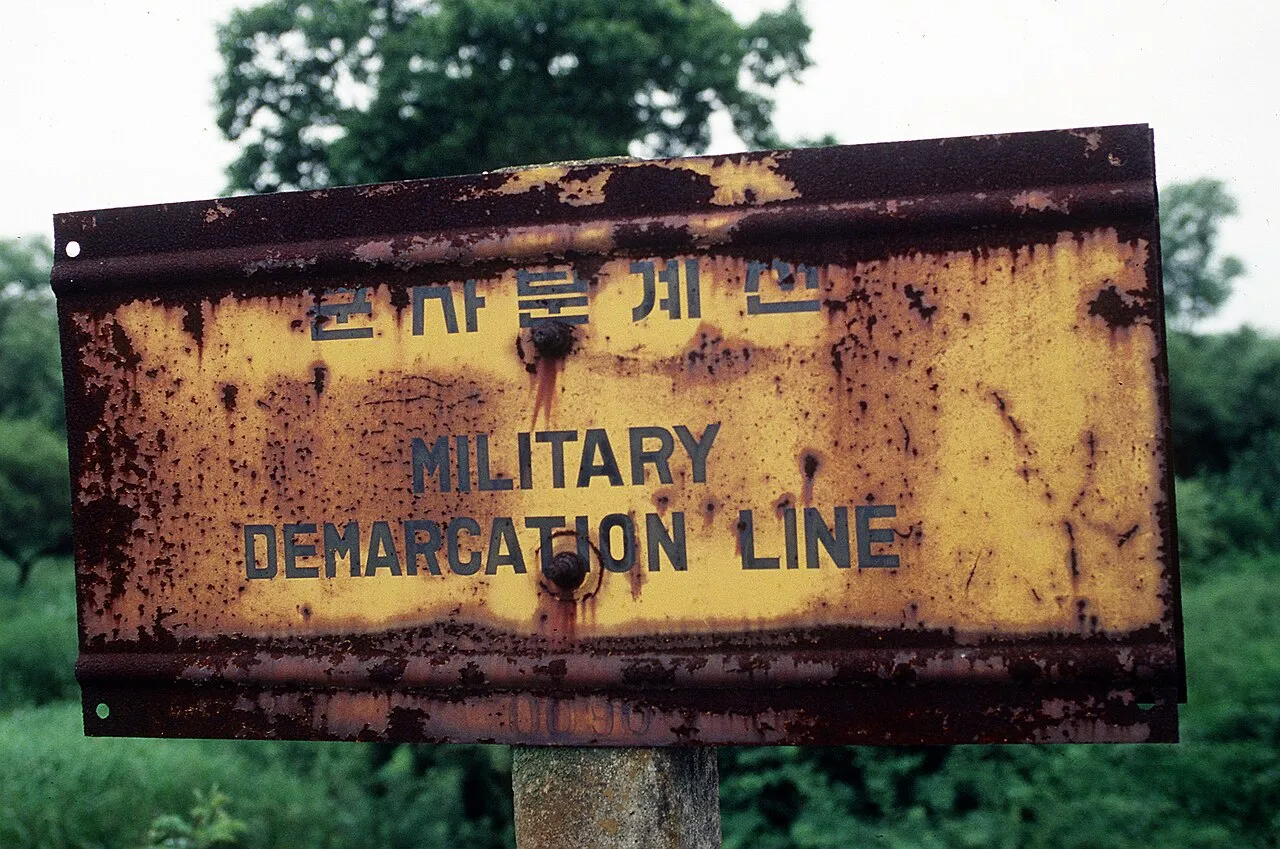
There is a structural reason for the rise in crossings. Of the 1,292 MDL markers erected after the armistice, the JCS can identify only about 200 (another report says about 250). Nor is there one baseline. The South Korean military uses the line on a 2004 map from the US National Geospatial-Intelligence Agency; the UN Command uses a 2016 line joining some 23,000 points at ten-metre intervals; and a third line joins the surviving markers. The three do not match, and the North may use yet another (sources 2, 6, 69). The JCS attributes the surge to construction starting on stretches where no work had been done, not to a change in military activity (reported, source 63). The director of the General Affairs Department claims North Korean soldiers have never crossed the line, yet does not say where Pyongyang thinks the line runs (source 2). Where the line has been erased, construction alone will push up crossings and warning shots, whatever either side intends.
Is North Korea preparing for war?
A state preparing for full-scale war leaves traces that are hard to hide. It calls up reserves, stockpiles food and fuel, disperses its leaders and switches civil defence to a war footing. The NIS briefing to parliament on 29 October 2026 covered the leader's visit to Dandong, the chance of talks with Washington and a possible forward deployment of the 600 mm launchers; it did not mention mobilisation (source 13). The US intelligence community's 2026 Annual Threat Assessment likewise stresses nuclear and missile build-up and the combat experience gained through cooperation with Russia rather than an imminent invasion (source 56).
| Indicator | Status | Interpretation |
|---|---|---|
| Large call-up of reserves (Training Units, Worker-Peasant Red Guards) | Not reported | An absence of reporting, not an official assessment |
| Special stockpiles of food and fuel | Not reported | Shortages were in fact cited against the "war is imminent" view (source 43) |
| Leadership dispersal, wartime civil defence | Not reported | — |
| Troops and munitions sent abroad | Observed (points the other way) | About 11,000 troops in Kursk (early 2026). More than 100 ballistic missiles and up to 9 million shells shipped (sources 19, 23) |
| Forward border fortification | Observed | About 960,000 mines, clearing about 90 per cent done, fences and minefields 30–60 per cent, completion expected in 2028 (sources 2, 5). It blocks the North's own routes south |
| Artillery shown at the front | Observed (small scale) | Three 122 mm self-propelled guns, left in view rather than hidden |
| 600 mm super-large rocket launchers | Observed (public firing); forward deployment unconfirmed | A battalion salvo shown publicly for the first time on 29 October. The NIS says it is "watching" for forward deployment (sources 13, 68) |
| Ballistic missile launches | Observed (rising) | Launches on 12 and 29 October, the year's 17th by the JCS count: tests and pressure signals at once |
| Propaganda loudspeakers | Maintenance observed; operation unconfirmed | An apparent test was reported on 29 October, but neither the NIS nor the JCS has confirmed it (sources 64–66) |
| Fissile material production | Observed | A second enrichment building at Yongbyon (room for up to 28 centrifuge cascades); the Kangson annex began operating early in 2026 (sources 24, 25) |
| Signals of outside talks | Observed (points the other way) | The NIS reads the foreign minister's presence on the leader's Dandong trip as a sign that talks with Washington are under review (source 13) |
Every lit indicator can be explained as a build-up of deterrence or as a pressure signal. The indicators that belong only to preparation for invasion remain unlit (Figure 1).
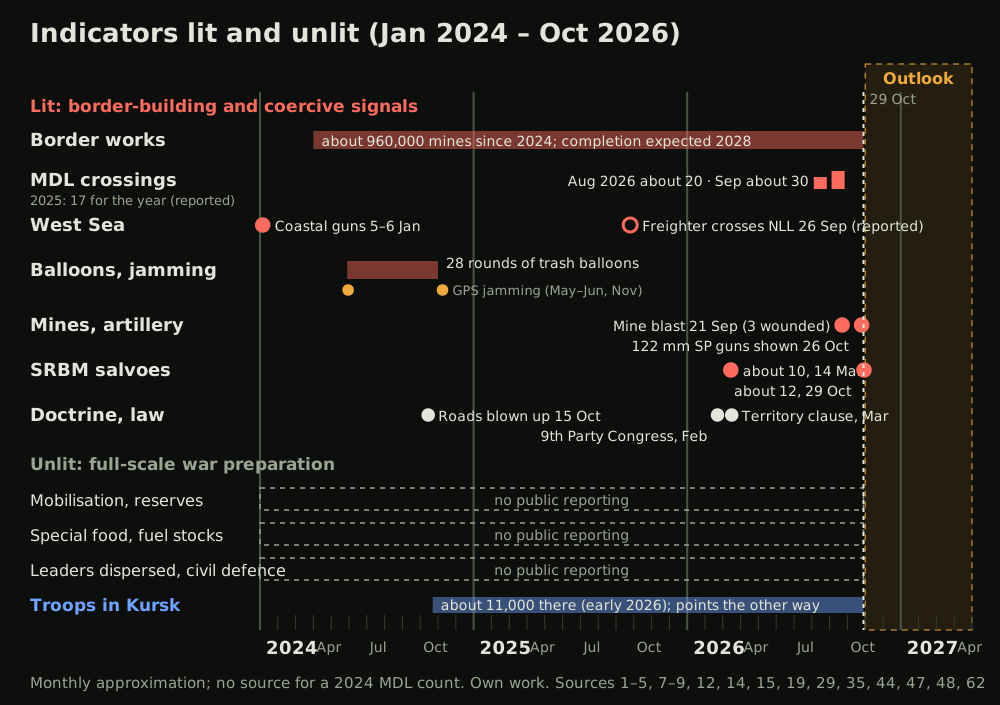
The strongest counter-argument is that a shift in nuclear doctrine lets North Korea strike a limited objective under a nuclear threat without mass mobilisation. If so, the absence of classic mobilisation indicators is not reassuring on its own. It has the same structure as the limited seizure of Baltic territory under nuclear cover that Foreign Policy sees as the next step to fear from Russia (source 33). We treat that path below, in the scenario of a direct strike on the north-west islands. In January 2024 two American North Korea specialists wrote that the leader had decided on war "like his grandfather in 1950" (claim). Most experts disagreed at the time, citing conventional inferiority and thin stockpiles (source 43), and in the two years and nine months since, the predicted war has not come.
Where friction will flare: the western front and the West Sea
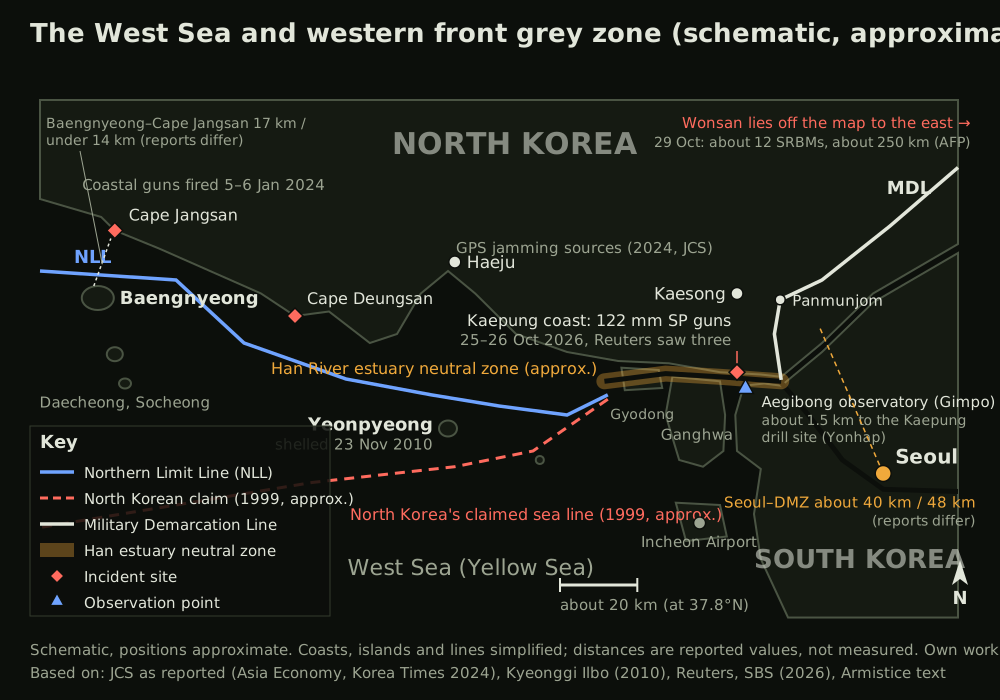
The western DMZ is the first arena. Construction is under way, the markers are gone and a mine has already put soldiers in hospital. The late-October self-propelled guns, fence work inside the DMZ and drills on the Kaepung coast were all concentrated opposite Gimpo, Ganghwa and Paju. The Kaepung drill site reported by Yonhap is about 1.5 km from the Aegibong observatory (source 9), and the residents who said they heard loudspeakers live in Paju's Daeseong-dong and Tongil-chon (source 65). Reports put Seoul about 40 km (25 miles) or about 48 km (30 miles) from the DMZ (sources 39, 40). South Korea's rules of engagement call for a warning broadcast when troops approach and warning shots and expulsion when they cross (source 63). Pyongyang claims there have been 2,870 warning broadcasts and 201 rounds of warning shots since August (claim, source 67). With those rules triggered several times a day, a single North Korean casualty would give Pyongyang a pretext to respond. The General Affairs Department director's threat, conditioned on harm "beyond a warning", is aimed at exactly that case.
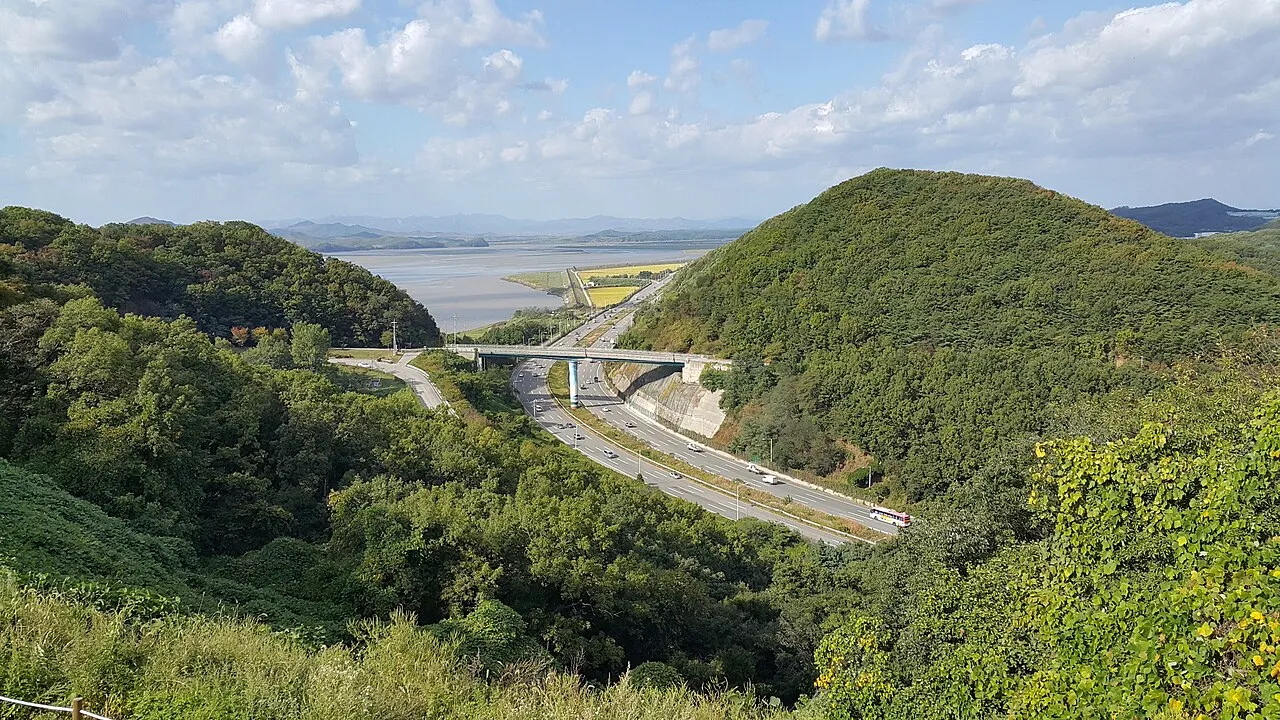
The Han River estuary neutral zone is a different case. The Armistice Agreement opens it to the civilian shipping of both sides, and the Military Armistice Commission sets the navigation rules (source 41). In June 2016 South Korean troops and the UN Command together expelled ten Chinese fishing boats that had entered the estuary (source 42). Our inference is that if the border works move west to face the estuary, Gyodong and Ganghwa, friction could arise in waters governed by rules different from those of the land MDL.
The West Sea is the second arena but carries the highest stakes. Since 1999 North Korea has claimed a "West Sea military demarcation line" south of the NLL, and in January 2024 it rejected the NLL again. A former deputy secretary of the UN Command Military Armistice Commission has sketched the likely path: publish a new boundary on a map, fill the waters between the NLL and the North's line with fishing boats, and watch them with armed personnel in plain clothes and with drones. South Korea would then hand the North a pretext if it expels them and accept a fait accompli if it does not (reported, source 34). The distances are short. Reports put Baengnyeong 17 km or "less than 14 km" from Cape Jangsan, and the North Korean islands of Galdo and Jangjaedo lie about 5 km and 7 km from Yeonpyeong (sources 35, 37, 38). Since January 2024, however, North Korea's West Sea actions have been limited to firing into its own side of the buffer zone and a freighter crossing. North Korean media said the 29 October demonstration hit an island target, but the firing ran from Wonsan towards the East Sea (source 68). Pressure one step below the direct strikes of 2010 has become the norm.
What North Korea has learnt from Russia
The Russian cases fall into three layers. In Crimea in 2014 unmarked troops, a local proxy government and a referendum under occupation created a fait accompli within days. In Donbas, proxy republics and the Minsk agreements prolonged "controlled instability". In Europe between 2023 and 2026 the emphasis shifted from cyber attacks and disinformation to physical means such as drones and sabotage. In September 2025 Poland's prime minister said there had been 19 violations of Polish airspace by Russian drones over seven hours, and Poland requested consultations under Article 4 of the NATO treaty (source 30). That month drones shut Copenhagen airport for four hours, and police could not identify who was behind them (source 31). In August 2026 a drone carrying explosives targeted a cargo aircraft at Leipzig/Halle airport, and the German government attributed it to Russia (reported, source 33).
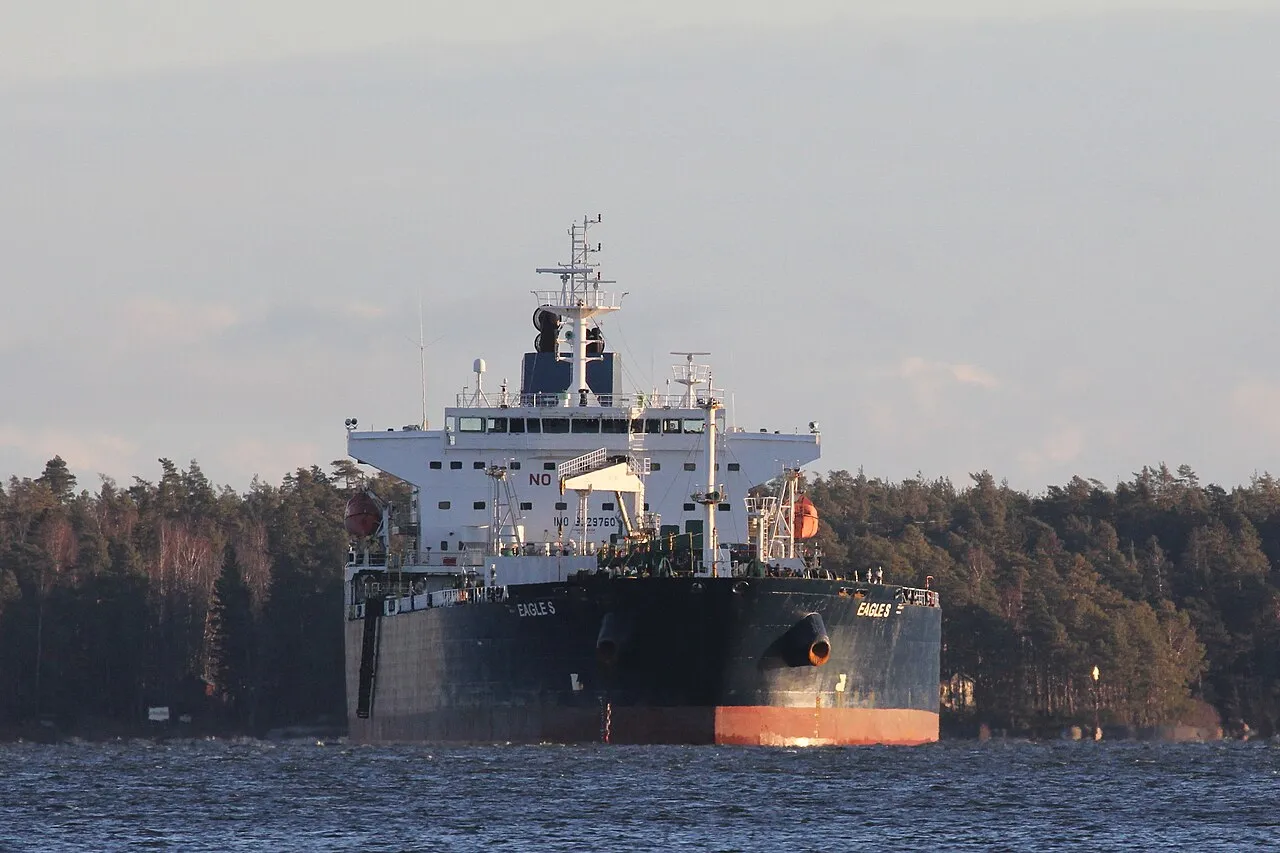
The campaign worked under two conditions. One is a gap in the law. On 25 December 2024 the tanker Eagle S dragged its anchor for about 90 km and damaged the EstLink 2 power cable between Finland and Estonia and four telecommunications cables. In October 2025 the Helsinki District Court dismissed the case, ruling that the events took place outside territorial waters, that Finnish criminal law could not apply and that jurisdiction lay with the flag state. The court treated the episode as a navigational accident in which the anchor fell because its securing gear failed (source 32). The other is that the threshold for a response is set by politics: an analyst quoted by Foreign Policy wrote that it is a matter of politics, not technology, and that Russia has raised it over years (source 33).
| Russian method | European case | Korean counterpart | Chance it transfers (our judgement) |
|---|---|---|---|
| Blurring agreements and lines | Posing as a "non-party" to the Minsk agreements | No MDL baseline published, NLL rejected, two offers of talks ignored | Very high (under way) |
| Making low-level violations routine | Donbas ceasefire violations | 20–30 crossings a month, buffer-zone firing | Very high (under way) |
| Signal jamming | Baltic region | GPS jamming from Haeju and Kaesong (2024; sources 28, 29) | High (already done) |
| Disguised civilian ships of unclear origin | Eagle S (2024) | Fishing boats and freighters around the NLL | Moderate |
| Drones of unclear origin | Poland and Denmark (2025), Leipzig (2026) | Over capital-region airports, air bases, West Sea islands | Low to moderate |
| Unmarked troops, proxy government | Crimea and Donbas (2014) | No pro-North population, so not applicable | Almost none |
North Korea has no proxies, so it cannot use Donbas-style deniable volunteers. Ambiguity about the line fills that gap. Whether a mine was buried south of the MDL, whether a patrol crossed, which line a fishing boat passed: once each of these becomes a question of "which line?", the violation itself can be disputed even when it is obvious who acted. We read North Korea's letter to the Security Council calling the incident a "fabrication", sent while it ignores the offer of talks on the baseline, as an effort to preserve that structure.
The South Korean government is itself divided over the incident. After the defence ministry and the UN Command concluded that North Korean troops had laid the mines, the unification minister called it "fundamentally a mine-explosion accident" (source 50). Public opinion has also shifted. In the Korea Institute for National Unification's 2025 survey, 51.0 per cent said unification was not necessary, the first majority since the survey began in 2014 (source 52). In Seoul National University's 2026 survey, 78.3 per cent said dialogue or compromise with the North Korean regime was impossible (source 53). In this setting, border incidents are easily absorbed into domestic political fights instead of being handled as inter-Korean issues. This is where Europe's lesson, that politics sets the threshold for a response, applies to Korea.
Kursk has given North Korea the experience to run these methods faster. The Royal United Services Institute (RUSI) judges that North Korean units linked reconnaissance-drone data to artillery and rocket fire control and cut the time from detection to fire "from hours to minutes" (reported, source 21). Ukrainian intelligence believes more than 3,000 North Korean soldiers have become instructors (claim, as reported by CNN, source 22). Others point out that acquiring a technology is not the same as knowing how to fight with it, and that mass production and command integration remain unproven (source 51). The direction is clear enough: at the 29 October demonstration the leader called for "absolute superiority" in drones (source 68). A unit that can spot targets with drones and fire within minutes can complete a "proportionate response" before Seoul has reached a political decision.
What is North Korea after on the border?
We tested four hypotheses against the evidence using analysis of competing hypotheses (ACH), which favours the hypothesis the evidence contradicts least (source 57).
- H1 Preparation for full-scale war or a major attack. The border works and friction are deception or a preparatory phase.
- H2 Fixing the border. Defensive works that physically entrench permanent division; the friction is a by-product.
- H3 Pressure signalling. Friction and shows of force are used as leverage to unsettle South Korean politics and build bargaining power with Washington.
- H4 Limited change to the status quo. Fixing the MDL baseline and the West Sea boundary on the ground in the North's favour.
H2 to H4 are not mutually exclusive. One construction programme can serve all three.
| Evidence (source) | Credibility | Weight | H1 | H2 | H3 | H4 |
|---|---|---|---|---|---|---|
| E1. No reporting of mobilisation, stockpiling or leadership dispersal (source 13) | Medium (absence of reporting) | 1 | I | C | C | C |
| E2. About 11,000 troops in Kursk; large shipments of missiles and shells (sources 19, 23) | High | 2 | I | N | N | N |
| E3. About 960,000 mines, fences and anti-tank obstacles blocking the North's own routes (sources 2, 5) | High | 2 | I | C | N | C |
| E4. Finding of mines south of the MDL; no baseline published; offers of talks ignored; "fabrication" letter (sources 6–8, 69, 70) | Medium | 1 | N | I | C | C |
| E5. Conditional opening for talks with the US; NIS reads signs that talks are under review (sources 13, 14) | Medium | 1 | I | N | C | N |
| E6. Since January 2024, buffer-zone firing and a freighter crossing in the West Sea, but no published coordinates or strikes on islands (sources 35, 48) | Medium | 1 | N | C | C | I |
| E7. Unification clauses deleted from the constitution; territory defined as bordering "the Republic of Korea" (source 15) | High | 2 | I | C | N | C |
| Inconsistency score | −8 | −1 | 0 | −1 |
Key: C consistent, I inconsistent, N not applicable. Each I costs its weight; the score ranks the hypotheses and is not a probability. The guns on show, the loudspeaker threat, the 29 October rocket and drone demonstration and the enrichment work at Yongbyon and Kangson contradict none of the hypotheses and are left out.
Provisional conclusion. H1 is the most contradicted hypothesis. We judge it very unlikely that North Korea is preparing for full-scale war before April 2027. H3 is the least contradicted, with H2 and H4 just behind. The most plausible picture combines them: fixing the border (H2) as the base, with the friction the works generate used as a pressure signal (H3). October's loudspeaker threat and weapons demonstration fit that picture. Indicators such as published West Sea coordinates will show whether it tips into H4. Our confidence in rejecting H1 is moderate; our confidence in the ordering of H2 to H4 is low.
Two rows decide the ranking. E4 rests on who is held responsible: North Korea denies it, and South Korea's unification minister spoke of an accident. Remove E4 and H2 ties with H3. E6 is the row most likely to date: a single publication of West Sea boundary coordinates would tilt the result towards H4.
The assumptions behind the judgement
| # | Assumption | Basis | Assessment | What we would see if wrong | Effect if wrong |
|---|---|---|---|---|---|
| 1 | No mobilisation in public reporting means none in fact | Not mentioned in the NIS briefing of 29 October (source 13) | Unsupported (absence of reporting is not evidence of absence) | Reports of a Training Unit call-up or civil defence on a war footing | H1 and scenario K must be reassessed |
| 2 | The 21 September mines were laid south of the MDL by North Korean troops, not washed there | Joint JCS–UN Command investigation; the UN Command judged them "artificially placed" (sources 6–8, 69) | Conditional (North denies; unification minister differs) | An independent finding of drifting mines | H3 and H4 weaken, H2 strengthens |
| 3 | The surge in crossings reflects wider construction | JCS explanation (reported, source 63) | Conditional | Crossings where there is no work; armed reconnaissance | Judgement shifts towards deliberate provocation |
| 4 | Kursk experience is passing to front-line units | RUSI, Ukrainian intelligence (sources 21, 22); the 29 October drone demonstration (source 68) | Unsupported (inference) | Returnees posted to forward corps; new drone units reported | Speed of escalation in scenarios F and G |
| 5 | Pressure on the South continues even if US talks open | Party congress left the US a conditional opening and offered the South "no deal" (source 14) | Conditional | Crossings and construction fall when talks start | Scenario likelihoods fall across the board |
Assumptions 1 and 4 lack support, so both stay on the watch list below.
Numbers to treat with caution
Several items behind our judgements, or likely to enter them, rest on weak or contested evidence:
| Item | Source type | Cross-check | Credibility | Handling |
|---|---|---|---|---|
| MDL crossings by year | About 50 in August–September 2026 from figures supplied to a lawmaker (sources 1, 3); 17 in 2025 from a search summary (source 4) | No source found for a 2024 total. The 2026 figure covers two months, not a year | Medium | No annual trend chart drawn |
| 2026 launch "17th" | Aju and Yonhap, both citing the JCS count (sources 11, 68) | The two agree; we could date fewer launches ourselves | Medium to high | Used as the JCS count |
| Range of about 250 km on 29 October | JCS statement of 30 October (source 68) | Matches AFP (source 12) | High | Used as stated |
| Loudspeaker test on 29 October | Resident accounts and Yonhap (sources 64, 65) | NIS calls it a false report; the JCS has confirmed nothing but does not rule out a low-power test heard only in places (sources 65, 66) | Low | Written as unconfirmed |
| Number of 122 mm guns | Three seen by a Reuters reporter, identified by Yonhap (source 9); SBS gives no number (source 10) | A broadcast report of "two" could not be opened; no official confirmation | Medium | Written as three, with sources |
| Mine-blast casualties | JCS final report: of 18 soldiers on the operation, three admitted (two serious, one minor), 15 discharged (source 69) | Outlets variously say three wounded or one | High | Follows the JCS report. Ranks omitted |
| Number of MDL markers | About 200 identified by the JCS (source 69); about 250 in another report (source 2) | Dates and counting rules may differ | Medium | JCS figure used, the other noted |
| 2,870 warning broadcasts, 201 rounds of warning shots | Statement by the General Affairs Department director (source 67) | No official South Korean count | Low | Used only as a North Korean claim |
| "Two states" in party rules | Summary on a news aggregator | No primary source | Low | Not used |
| Kursk loss estimates | From about 6,000 (NIS) to more than 7,000 (Ukrainian military intelligence, claim) (sources 19, 20) | Dates and definitions differ | Low to medium | Background only |
| 7,270 GPS interference cases | Ministry of Science and ICT data released by a lawmaker (source 28) | Sub-totals add to 7,315 within the article; no 2025–26 figures | Medium | Only 2024 cases used |
| Support for an independent nuclear arsenal | 61.1% (SNU), 68.0% (KINU), 80% (Asan Institute, original not opened) | Different questions and samples | — | Not combined into one figure; left out of the text |
The next six months
Likelihoods are our judgement of the chance that each event happens at least once in the six months, on the seven-band scale of US Intelligence Community Directive 203 (source 59).
| Almost no chance | Very unlikely | Unlikely | Roughly even chance | Likely | Very likely | Almost certain |
|---|---|---|---|---|---|---|
| 1–5% | 5–20% | 20–45% | 45–55% | 55–80% | 80–95% | 95–99% |
| # | Scenario | Likelihood | Basis and early warning |
|---|---|---|---|
| A | Border friction continues (crossings, warning shots, more mines found south of the MDL) | Almost certain | 20–30 crossings a month; construction with a 2028 completion target under way |
| B | North Korean loudspeakers fully switched on, with a psychological stand-off | Likely | The end-October deadline, continuing maintenance, the apparent test on 29 October. Seoul has removed its fixed loudspeakers and has not decided on a "proportionate" response (sources 65, 66) |
| C | A major crypto theft attributed to North Korea | Very likely | $1.34bn in 2024 (61 per cent of all stolen), at least $2.02bn in 2025 (sources 26, 27) |
| D | GPS jamming resumes | Roughly even chance | In 2024 jamming followed missile and satellite launches |
| E | Repeated West Sea buffer-zone firing or ship crossings | Roughly even chance | More coastal-gun ports open; renewed mention of a "median-line zone" |
| F | Warning shots escalate into an artillery exchange (2015-style) | Unlikely | Reports of North Korean casualties; the retaliation threat repeated; more guns shown |
| G | Drone incursions over the capital region, airports or air bases | Unlikely | North Korean drone tests publicised (as on 29 October); more drone detections near the border |
| H | Published West Sea boundary coordinates and massed fishing boats | Unlikely (lower end) | A maritime "border" law or coordinates announced; fishing boats gathering |
| I | Direct strike on north-west islands or ships (2010-style) | Very unlikely | Large coastal-gun deployments, ships sortieing, warnings aimed at residents |
| J | Sabotage of seabed cables or other maritime infrastructure | Very unlikely | Ships loitering near cable routes. Evidence of North Korean capability is thin |
| K | Full-scale war | Almost no chance | Mobilisation, stockpiling, leaders hiding, rear-area troops moving south |
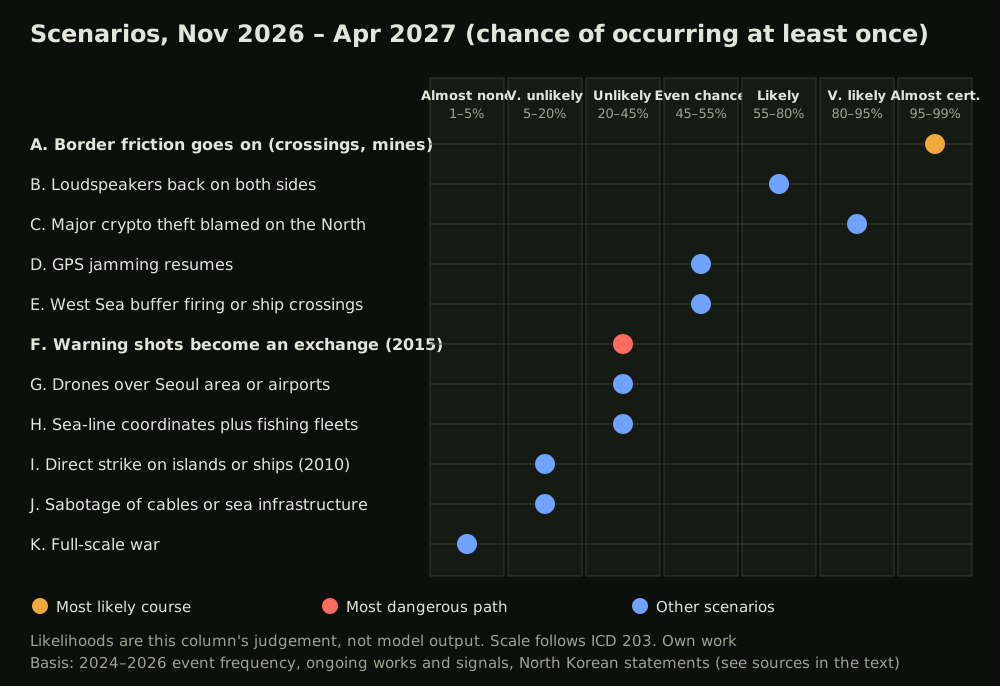
The most likely picture is constant low-level pressure in which A, B and C overlap, staying below the threshold of armed conflict while it keeps testing Seoul's ability to say who did what, and its domestic consensus. B does not lapse when the October deadline passes: Pyongyang can use the timing of the switch-on itself as leverage, while Seoul must first decide whether to put back the speakers it took down. The most dangerous path is F. It needs no plan from Pyongyang, only for one of the warning-shot episodes that now come several times a day to cause a North Korean casualty. The wooden-box mine crisis of August 2015 ran from a mine blast to resumed loudspeakers and an artillery stand-off before ending in a high-level agreement, and high-level contact was the way out. Today North Korea has ignored two offers of talks, so that way out is narrow, and we give more weight than in 2015 to the path from a local stand-off to the West Sea. Our confidence in this outlook is low: most border incidents are reported by one side, annual crossing counts conflict, and we have no figures for the North's forward order of battle.
Some factors point the other way. Contact between the North Korean and US leaders around the Asia-Pacific Economic Cooperation (APEC) summit in Shenzhen on 18–19 November is being discussed, and the NIS has not ruled out a shift towards talks around then (source 13). A researcher at the Carnegie Endowment for International Peace, however, put the chance below 10 per cent, and Reuters reported that US and South Korean officials see little chance of a meeting this year (sources 54, 55). Even if talks open, the North is likely to run a dual track, easing tension with Washington while keeping up border pressure on the South (assumption 5).
What to watch
| # | Indicator (what to look for) | Points to | Where to look | When |
|---|---|---|---|---|
| 1 | Official JCS confirmation that North Korean loudspeakers are running; Seoul's decision on a "proportionate" response | B, F | JCS, defence and unification ministry statements | November |
| 2 | North Korea's answer to the 23 October baseline-talks proposal; a single baseline published by Seoul and the UN Command | An answer lowers F; continued silence keeps A | Defence ministry, UN Command | November–December |
| 3 | Monthly MDL crossings; construction spreading west to face the Han estuary and Gyodong | A, estuary friction | Data supplied to parliament's defence and intelligence committees | Monthly |
| 4 | Confirmation of 600 mm super-large rocket launchers moved forward | F, I | NIS briefings to parliament | Any time |
| 5 | Published coordinates for a West Sea "southern border" or "median-line zone"; a maritime border law | H, hypothesis H4 | North Korean media | Any time |
| 6 | GPS jamming straight after missile or satellite launches | D | JCS, Ministry of Science and ICT | After launches |
| 7 | Training Unit call-ups, civil defence on a war footing, unusual leadership movements | K, reassess H1 | NIS, US and Japanese government assessments | Any time |
| 8 | US–North Korea contact around APEC, and whether crossings and construction continue after talks open | Assumption 5 | Government statements | Mid to late November |
| 9 | Return of troops from Kursk; reports of new drone units in forward corps | Assumption 4, F and G | NIS, Ukrainian intelligence | By spring 2027 |
Two tasks for South Korea follow from the right-hand columns. The first is to draw the line without waiting for the North. Even if the North refuses to talk, a single baseline published by Seoul and the UN Command, with markers and surveillance restored, would turn each crossing from an argument about "which line?" into a recorded violation. The second is to take the question of who did it out of politics. Without evidence standards and announcement procedures agreed in advance, the North's "fabrication" frame will simply amplify division at home; 29 October, when residents' accounts and official statements on the loudspeakers pulled in opposite directions, was a small-scale preview. In Kursk, North Korea shortened the time from sensor to shooter; South Korea needs to shorten the time from an incident to established facts and a decision on how to respond.
Limits of this analysis
The calls and weights in the hypothesis table are our own judgements, but the larger limits lie in the data. The mobilisation indicators rest on an absence of reporting; we could not obtain a 2024 crossing figure; and we found no 38 North or CSIS satellite analysis of the DMZ barrier works. Figure 2 is a schematic based on reported values, not a surveyed map. The list of indicators is therefore more useful than the likelihood language, and we will revise the judgement when they appear.
Sources
- Yonhap (via Korea Times), North Korean soldiers crossed the MDL about 50 times in August–September (2026-09-30). https://www.koreatimes.co.kr/foreignaffairs/northkorea/20260930/nk-soldiers-intrude-across-mdl-around-50-times-in-aug-sept-period-lawmaker (accessed 2026-10-29)
- Korea Times, North Korea's border fortification and the DMZ's buffer role (2026-10-03). https://www.koreatimes.co.kr/southkorea/defense/20261003/cover-story-north-koreas-border-fortification-raises-questions-over-dmz-buffer-role (accessed 2026-10-29)
- Financial News (Korea), MDL crossings in Defence Intelligence Agency data (2026-10-02). https://www.fnnews.com/news/202610020239271547 (accessed 2026-10-29)
- Yonhap (via Korea Times), more than 20 MDL crossings in August, exceeding the 17 of 2025 (2026-09-09). https://www.koreatimes.co.kr/foreignaffairs/northkorea/20260909/n-korean-troops-cross-mdl-more-than-20-times-in-august (accessed 2026-10-29, seen only as a search summary)
- Seoul Economic Daily, North Korea lays about 960,000 mines in the DMZ in two years (2026-10-23). https://en.sedaily.com/politics/2026/10/23/north-korea-lays-960000-mines-in-dmz-over-two-years-20261023 (accessed 2026-10-29)
- 38 North, The Korean DMZ has a verification problem (2026-10-15). https://www.38north.org/2026/10/the-korean-dmz-has-a-verification-problem/ (accessed 2026-10-29)
- UPI, Defence ministry proposes MDL talks; letter to the Security Council over the mine blast (2026-10-23). https://www.upi.com/Top_News/World-News/2026/10/23/korea-North-Korea-DMZ-border-defense-ministry-talks-MDL/4061792742282/ (accessed 2026-10-29)
- UPI, North Korea's UN mission rebuts the mine charge (2026-10-26). https://www.upi.com/Top_News/World-News/2026/10/26/North-Korea-DMZ-mine-blast-UNSC-letter/3891792997390/ (accessed 2026-10-29)
- Reuters (via TimesLIVE), letters at the UN and howitzers spotted at the border (2026-10-26). https://www.timeslive.co.za/news/world/2026-10-26-north-south-korea-tensions-high-as-letters-lodged-with-un-howitzers-spotted/ (accessed 2026-10-29)
- SBS, self-propelled guns on the Kaepung coast filmed from Aegibong (2026-10-26). https://news.sbs.co.kr/english/endPagePrintPopup.do?news_id=N1008815405 (accessed 2026-10-29)
- Aju Press, North Korea fires SRBMs from Wonsan, the 17th launch this year by JCS count (2026-10-29). https://www.ajupress.com/view/20261029141850611 (accessed 2026-10-29)
- France 24 (AFP), North Korea launches around a dozen ballistic missiles (2026-10-29). https://www.france24.com/en/asia-pacific/20261029-north-korea-launches-around-a-dozen-ballistic-missiles-amid-rising-tensions-with-south-korea (accessed 2026-10-29)
- Seoul Economic Daily, NIS briefing to parliament's intelligence committee: signs of interest in US talks, forward deployments watched (2026-10-29). https://en.sedaily.com/politics/2026/10/29/kim-jong-un-may-have-signaled-intent-on-us-talks-in-beijing (accessed 2026-10-30)
- Korea Economic Institute of America (KEI), analysis of the Ninth Party Congress (2026-02-27). https://keia.org/analysis/kim-jong-un-builds-a-wall-with-south-korea-at-party-congress/ (accessed 2026-10-29)
- Arab News (AFP), territory clause and deleted unification clauses in North Korea's revised constitution (2026-05-06). https://arabnews.com/node/2642522 (accessed 2026-10-29)
- AP (via WSLS), North Korea's constitution defines South Korea as a "hostile state" (2024-10-16). https://www.wsls.com/news/world/2024/10/16/north-korea-says-its-revised-constitution-defines-south-korea-as-hostile-state-for-first-time/ (accessed 2026-10-29)
- Korea JoongAng Daily, statement by the director of the party's General Affairs Department and the loudspeaker threat (2026-10). https://www.koreajoongangdaily.com/korea/kim-yojong-blames-seoul-for-border-tensions-threatens-to-resume-loudspeaker-broadcasts/12928611 (accessed 2026-10-29)
- Asia News Network, threats to resume loudspeakers and move tactical weapons forward (2026-10). https://asianews.network/north-koreas-kim-yo-jong-threatens-loudspeaker-broadcast-resumption-more-tactical-weapons-along-border/ (accessed 2026-10-29)
- Kyiv Independent, about 11,000 North Korean troops in Kursk at the start of 2026 (2026-02-13). https://kyivindependent.com/nearly-11-000-north-korean-troops-stationed-in-russias-kursk-oblast-at-start-of-2026-media-reports/ (accessed 2026-10-29)
- Kyiv Independent (via Yahoo), Ukrainian military intelligence estimates of North Korean losses (2026-06-29). https://www.yahoo.com/news/world/articles/ukraine-reveals-figures-north-korean-101443981.html (accessed 2026-10-29)
- Royal United Services Institute (RUSI), How North Korea is modernising its defence (2026-04-09). https://www.rusi.org/explore-our-research/publications/commentary/how-north-korea-modernising-its-defence (accessed 2026-10-29)
- War on the Rocks, North Korea's irregular warfare after Ukraine (2026-09-25). https://warontherocks.com/north-koreas-irregular-warfare-after-ukraine/ (accessed 2026-10-29)
- CNN (via Yahoo), first report of the Multilateral Sanctions Monitoring Team (MSMT): 14,000 troops, 100 ballistic missiles (2025-05-30). https://www.yahoo.com/news/14-000-troops-100-ballistic-080729426.html (accessed 2026-10-29)
- Financial News (English), IAEA report on a new enrichment building at Yongbyon and the Kangson annex (2026-09-10). https://en.fnnews.com/news/202609100802514878 (accessed 2026-10-29)
- CSIS Beyond Parallel, Suspected uranium enrichment building at Yongbyon complete (2026-04-13). https://beyondparallel.csis.org/suspected-uranium-enrichment-building-at-yongbyon-complete/ (accessed 2026-10-29)
- Chainalysis, crypto hacking and stolen funds in 2025 (2025-12-18). https://www.chainalysis.com/blog/crypto-hacking-stolen-funds-2026/ (accessed 2026-10-29)
- Chainalysis, crypto hacking and stolen funds in 2024 (2024-12-19). https://www.chainalysis.com/blog/crypto-hacking-stolen-funds-2025/ (accessed 2026-10-29)
- Segye Ilbo, cumulative GPS interference statistics (2024-11-17). https://www.segye.com/newsView/20241117507200 (accessed 2026-10-29)
- Dawn (AFP), GPS jamming from Haeju and Kaesong in November 2024 (2024-11). https://www.dawn.com/news/1871257 (accessed 2026-10-29)
- AP (via PBS), Poland shoots down Russian drones (2025-09-10). https://www.pbs.org/newshour/world/poland-says-it-shot-down-russian-drones-that-violated-its-airspace-during-strikes-on-ukraine (accessed 2026-10-29)
- Al Jazeera, Denmark shuts a second airport in a week (2025-09-25). https://www.aljazeera.com/news/2025/9/25/denmark-shuts-second-airport-in-a-week-more-unidentified-drones-spotted (accessed 2026-10-29)
- RNZ (AFP), Finnish court dismisses the Eagle S case (2025-10-04). https://www.rnz.co.nz/news/world/574951/finland-dismisses-case-over-baltic-cable-cuts (accessed 2026-10-29)
- Foreign Policy, Russia's hybrid war in Europe is escalating (2026-10-22). https://foreignpolicy.com/2026/10/22/europe-russia-hybrid-war-escalation/ (accessed 2026-10-29)
- Irregular Warfare Initiative, Grey-zone contestation between North and South Korea in the Yellow Sea (2026-07-22). https://www.irregularwarfare.org/gray-zone-contestation-between-north-and-south-korea-in-the-yellow-sea/ (accessed 2026-10-29)
- Asia Economy (English), North Korean coastal gunfire on 5 January 2024 (2024-01-05). https://www.asiae.co.kr/en/article/2024010513524606292 (accessed 2026-10-29)
- Korea Times, coastal gunfire for a second day (2024-01-06). https://www.koreatimes.co.kr/foreignaffairs/northkorea/20240106/n-korea-fires-artillery-shells-from-western-coast-for-2nd-day-jcs (accessed 2026-10-29)
- Kyeonggi Ilbo, distances between the north-west islands and North Korean coastal gun sites (2010-01-28). https://kyeonggi.com/article/201001280347352 (accessed 2026-10-29)
- Korea Education News, Baengnyeong's distance from Cape Jangsan, Pyongyang and Incheon (2026). https://www.hangyo.com/mobile/article.html?no=66035 (accessed 2026-10-29)
- The National Interest, Seoul's distance from the DMZ (25 miles) (date not confirmed). https://nationalinterest.org/node/56792 (accessed 2026-10-29)
- The Diplomat, North Korea's conventional threat and Seoul (30 miles) (2018-06). https://thediplomat.com/2018/06/trump-kim-summit-why-north-koreas-conventional-threat-to-south-korea-should-be-discussed-in-singapore (accessed 2026-10-29)
- US Forces Korea (USFK), text of the Armistice Agreement, Article I, paragraph 5 (Han River estuary) (1953). https://www.usfk.mil/portals/105/documents/sofa/g_armistice_agreement.pdf (accessed 2026-10-29)
- UPI, UN Command expels Chinese fishing boats from the Han River estuary (2016-06-10). https://www.upi.com/Top_News/World-News/2016/06/10/UN-Command-in-Korea-targets-illegal-Chinese-fishing-boats/7881465572866/ (accessed 2026-10-29)
- NBC News, the debate over whether North Korea has decided on war (2024-01). https://www.nbcnews.com/news/world/kim-jong-un-north-korea-war-rcna134046 (accessed 2026-10-29)
- NK News, JCS counts the 28th balloon launch since May (2024-10). https://www.nknews.org/2024/10/north-korea-floats-20-trash-balloons-toward-south-amid-drone-tensions/ (accessed 2026-10-29)
- Radio Free Asia (Korean), full suspension of the 19 September military agreement (2024-06-04). https://www.rfa.org/korean/in_focus/060424hw-06042024044742.html (accessed 2026-10-29)
- Korea JoongAng Daily, North Korea halts loudspeakers after the South (2025-06). https://www.koreajoongangdaily.com/korea/north-korea-halts-loudspeaker-broadcasts-following-souths-lead/12470263 (accessed 2026-10-29)
- The Star, North Korea blows up inter-Korean roads; South Korean troops return fire (2024-10-15). https://www.thestar.com.my/news/world/2024/10/15/north-korea-blows-up-parts-of-inter-korean-roads-on-its-side-s-korean-military-says (accessed 2026-10-29)
- UPI, North Korean vessel crosses the NLL; warning shots fired (2025-09-26). https://www.upi.com/Top_News/World-News/2025/09/26/South-Korea-fires-warning-shots-NLL-North-Korean-vessel-maritime-boundary/4751758858808/ (accessed 2026-10-29)
- Al Jazeera, South Korea pledges to restore the 2018 military agreement (2025-08-15). https://www.aljazeera.com/news/2025/8/15/south-korea-to-restore-pact-halting-military-activity-on-north-korea-border (accessed 2026-10-29)
- Korea JoongAng Daily, unification minister calls the mine incident an "accident" (2026-10). https://www.koreajoongangdaily.com/bilingual-news/unification-minister-downplays-north-korean-mine-provocation-kor/12914689 (accessed 2026-10-29)
- Asia Times, Drones could expand North Korea's grey-zone options (2026-09). https://asiatimes.com/2026/09/drones-could-expand-north-koreas-gray-zone-options/ (accessed 2026-10-29)
- Kyunghyang Shinmun, KINU Unification Survey 2025 (2025-10-20). https://www.khan.co.kr/article/202510201515001/ (accessed 2026-10-29)
- Financial News (Korea), Seoul National University Institute for Peace and Unification Studies 2026 survey (2026-09-28). https://www.fnnews.com/news/202609282021448142 (accessed 2026-10-29)
- France 24 (AFP), prospects for US–North Korea summit contact ahead of APEC (2026-10-23). https://www.france24.com/en/live-news/20261023-ahead-of-apec-summit-trump-comes-knocking-on-kim-s-door (accessed 2026-10-29)
- Reuters (via US News), US and South Korean officials see little chance of a summit this year (2026-10-23). https://www.usnews.com/news/world/articles/2026-10-23/exclusive-us-south-korean-officials-see-little-chance-of-trump-kim-meeting-this-year (accessed 2026-10-29)
- Office of the Director of National Intelligence (ODNI), Annual Threat Assessment 2026, unclassified (2026-03). https://www.intelligence.senate.gov/wp-content/uploads/2026/03/ATA-2026-unclassified-16-Mar-FINAL.pdf (accessed 2026-10-29)
- CIA Center for the Study of Intelligence, Psychology of Intelligence Analysis, chapters 4 and 8 (1999). https://www.cia.gov/resources/csi/static/Pyschology-of-Intelligence-Analysis.pdf (accessed 2026-10-27)
- CIA, A Tradecraft Primer (2009-03). https://www.cia.gov/resources/csi/static/Tradecraft-Primer-apr09.pdf (accessed 2026-10-27)
- Office of the Director of National Intelligence (ODNI), Intelligence Community Directive 203, Analytic Standards (2015, amended 2022). https://archive.dni.gov/files/documents/ICD/ICD-203.pdf (accessed 2026-10-27)
- University of Strathclyde repository, controlled experiment on ACH (Applied Cognitive Psychology, vol. 33) (2019). https://strathprints.strath.ac.uk/69049/ (accessed 2026-10-27)
- Reuters (via Daily Maverick), the southern border to become an "impregnable fortress" (2026-05-18). https://www.dailymaverick.co.za/article/2026-05-18-north-koreas-kim-calls-to-make-border-with-south-korea-an-impregnable-fortress/ (accessed 2026-10-29)
- Wikipedia, 2026 in North Korea (timeline, secondary compilation; entry for the 14 March launch). https://en.wikipedia.org/wiki/2026_in_North_Korea (accessed 2026-10-29)
- Herald Business, the JCS explanation of rising MDL crossings and the rules of engagement (2026-09-09). https://biz.heraldcorp.com/article/10867302 (accessed 2026-10-29)
- Korea Herald (Yonhap), North Korea appears to test propaganda loudspeakers along the border (2026-10-29). https://www.koreaherald.com/article/10919523 (accessed 2026-10-30)
- Maeil Shinmun, Paju border residents report loudspeaker sounds; NIS and JCS say no operation confirmed (2026-10-29). https://www.imaeil.com/page/view/2026102922371690117 (accessed 2026-10-30)
- Dailian, JCS reports only maintenance activity on North Korean loudspeakers (2026-10-30). https://www.dailian.co.kr/news/view/1708773/ (accessed 2026-10-30)
- Kyunghyang Shinmun, the General Affairs Department director's statement of 19 October, "We do not defend sovereignty with words" (2026-10-19). https://khan.co.kr/article/202610191824001 (accessed 2026-10-30)
- Yonhap (via Korea Times), North Korean media report a demonstration of cruise missiles, rocket launchers and drones; JCS statement (2026-10-30). https://www.koreatimes.co.kr/foreignaffairs/northkorea/20261030/n-korea-reports-weapons-demonstration-featuring-cruise-missiles-rocket-launchers-drones (accessed 2026-10-30)
- Korea.kr (government briefing), final findings of the JCS joint on-site investigation into the 25th Division DMZ mine blast (2026-10-05). https://www.korea.kr/policy/civilView.do?newsId=156784294 (accessed 2026-10-30)
- Al Jazeera, South Korea's first proposal of talks on the MDL (2025-11-17). https://www.aljazeera.com/news/2025/11/17/south-korea-proposes-talks-with-north-korea-on-military-demarcation-line (accessed 2026-10-30)
- Korea JoongAng Daily, North Korea denies removing its loudspeakers (2025-08). https://www.koreajoongangdaily.com/korea/not-willing-to-remove-them-norths-kim-yo-jong-refutes-loudspeaker-removal-claims-by-south/12205947 (accessed 2026-10-30)
- Korea JoongAng Daily, loudspeakers to run along the whole border by the end of October (2026-10-21). https://www.koreajoongangdaily.com/korea/north-korea-to-resume-using-loudspeakers-along-border-by-end-of-october/12932842 (accessed 2026-10-30)