
North Kordofan's dry season: can the desert-flank push relieve El Obeid?
· 2026-07 – 2027-04
This analysis is for education and research. Content on ongoing wars may change as new information emerges. We label claims separately from confirmed facts.
Overview (BLUF)
Between 25 July and 2 October 2026 the Sudanese Armed Forces (SAF) and the Joint Forces, a coalition of Darfuri armed movements, drove the Rapid Support Forces (RSF) out of most of North Kordofan. The direction of the advance matters. Rather than push straight west from El Obeid along the trunk road to an-Nahud, they went north through Bara, out to Sodari in the north-western semi-desert (25 September), and then collected al-Mazroub, which had been left between the two (2 October). The capture of al-Mazroub is an SAF claim; we found no RSF statement and no independent confirmation.
Most coverage of El Obeid frames it as a humanitarian emergency that could become "the next El Fasher" (sources 28, 42). This column asks a different question: what is the desert-flank push trying to cut, and whom does the coming dry season favour?
We reach three judgements. First, the push targets one of the RSF supply axes feeding the pressure on El Obeid. The main southern artery through an-Nahud, al-Khuwei and Babanusa in West Kordofan is untouched. Second, the common belief that "the dry season favours the army" does not fit the record: the late-2025 dry-season gains were the RSF's, and in 2026 the SAF advanced in the middle of the rains. Third, the most likely picture to April 2027 is an SAF that widens its north-western flank while the RSF presses El Obeid with drones rather than ground assaults. Even so, that picture is less likely than not.
The evidence has clear limits. Most town-level control information comes from one side, and we found no reporting after 21 October, so "now" in this column effectively means mid- to late October. One-sided statements are marked claimed and single uncorroborated reports reported.
The Situation as of 27 October 2026
Some background first. In early 2025 the SAF retook most North Kordofan towns and reopened the Kosti–El Obeid road, but its offensive stalled by mid-year without entering West Kordofan. When the dry season set in late in 2025, the RSF took El Fasher (26 October), Babanusa (1 December) and Heglig (8 December). By December, Bara, Umm Sumeima, al-Khuwei and Kazgil were back in RSF hands and El Obeid was surrounded on three sides (source 1). Bara kept changing hands: in March 2026 the RSF retook it ten days after an SAF recapture (sources 2, 3). On 30 June the conflict-data organisation ACLED judged that the RSF had effectively encircled El Obeid from the north, west and south, leaving the SAF only an eastern supply corridor, and that a full takeover was improbable while attrition continued (source 4). Yale's Humanitarian Research Lab (HRL) documented at least 14 checkpoints and 51 km of berms and trenches around the city (source 5).
The sequence since July is below. Dates come mainly from the Wikipedia 2026 timeline (a secondary compilation) and Sudan Tribune, whose article pages were blocked, so we relied on search summaries (source 6).
| Date (2026) | Event | Nature of the evidence |
|---|---|---|
| 25 Jul | Bara, Jabra al-Sheikh and nearby villages retaken | Announced by the Darfur governor and Joint Forces leader, claimed (sources 6, 7) |
| 27 Jul | Full control of the Khartoum–El Obeid road. Same day, the RSF commander reportedly let field commanders launch operations without central approval | SAF claim, AFP report (sources 6, 8) |
| Late Jul | Retreating RSF raid Umm Badr, Sodari, al-Mazroub and other villages; on the 29th SAF drones hit RSF convoys in the area | Local reports, SAF claim (sources 6, 9) |
| Aug | RSF block food into al-Mazroub; cholera and market looting reported | Local reports (source 10) |
| 13–14 Aug | Fighting at Jabra al-Sheikh and Bara; clashes over Umm Arada, about 25 km south-west of El Obeid | Competing claims (source 11) |
| 6–7 Sep | Hamrat al-Wiz and al-Safiya retaken | SAF claim (source 6) |
| 17 Sep | "11 areas" retaken. A local emergency-room member said the RSF had pulled out of Hamrat al-Sheikh, al-Mazroub and Sodari in large numbers, moving to an-Nahud, Ghebeish and Wad Banda in West Kordofan | SAF claim, local testimony (sources 12, 13) |
| 18–19 Sep | al-Jamama retaken | SAF and Joint Forces claim (source 14) |
| 25 Sep | Sodari retaken. The same day an SAF drone strike on al-Mazroub market left 17 dead | SAF claim, widely reported (source 15) |
| 2 Oct | al-Mazroub taken. An SAF special forces spokesman called it the link between North and West Kordofan and said the aim was to cut RSF supply lines. Residents said the RSF had left in September, came back after Sodari fell and pulled out again as the SAF approached | SAF claim, no RSF statement (sources 16, 17) |
| 3 Oct | RSF execute at least 25 civilians in Umm Badr | Reported; suggests the RSF were still present (source 6) |
| 10–18 Oct | SAF air strikes: an-Nahud (10th), Abu Zaima (15th, five children died), Umm Sumeima (16th, an RSF media official died), al-Dibab in West Kordofan (18th, at least 150 deaths alleged) | Reported and alleged (source 6) |
| 20 Oct | RSF drone hits Tandalti power station, cutting power to North Kordofan | Reported (source 6) |
| 21 Oct | More than 600 bodies recovered in Bara, mostly attributed by volunteers to RSF reprisals | Middle East Eye report, via secondary compilation (source 6) |
| 22–27 Oct | No reporting found | — |
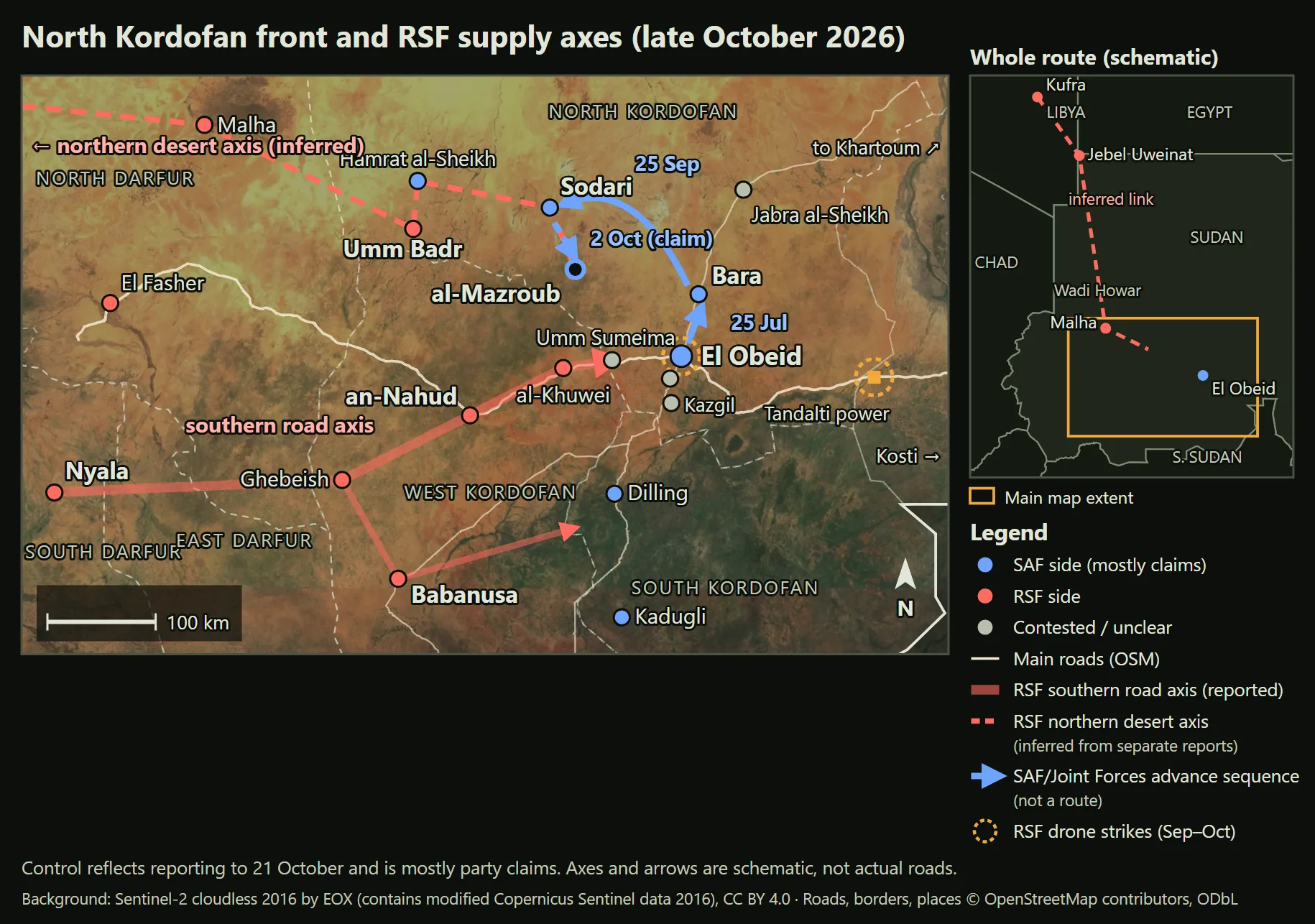
Plotting the towns shows the shape of the advance. Using OpenStreetMap (OSM) coordinates, al-Mazroub lies about 116 km west of Bara and about 61 km south-south-east of Sodari in a straight line (Figure 1, source 48). In other words al-Mazroub was not the tip of the advance but a pocket left between Bara and Sodari. The SAF took the more distant Sodari first and cleared al-Mazroub a week later, which fits residents' accounts that the RSF returned to al-Mazroub after Sodari fell. From Sodari, the north-western tip of the advance, Umm Badr is a further 127 km or so.
As of late October, it is reasonable to treat El Obeid, the road towards Khartoum, Bara and Sodari as SAF-held. al-Mazroub rests on the SAF claim alone. For Jabra al-Sheikh, the July recapture claim conflicts with an Anadolu report that it "remains under RSF control" (source 19). There are signs of an RSF presence into mid-October at Umm Badr, a gold-mining area in the far north-west, and at Umm Sumeima, about 64 km west of El Obeid. An-Nahud, Ghebeish, Wad Banda, al-Khuwei and Babanusa in West Kordofan are RSF-held. Dilling and Kadugli in South Kordofan are held by the SAF but blockaded by the RSF and the SPLM-N.
The "siege" of El Obeid has also changed shape. The three-sided encirclement of June is no longer the picture; what remains is ground pressure from the west and south-west overlaid by a drone blockade. The city holds about 500,000 people, more than 83,000 of them displaced (source 18). RSF drones struck a college on 9 September and a University of Kordofan dormitory on 1 October (five dead, 47 injured). On 20 October they hit the Tandalti power station in White Nile State, east of El Obeid, and the government has accused the RSF of striking fuel facilities (sources 6, 18, 19).
Two Supply Axes
The RSF's Kordofan front is supplied from Darfur along two broad families of routes (Figure 1).
- The southern road axis. From Darfur through Babanusa, Ghebeish, an-Nahud and al-Khuwei in West Kordofan to the west and south-west of El Obeid. On the OSM map this is the El Obeid–an-Nahud trunk road. It is the main artery for the pressure west of El Obeid and for the South Kordofan sieges (sources 1, 12). In ACLED data for April 2023 to 19 September 2026, of 723 attacks in West Kordofan, 142 were at Babanusa, 119 at an-Nahud and 112 at al-Khuwei, all on this road (source 18).
- The northern desert axis. From Kufra in south-eastern Libya through the Jebel Uweinat area where Libya, Egypt and Sudan meet, into the North Darfur desert (Wadi Howar, Malha, Bir Mirgui), then along the old caravan route of Darb al-Arba'in (the Forty Days Road) into north-western North Kordofan. Citing military sources, Sudan Tribune described the road as a corridor the RSF used to move fighters and equipment from Darfur (sources 13, 20).
Each segment of the northern axis has its own evidence. The UN Panel of Experts on Libya reported that a Libyan armed group around Kufra passed recruits, weapons and fuel to the RSF and used Kufra airport (sources 21, 22). In September 2026 the UN Fact-Finding Mission pointed to supply networks transiting Chad, Libya (Benghazi, Kufra, Jufra) and Somalia; the UAE denies involvement (source 23). 2025 material from the UN Panel of Experts on Sudan describes supplies flowing from eastern Chad and southern Libya to a base at Bir Mirgui in North Darfur (sources 24, 25). The RSF took the Jebel Uweinat triangle in June 2025 (source 26). In August 2026 the Joint Forces claimed to have destroyed an RSF convoy in the desert near the Libyan border; Reuters could not verify this (source 27). Russia's bases in southern Libya are covered in our column From Wagner to Africa Corps.
But a single line from Kufra to al-Mazroub is our inference. No source maps the route end to end. A Sudanese media report that an SAF strike at Umm Badr on 28 September left a Libyan officer advising the RSF dead is also single-source (source 6). If it is right, Umm Badr may be where the Libyan route enters North Kordofan. Malha to Umm Badr is about 214 km in a straight line (source 48).
The SAF's line that it has "cut supply lines" is therefore better read as "squeezed one of several". Sodari and al-Mazroub close the eastern end of the northern desert axis, but they do not reach the southern road axis that feeds the pressure west of El Obeid and in South Kordofan.
Season: Testing "the Dry Season Favours the Army"
Sudan's main rainy season runs from June to September and in some years into October (sources 30, 31). Rainfall in June–September 2026 was below average, and the main harvest runs from October 2026 to January 2027 (sources 29, 32, 33). The usual assumption is that once the rains stop and the ground dries, heavy vehicles and supply trucks move again, which favours the side with heavier armour and logistics, the army.
The record does not bear this out (Figure 2). The big gains of the late-2025 dry season were the RSF's: El Fasher, Babanusa and Heglig. The SAF's gains came in early 2025 and during the July–September 2026 rains (sources 1, 6). The RSF besieged El Obeid from 2023 to early 2025 without taking it (source 4). Rather than the season favouring one side, whichever side held the initiative when the season turned used the window.
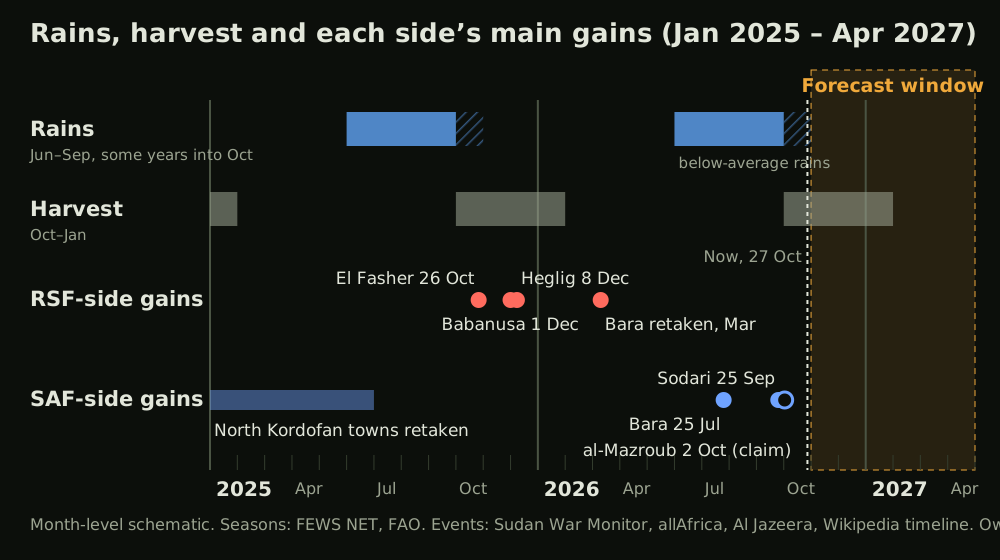
Conditions this year are also different. The rains were light and the SAF has already moved through the wet season, so the "opening" effect of the dry season is weaker than usual: both sides are effectively in it already. The dry season widens movement for both. We add one inference of our own: clear skies and tyre tracks on dry ground make vehicle columns crossing the desert easier to spot and strike from the air. As the imagery in Figure 1 shows, the north is sparsely vegetated semi-desert with little cover. The SAF has extended its air strikes to an-Nahud, Nyala and towards the Chadian border (source 6). This year's dry season therefore offers openings both to SAF air interdiction and to an RSF main body that withdrew intact into West Kordofan. In our view the contest turns less on "whose season it is" than on "who squeezes the other's supply axis first".
Humanitarian conditions are tied to the season as well. As of 3 September 2026 the UN Food and Agriculture Organization (FAO) counted 19.5 million people in Integrated Food Security Phase Classification (IPC) Phase 3 or worse, famine risk in 14 areas and diesel prices that doubled between March and June (source 29). The International Rescue Committee (IRC) reports that fuel moves in small containers (source 28). With the harvest overlapping the front line, which roads lorries carrying fuel and food can use shapes both military supply and people's livelihoods.
Competing Hypotheses 1: What Is the SAF After?
Analysis of Competing Hypotheses (ACH) sets several hypotheses against the evidence and favours the one that is least contradicted, not the one with the most support (sources 44, 45). Evidence consistent with every hypothesis has no diagnostic value and is left out. Cells read C (consistent), I (inconsistent) or N (not applicable). Each I scores −1 times its weight (high 2, medium 1, low 0.5). The score ranks hypotheses; it is not a probability.
- S1 The desert flank is the main effort. Clear Umm Badr, then push along Darb al-Arba'in into the North Darfur desert and link up with the Joint Forces' interdiction near the Libyan border.
- S2 The north is a shaping operation; the main effort is west or south. Secure El Obeid's north, then go via Umm Sumeima and al-Khuwei to an-Nahud, or south to relieve Dilling and Kadugli.
- S3 Consolidation. Hold the gains, rely on air strikes and drones, and wait on the truce and diplomatic track.
| Evidence (source, date) | Credibility | Weight | S1 | S2 | S3 |
|---|---|---|---|---|---|
| E1. Military sources: the aim is to push towards Darfur along Darb al-Arba'in (Sep, source 13 summary) | Medium | 1 | C | I | I |
| E2. SAF spokesman: al-Mazroub links North and West Kordofan; the aim is to cut supply lines (2 Oct, source 17) | Low (party claim) | 0.5 | C | C | I |
| E3. No new ground-capture claims 3–21 Oct; air strikes concentrated on an-Nahud, Umm Sumeima and al-Dibab (source 6) | Medium | 1 | I | C | C |
| E4. SAF leadership rejects the truce plan as giving the RSF "time to regroup" (23 Sep, source 39) | Medium | 1 | C | C | I |
| Inconsistency score | −1.0 | −1.0 | −2.5 |
Three items were removed as non-diagnostic. The August claim of a convoy strike in the border desert and Chad's accusations of cross-border strikes fit both S1 and the air-centred S3. That the SAF took several villages the RSF had already left, and that the Joint Forces are also fighting in West Darfur, contradict none of the hypotheses.
Tentative conclusion. S3 is the most contradicted. We judge it likely that the SAF continues offensive operations in the dry season. Whether the main effort is the desert (S1) or west/south (S2) is a roughly even chance. The two are not mutually exclusive: securing the north first and then wheeling west is possible. We hold this judgement with low confidence.
Sensitivity check. Two rows decide it. E1 is a search summary of a blocked article quoting anonymous military sources; if E1 is wrong, S2 leads. The E3 lull may be a post-rains pause or simply the reporting gap after 21 October; drop E3 and S1 leads. Desert or west cannot be settled with the evidence available now. Indicators 2, 3 and 4 below will settle it.
Competing Hypotheses 2: The RSF's Dry-Season Course
- R1 A dry-season ground counteroffensive. A coordinated ground offensive west and south-west of El Obeid, as in late 2025.
- R2 Drone blockade and defence of West Kordofan. Strike El Obeid's infrastructure and rear cities with drones, hold the an-Nahud–Babanusa line on the ground, and weight the South Kordofan sieges alongside the SPLM-N.
- R3 Shift the effort elsewhere. Move to other fronts such as Blue Nile or the Darfur borders, or turn inwards to manage defections.
| Evidence (source, date) | Credibility | Weight | R1 | R2 | R3 |
|---|---|---|---|---|---|
| F1. Since al-Mazroub, drone strikes only, with no reported ground counterattack (1 Oct dormitory, 9 Oct, 20 Oct power station, fuel-facility accusations; sources 6, 18, 19) | Medium | 1 | I | C | C |
| F2. Reported devolution of authority to field commanders on 27 Jul and claimed RSF commander defections Aug–Oct (mostly SAF-side; defections also run the other way; source 6) | Medium | 1 | I | C | C |
| F3. Signs of RSF presence at Umm Badr (3 Oct) and Umm Sumeima (16 Oct) into mid-October (source 6) | Low | 0.5 | C | C | I |
| Inconsistency score | −2.0 | 0 | −0.5 |
Removed as non-diagnostic: the RSF's September pullback into West Kordofan, which fits preparation for a counterstroke, defence and a shift elsewhere alike; the long-range drone strikes reaching Gedaref, Kassala and Khartoum airport on 18–19 October; and the 16 September capture of Jabal Kadam in Blue Nile together with the continuing South Kordofan sieges. The late-2025 precedent is a starting point (a prior), not evidence of current intent, so it is handled in the key assumptions check rather than the matrix.
Tentative conclusion. It is likely that R2 is the RSF's main course to January 2027. It is unlikely that a coordinated ground counteroffensive (R1) retakes Bara or al-Mazroub by April. A shift of effort elsewhere (R3) is also unlikely. We hold this judgement with low confidence.
Sensitivity check. F1 is fragile over time: the 2025 offensive did not begin until late October, so three quiet weeks are weak evidence. F2 rests largely on defection figures announced by the SAF. If both rows are wrong, the gaps between the three hypotheses almost vanish. The RSF's Chinese-made FH-95 long-range unmanned aerial vehicles (UAVs) at Nyala airport and its stock of loitering munitions (at least 40 as of February 2026) are the means to sustain R2 (sources 34, 35). Conversely, if the SAF claim to have downed about eight FH-95s in ten days in late September is true, a drone blockade will be harder to sustain (source 36).
Key Assumptions Check
| # | Assumption | Basis | Rating | What would show it wrong | Effect if wrong |
|---|---|---|---|---|---|
| 1 | The SAF actually holds al-Mazroub | SAF statement; residents say the RSF left (sources 16, 17) | Caveated | RSF recapture claims or reported fighting at al-Mazroub or Sodari | Weakens S1 and scenarios A and B |
| 2 | The RSF withdrew rather than was defeated, and its main body is intact in West Kordofan | September local testimony of "massive pullbacks" (sources 12, 13) | Caveated | Large surrenders around an-Nahud; SAF entry without resistance | R1 weakens further; A strengthens |
| 3 | The northern desert axis is one of several supply axes, not the main artery | The UN panel's three routes (eastern Chad, southern Libya, CAR); fighting concentrated on the southern road (sources 18, 24) | Unsupported (inference) | RSF activity west and south of El Obeid drops markedly after al-Mazroub | Our low estimate of the northern cut's effect would need revising |
| 4 | The dry season favours the SAF | Conventional wisdom only; the 2025 record says the opposite (source 1) | Unsupported | SAF ground entry into West Kordofan in Nov–Dec | Our seasonal judgement would need revising |
| 5 | After devolution and defections, the RSF struggles to coordinate a multi-axis offensive | 27 Jul devolution report; defection claims (source 6) | Caveated (defection figures mostly SAF claims) | Simultaneous ground attacks from two or more directions west and south-west of El Obeid in Nov–Dec | R1 and scenarios B and C rise |
Assumptions 3 and 4 are unsupported, so both carry over into the indicator list below.
Quality of Information Check
Weakly sourced items that were used, or might tempt use, are listed separately.
| Item | Source type | Corroboration | Reliability | Used for |
|---|---|---|---|---|
| Capture of al-Mazroub (2 Oct) | SAF spokesman via Al Jazeera; some resident accounts | No RSF statement, imagery or other independent confirmation | Party claim | S1; scenario horizontal axis |
| Egyptian Air Force strike on the Uqaydat mine (10 Oct, 72+ dead) and accusation of Egyptian involvement in a Nyala strike (16 Oct) | Wikipedia compilation; the latter an RSF accusation | Primary sources not checked | Low | Not used for conclusions |
| US envoy's contact with the SAF leadership at New Alamein (around 4 Oct, a lunch hosted by Egypt's president) | One news-aggregator source (source 41) | None | Low | Truce indicator only |
| Report that the US withdrew recognition of the SAF leadership's "ruling authority" | Lower-tier outlet (source 40) | None | Low | Not used |
| Scale of RSF commander defections, Aug–Oct | Mostly SAF-side announcements | Defections in the other direction also claimed | Low to medium | F2; assumption 5 |
| About eight FH-95s downed in late September | SAF military sources (source 36) | None | Low | R2 sensitivity |
| August convoy strike in the border desert | Joint Forces statement (source 27) | Reuters could not verify | Low | Removed as non-diagnostic |
| Sudan Tribune articles, Jul–Sep | Pages blocked; search summaries | Partly overlap with Al Jazeera and Anadolu | Medium | Timeline; E1 |
Outlook: November 2026 – April 2027
Likelihood terms follow the scale in US Intelligence Community Directive 203 (source 46). Confidence is a separate concept and is stated in separate sentences.
| Almost no chance | Very unlikely | Unlikely | Roughly even chance | Likely | Very likely | Almost certain |
|---|---|---|---|---|---|---|
| 1–5% | 5–20% | 20–45% | 45–55% | 55–80% | 80–95% | 95–99% |
Two axes give four futures. The horizontal axis is whether the SAF holds and extends the north-western desert flank (Umm Badr and beyond) or stalls or is pushed back. The vertical axis is whether the RSF can mount a coordinated ground offensive or stays with a drone-led posture.
| RSF drone-led | RSF coordinated ground offensive | |
|---|---|---|
| SAF extends the flank | A. Desert-flank closure: the SAF takes Umm Badr and extends interdiction towards Darb al-Arba'in. The RSF keeps striking El Obeid's power and fuel with drones. El Obeid's north stabilises but the southern road axis is intact. Unlikely (the most likely of the four) | B. Trade-off: while the SAF advances in the north-west, the RSF attacks west and south-west of El Obeid on the ground from the an-Nahud side (towards Umm Arada and Kazgil). Unlikely |
| SAF stalls or falls back | D. Attritional stalemate: dispersion or truce pressure halts the SAF short of Umm Badr, and both sides strike each other's infrastructure with drones. Unlikely | C. A repeat of 2025: the RSF returns to Sodari, al-Mazroub or Bara and pressure on El Obeid grows on three sides again. Very unlikely |
A is the most likely of the four, but still less likely than not. Taking the horizontal axis alone, it is likely that the SAF holds and extends its flank. Taking the vertical axis alone, it is also likely that the RSF stays with a drone-led posture. We hold this outlook with low confidence, because most control information is party claims, there is no reporting after 21 October, and we have no order of battle figures for either side.
Indicators to Watch
| # | Indicator (observable threshold) | Points to | Where to look | When |
|---|---|---|---|---|
| 1 | UN Security Council decision on the Darfur arms embargo and the Sudan Panel of Experts: repeated one- or two-month extensions, a one-year renewal, or lapse | A lapse weakens monitoring of outside supply and raises the risk of B and C | Council records | Early December (around the end of the two-month extension of 9 October; our estimate) |
| 2 | RSF reaction at al-Mazroub or Sodari: reports of an RSF return or RSF recapture claims | B, C | Both sides' statements, Al Jazeera, Sudan Tribune | Nov–Dec |
| 3 | SAF claim to Umm Badr, or reports of movement west along Darb al-Arba'in into North Darfur | A, B; SAF hypothesis S1 | Both sides' statements, independent reporting | Nov – Jan 2027 |
| 4 | SAF ground attacks at Umm Sumeima, al-Khuwei or an-Nahud | SAF hypothesis S2 | ACLED, both sides' statements | Dec – Feb 2027 |
| 5 | Drone strikes on El Obeid's power and fuel facilities: monthly strikes without ground attacks point to A or D; strikes accompanied by ground attacks at Umm Arada or Kazgil point to B or C | A/D or B/C | ACLED counts for Sheikan locality (monthly record 27, June 2026) | Monthly |
| 6 | Truce track: a signed text of the Quad (US, Saudi Arabia, UAE, Egypt) 90-day truce, or SAF leadership acceptance | Towards D; downgrades the rest | Government statements, Reuters | Any time |
For reference, Umm Arada lies about 23 km south-west and Kazgil about 44 km south of El Obeid (straight-line distances from OSM coordinates; sources 43, 48).
The truce track is blocked for now. In September 2025 the Quad proposed a three-month truce and a nine-month transition; in November the SAF leadership rejected it as biased (sources 37, 38). On 23 September 2026 the US tied the SAF leader's UN General Assembly visa to acceptance of the 90-day truce plan, and the Sudanese government replied that a truce would only help the RSF regroup (source 39). We found no reporting of truce talks for 5–27 October. The Quad is itself split, with Egypt now reported as a kinetic actor on the SAF side and the UAE accused of backing the RSF. We therefore judge it unlikely that the Quad secures a truce before the dry-season campaign.
Limits of the Method
Structured analytic techniques lay reasoning out so that others can check it; they do not guarantee that it is right. The C/I ratings and weights in the two matrices are our own judgements. Even in a controlled experiment that randomly assigned 50 analysts, evidence that ACH reduces confirmation bias was mixed, and there were signs it can make judgements less consistent (source 47). Here the bigger limit is the evidence: most control information is party claims, there is nothing after 21 October, and we found no seasonal trafficability data for the sand sheets and clay plains. The satellite background in Figure 1 is a 2016 composite and shows neither current cultivation nor positions. The indicator list is the most useful part of this column, more than the likelihood words: when the indicators move, we will revise.
Sources
- Sudan War Monitor, map of the drone war in Kordofan and the 2025 dry-season shift (2025-12-19). https://sudanwarmonitor.com/p/map-the-drone-war-in-kordofan (accessed 2026-10-27)
- Al Jazeera, the RSF's capture of Bara and the threat to El Obeid (2025-11-14). https://www.aljazeera.com/features/2025/11/14/will-sudans-rsf-turn-strategic-city-of-el-obeid-into-another-el-fasher (accessed 2026-10-27)
- allAfrica, the RSF retakes Bara (2026-03-17). https://allafrica.com/stories/202603170052.html (accessed 2026-10-27)
- ACLED expert comment, can the RSF seize El Obeid? (2026-06-30). https://acleddata.com/expert-comment/can-rsf-seize-el-obeid (accessed 2026-10-27)
- Yale Humanitarian Research Lab (HRL), El Obeid situation report 77 (2026, date not confirmed). https://ysph.yale.edu/download-file/76d1775e-de0c-4861-afae-7aa92c4c0228/ (accessed 2026-10-27)
- Wikipedia, Timeline of the Sudanese civil war (2026) (secondary compilation, read up to the 22 October entry). https://en.wikipedia.org/wiki/Timeline_of_the_Sudanese_civil_war_(2026) (accessed 2026-10-27)
- Sudan Tribune, recapture of Bara, al-Baraka and Um Sayala (2026-07). https://sudantribune.com/article/316601 (accessed 2026-10-27; page blocked, search summary used)
- L'Orient-Le Jour (AFP), the RSF renews its assault on El Obeid as drones strike the capital (2026-07). https://today.lorientlejour.com/article/1544343/rsf-renews-assault-on-sudan-s-al-obeid-as-drones-strike-capital-witnesses-say (accessed 2026-10-27)
- Sudan Tribune, retreating RSF raid north-western villages (2026-07). https://sudantribune.com/article/316794 (accessed 2026-10-27; search summary)
- Sudan Tribune, food blockade and cholera in al-Mazroub (2026-08). https://sudantribune.com/article/317278 (accessed 2026-10-27; search summary)
- Sudan Tribune, fighting at Jabra al-Sheikh and Umm Arada (2026-08). https://sudantribune.com/article/317390 (accessed 2026-10-27; search summary)
- Sudan Tribune, the SAF's claim to have retaken "11 areas" (2026-09-17). https://sudantribune.com/article/318891 (accessed 2026-10-27; search summary)
- Sudan Tribune, RSF pullbacks and the push along Darb al-Arba'in (2026-09). https://sudantribune.com/article/318939 (accessed 2026-10-27; search summary)
- AzerNews (Anadolu), al-Jamama retaken (2026-09). https://www.azernews.az/region/264134.html (accessed 2026-10-27)
- Sudan Tribune, Sodari retaken and the al-Mazroub market strike (2026-09-25). https://sudantribune.com/article/319247 (accessed 2026-10-27; search summary)
- Al Jazeera, Sudan's army says it captured an RSF stronghold in North Kordofan (2026-10-02). https://www.aljazeera.com/news/2026/10/2/sudans-army-says-it-captured-rsf-stronghold-in-north-kordofan (accessed 2026-10-27)
- Al Jazeera, is the Sudanese army gaining momentum? (2026-10-04). https://www.aljazeera.com/news/2026/10/4/is-the-sudanese-army-gaining-momentum-against-the-rsf (accessed 2026-10-27)
- Al Jazeera, the battle for Kordofan, with ACLED data (2026-10-01). https://www.aljazeera.com/news/2026/10/1/the-battle-for-kordofan-the-corridor-linking-sudans-east-and-west (accessed 2026-10-27)
- Anadolu, Sudan accuses the RSF of drone attacks on service facilities and fuel stations in North Kordofan (2026, date not confirmed). https://www.aa.com.tr/en/middle-east/sudan-accuses-rsf-of-drone-attacks-on-service-facilities-fuel-stations-in-north-kordofan/4098865 (accessed 2026-10-27)
- Sudan Tribune, the campaign to sever Darfur–Kordofan supply corridors (2026, date not confirmed). https://sudantribune.com/article/319523 (accessed 2026-10-27; search summary)
- ABC News (AP), the UN Libya panel's report on support for the RSF (2026). https://abcnews.com/International/wireStory/libya-fueled-war-sudan-colombian-mercenaries-equipment-report-132235661 (accessed 2026-10-27)
- Libya Security Monitor, Kufra armed groups and the RSF (date not confirmed). https://libyasecuritymonitor.com/?p=9572 (accessed 2026-10-27)
- American Society of International Law (ASIL), summary of the UN Fact-Finding Mission's findings on external support (2026-09). https://asil.org/ilib/un-fact-finding-mission-finds-external-support-sustaining-military-operations-in-sudan/ (accessed 2026-10-27)
- Sudans Post, extracts from the UN Panel of Experts on Sudan (2025). https://www.sudanspost.com/darfur-has-witnessed-worst-violence-since-2005-un-experts/ (accessed 2026-10-27; search summary)
- Radio Tamazuj, UN experts on RSF supply lines through South Sudan (date not confirmed). https://radiotamazuj.org/en/news/article/un-experts-sudanese-paramilitary-rsf-opened-supply-lines-through-south-sudan-to-take-darfur (accessed 2026-10-27)
- Wikipedia, Battle of Gabal El Uweinat (events of June 2025). https://en.wikipedia.org/wiki/Battle_of_Gabal_El_Uweinat (accessed 2026-10-27)
- Sudan Tribune, the Joint Forces' claimed strike on an RSF convoy in the border desert (2026-08). https://sudantribune.com/article/317787 (accessed 2026-10-27; search summary)
- International Rescue Committee (IRC), warning of humanitarian catastrophe in North Kordofan (2026). https://www.rescue.org/press-release/sudan-imminent-rsf-offensive-pushing-north-kordofan-toward-humanitarian-catastrophe (accessed 2026-10-27)
- FAO Global Information and Early Warning System (GIEWS), Sudan country brief (reference date 2026-09-03). https://www.fao.org/giews/countrybrief/country.jsp?code=SDN (accessed 2026-10-27)
- FEWS NET, Sudan food security outlook (2017-06). https://fews.net/east-africa/sudan/food-security-outlook/june-2017 (accessed 2026-10-27)
- FEWS NET, Sudan food security outlook (2019-10). https://fews.net/sites/default/files/documents/reports/SUDAN_Food_Security_Outlook_October_2019_final.pdf (accessed 2026-10-27)
- DevelopmentAid, Sudan's harvest at risk and hunger in 2027 (2026). https://www.developmentaid.org/news-stream/post/211205/sudans-harvest-at-risk-as-millions-face-worsening-hunger-in-2027 (accessed 2026-10-27)
- allAfrica, Sudan harvest outlook (2026-09-09). https://allafrica.com/stories/202609090002.html (accessed 2026-10-27)
- Dabanga, Yale HRL identifies FH-95 UAVs at Nyala (2025). https://www.dabangasudan.org/en?p=20112148 (accessed 2026-10-27)
- Yale HRL, loitering munitions at Nyala airport (as of 2026-02-04). https://ysph.yale.edu/download-file/b2e415be-9df9-483b-a20e-b682fd06b12d/ (accessed 2026-10-27)
- Sudan Tribune, SAF claims of FH-95 interceptions (2026-09). https://sudantribune.com/article/319338 (accessed 2026-10-27; search summary)
- allAfrica, the Quad statement and truce plan (2025-09-16). https://allafrica.com/stories/202509160479.html (accessed 2026-10-27)
- RTHK, the SAF leadership rejects the Quad proposal (2025-11-24). https://news.rthk.hk/rthk/en/component/k2/1832987-20251124.htm (accessed 2026-10-27)
- TimesLIVE (Reuters), US ties a UN General Assembly visa to the truce plan (2026-09-23). https://www.timeslive.co.za/news/africa/2026-09-23-us-ties-sudanese-army-leader-burhans-un-visa-to-ceasefire-plan-sources/ (accessed 2026-10-27)
- Modern Diplomacy, the US visa refusal and questions of legitimacy (2026-09-23). https://moderndiplomacy.eu/2026/09/23/us-strips-legitimacy-from-sudans-warring-factions-blocks-al-burhans-un-visa/ (accessed 2026-10-27)
- Ground News, aggregated reports of the New Alamein lunch meeting (2026-10). https://ground.news/daily-briefing/278eb1c2-89f9-441c-aad8-e0a58edadddd (accessed 2026-10-27)
- Al Jazeera, El Obeid under siege: the humanitarian risk (2026-07-06). https://www.aljazeera.com/news/2026/7/6/el-obeid-under-siege-by-rsf-could-this-be-sudans-next-el-fasher (accessed 2026-10-27)
- Dabanga, Kazgil south of El Obeid (2025). https://www.dabangasudan.org/en?p=20119149 (accessed 2026-10-27)
- CIA Center for the Study of Intelligence, Psychology of Intelligence Analysis, chapters 4 and 8 (1999). https://www.cia.gov/resources/csi/static/Pyschology-of-Intelligence-Analysis.pdf (accessed 2026-10-27)
- CIA, A Tradecraft Primer (2009-03). https://www.cia.gov/resources/csi/static/Tradecraft-Primer-apr09.pdf (accessed 2026-10-27)
- Office of the Director of National Intelligence (ODNI), Intelligence Community Directive 203, Analytic Standards (2015, amended 2022). https://archive.dni.gov/files/documents/ICD/ICD-203.pdf (accessed 2026-10-27)
- University of Strathclyde repository, controlled experiment on ACH (Applied Cognitive Psychology, vol. 33) (2019). https://strathprints.strath.ac.uk/69049/ (accessed 2026-10-27)
- OpenStreetMap (OSM), Nominatim place coordinates and main roads and administrative boundaries, ODbL (queried 2026-10-27). https://www.openstreetmap.org/copyright (accessed 2026-10-27)
- EOX, Sentinel-2 cloudless 2016 satellite composite, CC BY 4.0 (2016 data). https://s2maps.eu (accessed 2026-10-27)